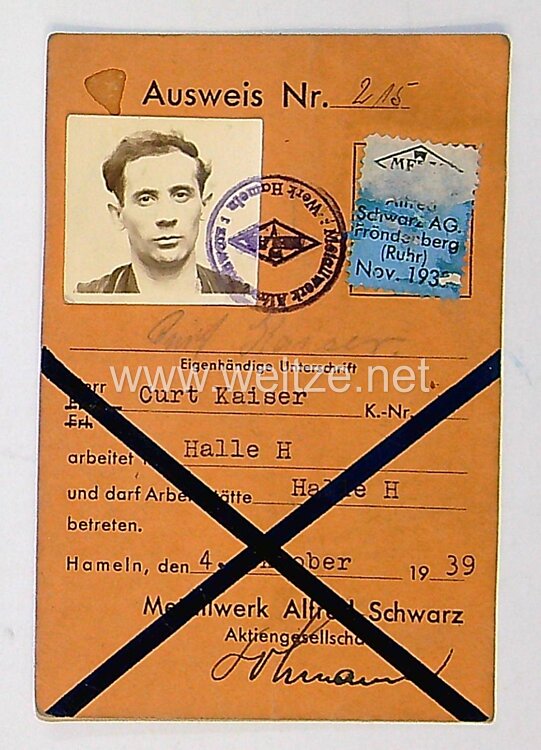
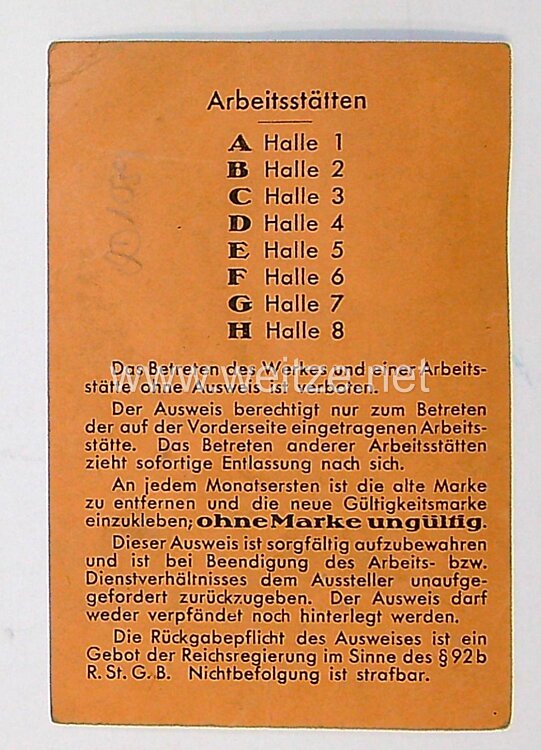
Third Reich - Identity Card for Metallwerke Alfred Schwarz in Hameln
This factory identification card from Metallwerke Alfred Schwarz in Hameln, issued on October 4, 1939, represents a significant contemporary historical document from the early months of World War II. Such identification cards were not merely simple identity documents but played a central role in the strictly organized system of the German war economy under the Third Reich.
The Metallwerke Alfred Schwarz in Hameln belonged to the numerous industrial enterprises that were integrated into armaments production after the outbreak of World War II on September 1, 1939. Hameln, a city in Lower Saxony on the Weser River, possessed an established metalworking industry that was of strategic importance for the war effort. Metal works produced various components for the Wehrmacht during the war, ranging from ammunition parts to vehicle components and technical equipment.
The issuance of this identification card only one month after the war began illustrates the rapid conversion of the German economy to war production. The Reich Ministry of Labor and other responsible authorities had already made preparations in the years before 1939 to enable quick mobilization of industrial capacities in the event of war. The Four Year Plan under Hermann Göring had systematically worked toward economic autarky and war preparation since 1936.
Factory identification cards of this type served several purposes: They legitimized access to often-guarded factory premises, documented employment in war-essential enterprises, and could serve as proof of uk-Stellung (indispensable status). Workers in war-essential industries could be deferred from military service through this status, which further increased the importance of these documents. The attached photograph served for unambiguous identification and corresponded to the strict security regulations of the time.
The design of such identification cards usually followed standardized specifications from the responsible authorities. They typically contained the holder's personal data, the date of issue, a stamp from the issuing company, and often references to security regulations. The cards had to be carried on factory premises at all times and were checked during inspections by factory security or other security organs.
In the context of National Socialist rule, such documents were also part of a comprehensive system of surveillance and control. The German Labor Front (DAF) and other Nazi organizations monitored the factories, and the identification cards contributed to the complete registration of all workers. This was particularly important as forced laborers and prisoners of war were increasingly employed in German enterprises during the war years, who also received corresponding identification markings.
The metalworking industry in Germany employed several million people in 1939 and formed the backbone of armaments production. Enterprises like Metallwerke Alfred Schwarz were integrated into a far-reaching network of suppliers and customers. Production was centrally coordinated and controlled by the Reich Ministry of Armament and Munitions (from 1940 onwards).
From a collector's and historical perspective, such factory identification cards are valuable contemporary witnesses today. They provide insights into the everyday life of the war economy, document individual enterprises and their role in armaments production, and contribute to the reconstruction of local industrial history. The good condition (condition 2) of this document makes it a particularly significant example of this class of documents.
Research on Nazi forced labor and the role of individual enterprises in the war economy has gained considerable importance in recent decades. Documents like this factory identification card serve as important sources for coming to terms with this dark period of German history. They help identify enterprises that were involved in armaments production and can provide clues about employment relationships and operational structures.