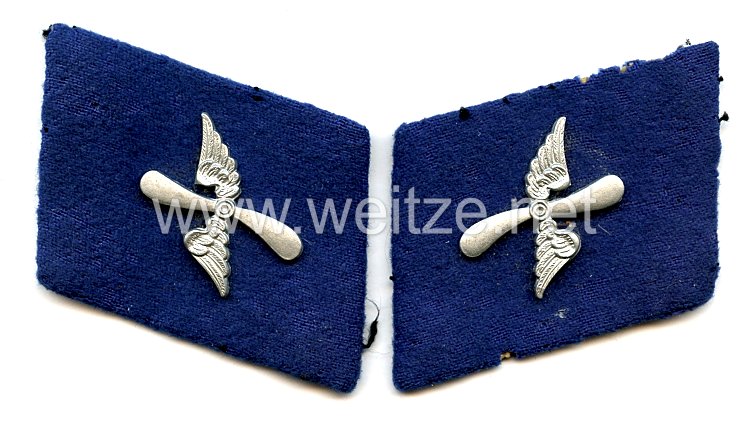
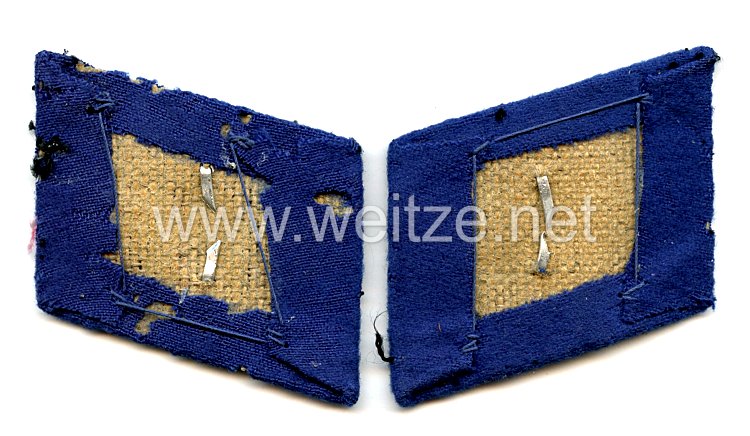
DLV Deutscher Luftsport Verband: Pair of Collar Tabs for Aviators (Enlisted Men)

circa 1934. Complete with aluminum insignia. Heavily worn, some moth damage, condition 2-.
371245
235,00

DLV Deutscher Luftsport Verband: Pair of Collar Tabs for Aviators (Enlisted Men)

These collar tabs of the Deutscher Luftsport Verband (DLV) for enlisted flying personnel represent a fascinating testimony to German aviation history during the interwar period. Manufactured around 1934, these insignia document a crucial phase in the development of German air forces during a period of official armament restrictions.

The Deutscher Luftsport Verband (German Air Sports Association) was founded on March 25, 1933, and served as a civilian cover organization for the secret establishment of a German air force, which was strictly prohibited by the Treaty of Versailles of 1919. Under the leadership of Hermann Göring, the DLV officially functioned as a sports association promoting civilian aviation, but in reality served as a training and recruitment organization for the future Luftwaffe. This dual function makes DLV insignia particularly significant historical objects.

The collar tabs were part of the DLV uniform worn between 1933 and 1935. The examples described here with aluminum insignia specifically identified the flying branch within the organization. The aluminum used was typical for enlisted ranks, while NCOs and officers sometimes wore silver or silver-plated insignia. The design already followed military principles and foreshadowed the later rank structure of the Luftwaffe.

The temporal placement around 1934 is particularly significant. During this year, Germany was in a transitional phase: officially still bound by the Treaty of Versailles, the Nazi regime was already intensively preparing for rearmament. The DLV served as perfect camouflage for training pilots, testing aircraft, and building organizational structures. Only on March 1, 1935, was the existence of the Luftwaffe officially announced, making the DLV obsolete in its military function.

The wearing of collar tabs followed military standards: they were attached in pairs to the uniform collar and displayed various symbols depending on the design. For aviators, these typically consisted of wing symbols or propeller representations in aluminum. The basic color of the tabs was usually dark blue, which later became the branch color of the Luftwaffe.

The described condition with heavy wear and moth damage tells its own story. These insignia were obviously worn extensively, indicating active service by the original wearer. Moth damage on uniform items from this era is not uncommon and results from the use of wool as the base material. Decades of storage under often suboptimal conditions have led to similar damage in many surviving DLV uniform items.

Membership in the DLV was considerable: by 1935, the organization included over two million members, including approximately 300,000 active pilots and flight students. These numbers illustrate the scale of the covert rearmament. After the official founding of the Luftwaffe, many DLV members were directly transferred into the new armed forces.

From a collector's and historical perspective, DLV collar tabs are sought-after objects today. They document a brief but decisive transitional period in German military history. Their relative rarity is explained by the short period of use of only about two years and the fact that many uniform items were destroyed or lost after 1945.

The aluminum insignia on these collar tabs were manufactured in specialized workshops, often by the same companies that later produced Luftwaffe effects. Quality varied by manufacturer, with early pieces from 1933-1934 often showing finer craftsmanship than later productions.

The DLV's organizational structure closely mirrored that of a military air force, with distinct branches for pilots, observers, technical personnel, and administrative staff. This pre-militarization made the transition to the official Luftwaffe remarkably smooth and efficient. The collar tabs worn by enlisted flying personnel were just one element of a comprehensive uniform system that included caps, tunics, trousers, and various other insignia.

In summary, these collar tabs represent an important chapter in German aviation and military history. They are silent witnesses to the systematic circumvention of international treaties and the preparation for the coming conflict. For historians and collectors, they offer valuable insights into the uniforming and organizational structures of a formation that deliberately operated in the shadow of official history.