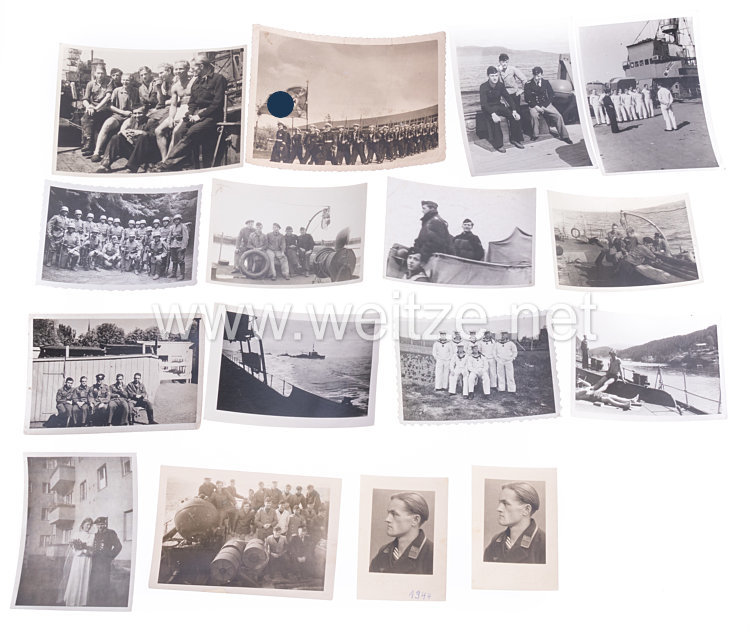
Kriegsmarine Photograph Group, Sailor on a Minesweeper in Norway
This collection of 16 photographs documents the life of a Kriegsmarine sailor serving aboard a minesweeper during operations in Norway during World War II. Such personal photo collections provide valuable insights today into maritime wartime life and German naval operations in Scandinavian waters between 1940 and 1945.
Following the occupation of Norway during Operation Weserübung in April 1940, the German Wehrmacht established an extensive military presence along the Norwegian coast. Norway held immense strategic importance for German warfare: its long coastlines provided access to the North Atlantic, secured iron ore shipments from Sweden via the port of Narvik, and enabled operations against Allied convoys to Murmansk.
Minesweepers (also designated as Räumboote or M-boats) of the Kriegsmarine played a crucial role in securing Norwegian coastal waters. These vessels typically measured between 40 and 60 meters in length and displaced between 600 and 900 tons. The most important classes included the M35-class, M40-class, and the larger M43-class boats. They were equipped with sweeping gear for magnetic and acoustic mines and usually carried armament consisting of 37mm and 20mm anti-aircraft guns.
The crews of minesweepers belonged to the most heavily tasked units of the Kriegsmarine. Their duty was life-threatening: they had to clear shipping lanes for larger warships and merchant vessels, threatened by both Allied forces and German defensive minefields. Norwegian waters, with their fjords, skerries, and unpredictable weather conditions, presented particular challenges. Fog, storms, and the extreme darkness periods of the Nordic winter significantly complicated navigation and minesweeping operations.
From 1940, the Kriegsmarine built a network of bases along the Norwegian coast, including in Bergen, Trondheim, Narvik, Tromsø, and Kirkenes. Minesweeping units were assigned to these bases and conducted daily patrol and sweeping duties. Crews often lived for months under cramped conditions aboard their boats or in simple shore quarters.
Photographs like those in this collection were important personal documents for soldiers. Although military regulations existed regarding photography—particularly concerning technical details and strategic information—the taking of commemorative photos was largely tolerated. Soldiers often used private cameras or official war correspondent services to record their life aboard. These images typically showed comrades at work, harbor scenes, the Norwegian landscape, and daily life on board.
Losses among minesweeper crews were substantial. Many boats were lost through mine detonations, submarine attacks, air raids by the Royal Air Force and Soviet air forces, or due to harsh sea conditions. Toward the war's end, Allied attacks on German shipping routes intensified dramatically, and minesweepers were often prime targets for enemy fighter-bombers.
After the German surrender in May 1945, the minesweepers stationed in Norway were largely confiscated by the Allies. Ironically, many of these boats and their German crews were employed for months longer in clearing operations, as Norwegian waters were infested with thousands of mines—of both Allied and German origin. This mine-clearing operation, called Operation Deadlight, continued until 1946.
Photographic collections like these are important historical sources today. They supplement official war diaries and military reports with the personal perspective of ordinary soldiers. They document not only military operations but also the human aspects of war: camaraderie, daily life, interaction with the local Norwegian population, and the environment in which these young men had to serve. For maritime historical research, such photos also provide valuable insights into ship types, equipment, uniforms, and the actual conditions of naval warfare that were often not captured in official documents.