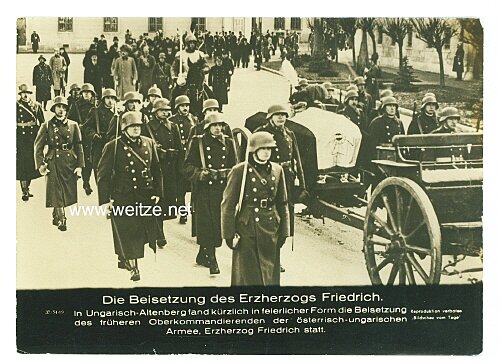
Third Reich - Press Photo - Picture Show of the Day - The Funeral of Archduke Friedrich

, 10 x 15cm, reproduction prohibited, condition 2.
210744
7,50

Third Reich - Press Photo - Picture Show of the Day - The Funeral of Archduke Friedrich

This object is a press photograph from the era of the Third Reich documenting the funeral of Archduke Friedrich of Austria. Measuring 10 x 15 cm, it corresponds to the standard format for press image material of that time and bears the explicit notation “Reproduction Prohibited,” indicating the strict control over visual reporting in Nazi Germany.

Archduke Friedrich of Austria (1856-1936) was a significant figure of the Habsburg monarchy who served as Inspector General of the Austro-Hungarian Army and temporarily as Supreme Army Commander during World War I. His military career and role in the First World War made him one of the most prominent figures of the Austrian Imperial House. After the collapse of the Austro-Hungarian Empire in 1918, he lived in seclusion in Hungary, where he died in 1936.

Friedrich's funeral took place at a historically significant moment, when Austria was already under increasing German influence but still before the Anschluss of 1938. The fact that the Nazi Propaganda Ministry under Joseph Goebbels paid attention to this event demonstrates the complex relationship between the Third Reich and the Habsburg past. While the National Socialists fundamentally rejected the Habsburgs, they recognized the propagandistic value of certain historical events.

Press photography in the Third Reich was strictly regulated and centrally organized. After the seizure of power in 1933, all aspects of media coverage were subjected to Nazi control. The Reich Ministry for Public Enlightenment and Propaganda controlled the distribution of image material through various mechanisms. Press photos were distributed through official channels such as the German News Bureau (DNB), the Hoffmann Agency, and other state-controlled image services.

The notation “Reproduction Prohibited” was a standardized element on many press photos of this era and was intended to prevent unauthorized duplication and distribution. This served both copyright protection and control over image usage in the press. Newspapers and magazines had to obtain such photos directly from authorized agencies and could only publish them with appropriate permission.

The designation “Picture Show of the Day” (Bildschau des Tages) suggests a regular series of press photos documenting current events. Such series were systematically distributed to editorial offices and formed the basis for visual reporting in the synchronized press. The standardized formats and captions enabled efficient distribution and archiving.

The 10 x 15 cm format was the common postcard format, which proved practical for press photos. This size enabled easy handling, archiving, and distribution to editorial offices. Many of these photos were produced on high-quality photographic paper and often bore stamps, inscriptions, and censorship marks on the reverse.

From a historical perspective, such press photos represent important contemporary historical documents today. They document not only the depicted events but also the way the NS regime staged and controlled certain topics in the media. The selection of photographed events, the image composition, and distribution through official channels were part of the comprehensive propaganda strategy.

For collectors and historians, such photos are of interest because they provide insights into the media landscape of the Third Reich. The condition grade 2 indicates a well-preserved specimen with only minor signs of use. The authenticity of such pieces can usually be verified by typical characteristics such as paper quality, print quality, stamps, and the characteristic inscriptions.

It is important to emphasize that the historical classification and study of such objects serve scientific research and understanding of history. They document a dictatorial era in which media and culture were completely instrumentalized and contribute to understanding the mechanisms of totalitarian rule.