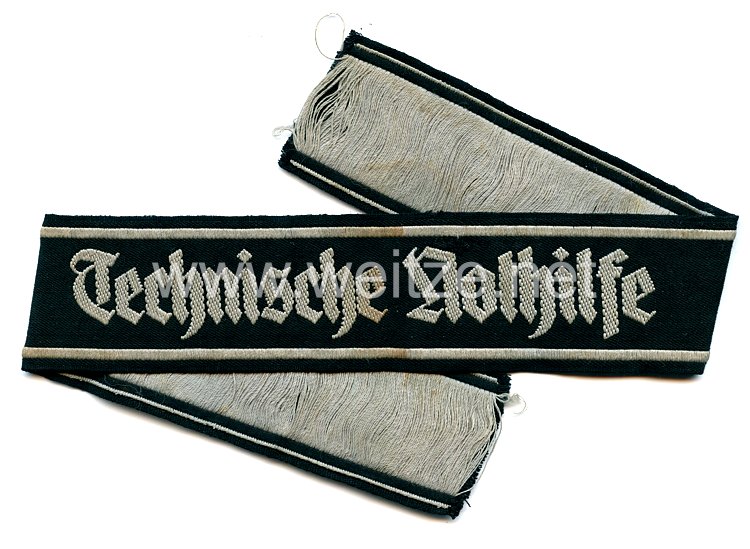
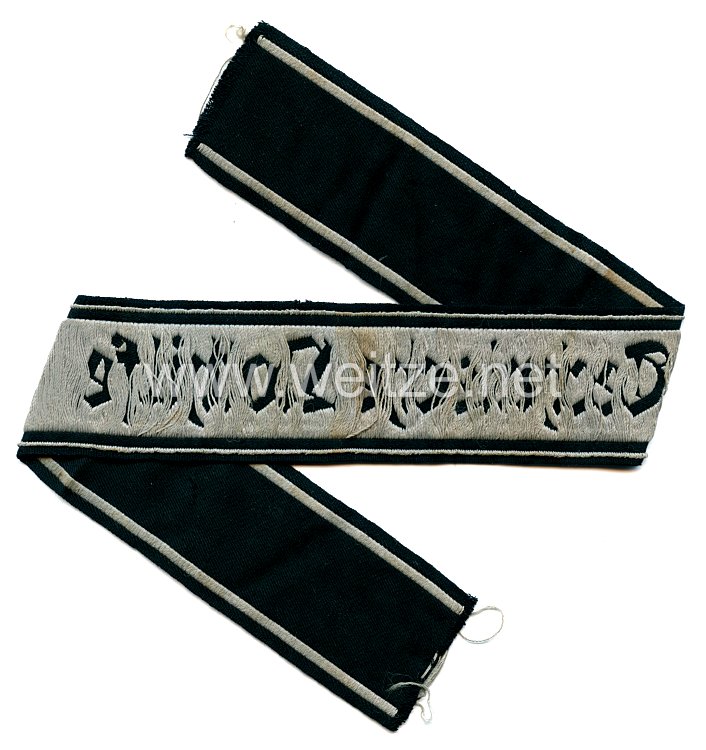
TeNo Enlisted Ranks Armband “Technische Nothilfe”
The armband of the Technische Nothilfe (TeNo) represents a significant artifact of German civil defense history during the Weimar Republic and the Third Reich. The Technische Nothilfe (Technical Emergency Service) was founded on September 30, 1919, by the Prussian Minister of the Interior Wolfgang Heine as a paramilitary organization, originally established to maintain vital supply facilities during strikes and unrest in the post-war period.
The organization evolved into a professional technical assistance service focusing on ensuring public utilities, disaster relief, and technical emergency response. Its members were volunteers with technical expertise who could intervene in critical situations.
The armband was an essential component of the TeNo enlisted personnel uniform. It was worn on the left upper arm of the service uniform and served to immediately identify the wearer as a member of this state auxiliary organization. The woven version was the standard variant for enlisted ranks and differed from the higher-quality, often embroidered versions for leadership personnel.
Production took place in specialized weaving mills, with black fabric featuring the characteristic white inscription “Technische Nothilfe” or the abbreviation “TeNo.” The design was deliberately simple to ensure clear and widely visible identification. The materials used typically included cotton or rayon, conforming to contemporary textile standards.
After the Nazi seizure of power in 1933, the Technische Nothilfe was integrated into the National Socialist system of rule. As early as February 8, 1933, the organization was placed under the supervision of the Reich Ministry of the Interior. From 1936, it came under the Order Police and was subordinated to Reichsführer-SS Heinrich Himmler in 1937. These structural changes reflected the increasing militarization and coordination of the organization.
TeNo members wore various uniform variants that evolved over the years. However, the armband remained a constant identifying feature. Wearers were required to display it during duty, especially during operations in public spaces, to document their official function.
The TeNo's tasks expanded considerably during the 1930s. Beyond the original strike-breaking function, the organization increasingly assumed responsibilities in civilian air defense, clearing bomb damage, restoring infrastructure, and providing technical support during wartime. During World War II, the TeNo played an important role in maintaining public utilities and cleanup operations after air raids.
The present armband in full length corresponds to the original specifications for enlisted personnel. The woven execution indicates standard production for regular members. Such armbands were sewn onto uniforms or in some cases attached with special fastening methods. The traces of adhesive on the described specimen suggest later mounting for collection or exhibition purposes, which is not uncommon with historical textiles.
After the war ended in 1945, the Technische Nothilfe was dissolved by the Allies. In the Federal Republic of Germany, the Technisches Hilfswerk (THW) was founded in 1950, which in some ways continued the civilian aid functions of the TeNo, but under completely different political and organizational frameworks as a democratic relief organization.
From a collector's and historical perspective, TeNo armbands today are significant documents of German social and organizational history. They document the development of civil defense organizations, uniform history, and the complex transformations of state auxiliary organizations under different political systems. For scholarly research, such objects provide important material evidence for reconstructing everyday history and the organizational structures of this era.