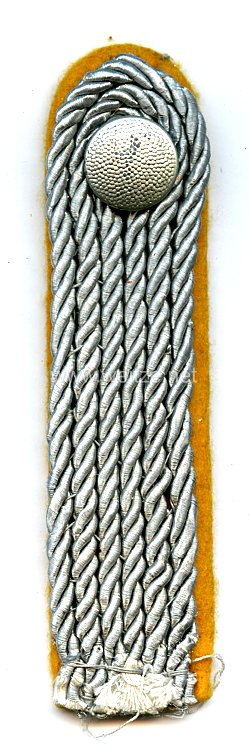
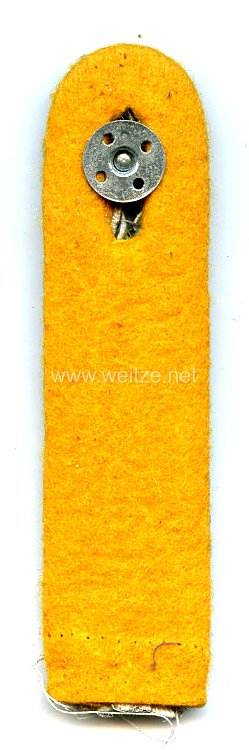
NSFK Single Shoulder Board for a Sturmführer to Hauptsturmführer
The present object is an NSFK single shoulder board for ranks between Sturmführer and Hauptsturmführer, designed to be sewn into the uniform. This shoulder strap represents an important element of the uniform of the National Socialist Flying Corps (NSFK), a paramilitary organization of National Socialist Germany.
The NSFK was founded on April 17, 1937, through the merger of the German Air Sports Association (DLV) under the leadership of Friedrich Christiansen. The organization was directly subordinate to the Reich Aviation Ministry and served as a pre-military training organization for the Luftwaffe. The NSFK's mission was to promote aviation training among German youth and prepare recruits for the Luftwaffe. From 1942, Generaloberst Alfred Keller assumed leadership of the corps.
The rank structure of the NSFK closely followed that of other NS organizations, particularly the SA and SS. The rank of Sturmführer corresponded to a lieutenant, while Hauptsturmführer was equivalent to a captain. These middle leadership ranks carried significant responsibility in the organization and training.
The shoulder boards of the NSFK were an essential component of rank insignia and were worn on the shoulders of various uniform types. They followed a standardized system regulated by official uniform regulations. The shoulder boards for these ranks were characterized by specific designs: they displayed characteristic rank insignia in the form of stars or cords on a colored background.
The basic color of shoulder boards in the NSFK was typically Luftwaffe blue or gray, with the branch color indicated by piped borders or backgrounds. Distinction between individual ranks was made through the number and arrangement of rank stars and different braid designs.
The piece described here is designed as a single shoulder board intended for sewing in. This means it was sewn directly into the uniform, as opposed to removable variants with buttons or hooks. This type of attachment was common in various NS organizations and ensured a secure fit of the rank insignia.
The production of such shoulder boards was carried out by authorized manufacturers who had to comply with official regulations. Quality varied depending on the time of manufacture and producer. During the war years from 1939 onward, material shortages increasingly led to simplified designs and the use of substitute materials.
The NSFK played an important role in the air war preparations of the Third Reich. The organization offered glider, motor flight, and technical training and operated numerous flight schools throughout the Reich territory. NSFK members received basic aviation training that was later expanded upon in the Luftwaffe. In this way, the corps contributed significantly to providing trained personnel for the Wehrmacht.
The uniforming of the NSFK went through several developmental stages. Early uniforms still showed strong borrowings from the DLV, while from 1937 onward there was increasing standardization and alignment with military norms. The characteristic NSFK uniform consisted of a blue or gray service jacket, matching trousers, shirt with tie, and peaked cap.
The condition of the present piece is described as “lightly worn,” indicating authentic use during the period of service. Such shoulder boards are today significant historical documents that provide insight into the organization, hierarchy, and material culture of NS paramilitary organizations.
After the end of World War II, the NSFK, along with all other NS organizations, was dissolved and banned by the Allied Control Council. Uniform parts and insignia were largely confiscated or destroyed, making preserved pieces rare witnesses to this historical era.