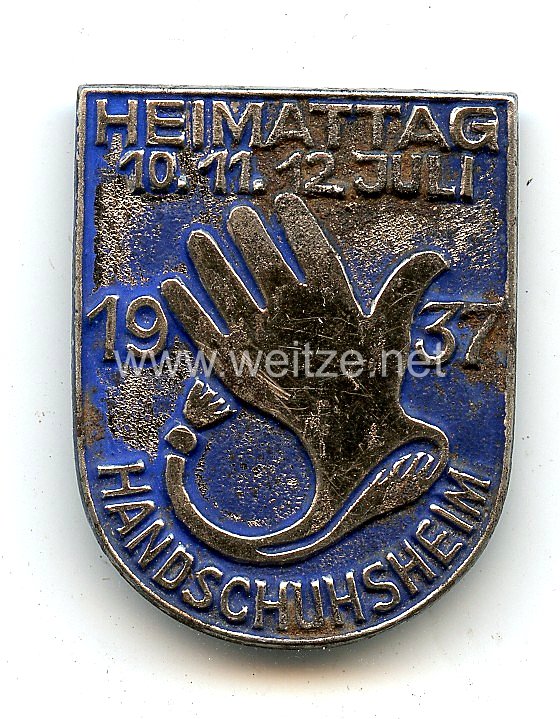
Third Reich - Heimattag Handschuhsheim July 10, 11, 12, 1937

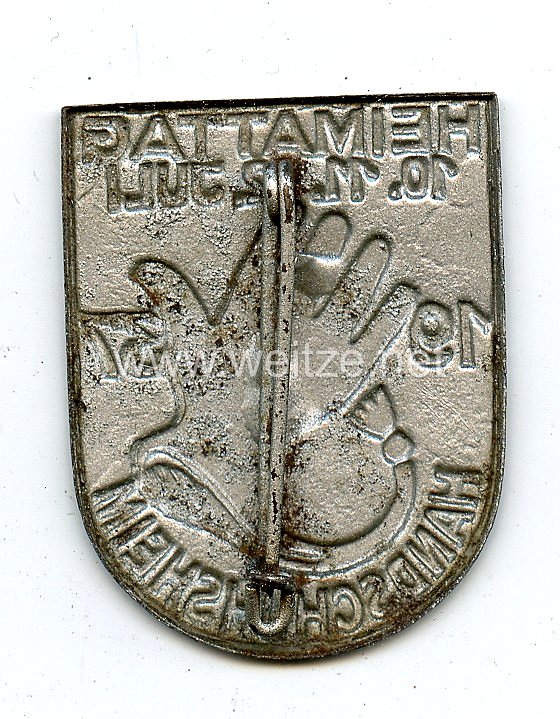
partially colored sheet iron badge, on pin, condition 2-
448743
15,00

Third Reich - Heimattag Handschuhsheim July 10, 11, 12, 1937

This badge commemorates the Heimattag Handschuhsheim (Handschuhsheim Homeland Day) held from July 10-12, 1937. Handschuhsheim, now a district of Heidelberg in Baden-Württemberg, was the site of numerous propagandistic events during the National Socialist era, designed to ideologically penetrate the population and demonstrate Nazi power.

The badge itself is made of partially colored sheet iron and features a pin for attachment to clothing. This manufacturing technique was widespread in the 1930s and enabled cost-effective mass production of such commemorative and participant badges. The partial coloring was typically achieved through enameling or lacquering and served to make the badges more attractive and highlight symbolic elements.

Heimattage (Homeland Days) were central events in the Third Reich for cultivating local traditions, which were invariably instrumentalized in accordance with National Socialist ideology. They served to create a connection between regional identity and the Nazi concept of the Volksgemeinschaft (people's community). Such events typically included parades, speeches by local NSDAP functionaries, folk festivals, sporting competitions, and cultural performances.

The summer of 1937 was a period of relative economic stabilization in the German Reich, during which the regime had consolidated its power and was intensively preparing for the coming war. Simultaneously, the population was mobilized and indoctrinated in the National Socialist spirit through numerous festivals, celebrations, and mass events. The organization of such Heimattage was usually the responsibility of local NSDAP branches in cooperation with traditional clubs and associations.

Badges like this served multiple functions: they acted as souvenirs for participants, as admission tickets or proof of attendance, and not least as propaganda instruments. Wearing such badges demonstrated belonging to the Volksgemeinschaft and support for the regime. Collectors often acquired multiple badges from different events, which was certainly desired by the organizers as it generated additional revenue.

The production of these badges was usually carried out by specialized companies that focused on manufacturing orders, decorations, and event badges. The design had to conform to certain ideological guidelines, combining local elements with National Socialist symbolism. Typical motifs included coats of arms, swastikas, eagles, Germanic runes, or regionally significant symbols.

From today's perspective, such badges are important historical documents that provide insight into the everyday culture and propaganda practices of the Third Reich. They demonstrate how the Nazi regime attempted to penetrate all areas of public life and instrumentalize them for its purposes. The preservation and scientific documentation of such objects is significant for historical research in understanding the mechanisms of totalitarian rule and mass mobilization.

The condition rating of 2- (according to numismatic or militaria collector grading scales) indicates a well-preserved specimen with minor signs of wear, which is remarkable given its age of over 85 years. Such badges were typically worn only during the respective event and then stored away, which explains their relatively good preservation.

These artifacts serve as tangible reminders of how the Nazi regime exploited local traditions and community celebrations for propagandistic purposes, transforming innocent regional festivals into vehicles for ideological indoctrination and political control.

r