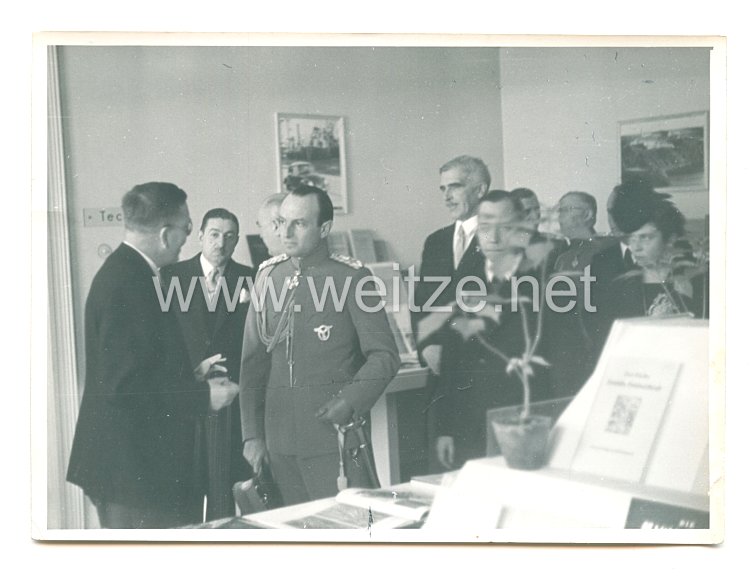
Third Reich Press Photo: Prince Regent Paul at the German Book Fair

Dimensions approx. 13 x 18 cm, verso without inscription, used condition.
343843
20,00

Third Reich Press Photo: Prince Regent Paul at the German Book Fair

Historical Context: Press Photography from the Third Reich – Prince Regent Paul at the German Book Fair

This press photograph documents a significant moment in diplomatic relations between National Socialist Germany and the Kingdom of Yugoslavia during the period before World War II. The image shows Prince Regent Paul of Yugoslavia visiting the German Book Fair, most likely in Leipzig, which played an important role in cultural propaganda during the Nazi era.

Prince Regent Paul and His Political Position

Prince Paul Karađorđević (1893-1976) assumed the regency in 1934 for his underage nephew, King Peter II, after King Alexander I was assassinated in Marseille. Paul found himself in an extremely difficult political situation: Yugoslavia was surrounded by fascist and National Socialist powers, and he attempted to preserve his country's independence through a policy of cautious neutrality. Paul was British-educated and had personal ties to Great Britain, but found himself increasingly forced to cooperate with Germany.

The Leipzig Book Fair as a Propaganda Instrument

The Leipzig Book Fair had a centuries-long tradition and had been a significant international marketplace for books and printed materials since the 17th century. After the Nazi seizure of power in 1933, the regime instrumentalized the Book Fair for its propaganda purposes. Under the direction of the Reich Ministry of Public Enlightenment and Propaganda led by Joseph Goebbels, the fair became a showcase for National Socialist cultural policy.

The fair served to impress foreign diplomats and dignitaries and to present the alleged cultural achievements of the Third Reich. At the same time, it was a place of strict censorship: books by Jewish authors, politically undesirable writers, and critical works were banned. The book burnings of 1933 had already set the tone for National Socialist literary policy.

Press Photography in the Third Reich

Photographs like the present one played a central role in Nazi propaganda. The regime recognized early on the power of visual media and established a comprehensive system for controlling and distributing press images. Official press photographers accompanied important events, and their photographs were distributed through central picture agencies such as Scherl, Hoffmann, or Presse-Illustrationen Hoffmann.

These photographs were distributed to newspapers and magazines at home and abroad and were intended to convey a specific image of the Third Reich: modern, culturally significant, and internationally recognized. Visits by foreign dignitaries to German cultural events were a popular motif, as they suggested diplomatic recognition and normalcy.

German-Yugoslav Relations

Relations between Germany and Yugoslavia in the late 1930s were characterized by increasing German dominance. Germany became Yugoslavia's most important trading partner, which strengthened economic dependence. Prince Regent Paul attempted, despite personal reservations about Hitler, to perform a balancing act between the Axis powers and the Western democracies.

In March 1941, Paul finally signed the Tripartite Pact under massive pressure, which effectively tied Yugoslavia to the Axis powers. This decision led to a military coup in Belgrade on March 27, 1941, in which Paul was overthrown and replaced by his nephew Peter II. Hitler responded with the order for Operation Marita and the subsequent attack on Yugoslavia in April 1941, which led to the dismemberment of the country.

The Significance of Such Documents Today

Press photographs from the Third Reich are important historical sources today. They document not only the events depicted but also the propaganda mechanisms of the regime. For historians, such images are valuable for analyzing the staging of power, the representation of international relations, and the functioning of Nazi media policy.

The format of approximately 13 x 18 cm corresponds to a typical standard format for press photos of this period. The reverse inscription is missing in this case, which sometimes occurs with archival material when images were not used for publication or were removed from their original context.

Such photographs serve as reminders of a time of intense diplomatic negotiations before the outbreak of World War II in the Balkans, when smaller nations attempted to preserve their sovereignty against expanding totalitarian powers – an endeavor that ultimately failed and led to immeasurable suffering.