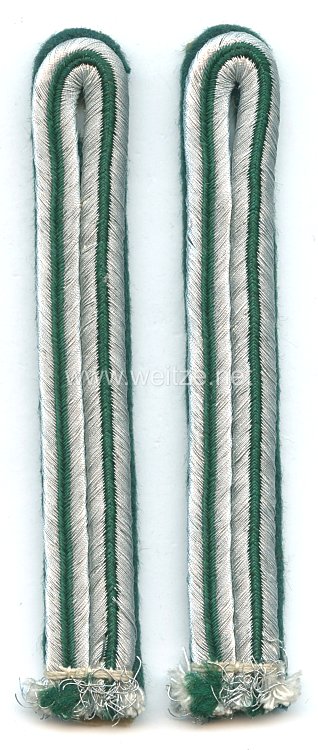
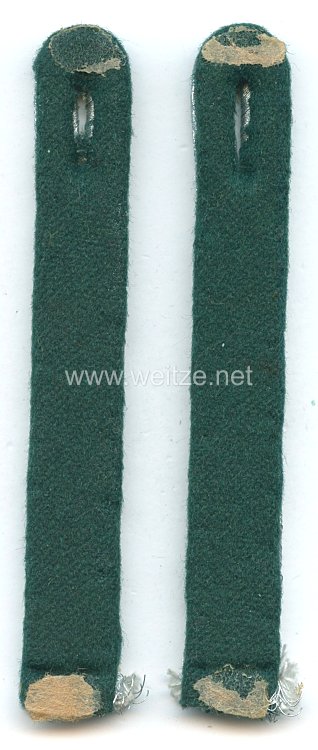
SHD Sicherheits- und Hilfsdienst Pair of Shoulder Boards for a Zugführer (Platoon Leader)
The shoulder boards of the Security and Auxiliary Service (Sicherheits- und Hilfsdienst, SHD) for a platoon leader represent a rare and historically significant artifact from German civil defense organizations during World War II. The SHD was a paramilitary auxiliary organization that played an important role in air raid protection and civil defense.
Organizational History of the SHD
The Security and Auxiliary Service was established as part of the expanded air defense system of the German Reich. Following the passage of the Air Protection Law of 1935, the organization of civil air defense was systematically expanded. The SHD complemented other air defense organizations such as the Reich Air Protection League (Reichsluftschutzbund, RLB) and the fire-fighting police. Its primary tasks included rescuing people trapped in rubble, fighting fires, defusing unexploded ordnance, and maintaining public order during and after air raids.
Rank Structure and Insignia
The rank insignia of the SHD followed a hierarchical system modeled after military precedents. A Zugführer (platoon leader) typically commanded a unit of approximately 30 to 50 men and occupied a middle leadership position within the organization. The shoulder boards served the immediate recognition of rank and organizational affiliation, which was crucially important in the chaotic situations of air raids.
The shoulder boards described here were designed to be sewn into the uniform, which was characteristic of SHD service uniforms. The adhesive traces on the reverse side suggest that the pieces may have been additionally secured or later removed from the uniform. This design differed from the detachable shoulder boards of other organizations and reflected the practical, mission-oriented character of SHD uniforming.
Uniform Regulations and Wearing
SHD uniforms were regulated by detailed ordinances that precisely specified color, cut, and insignia. The organization typically used dark blue or black uniforms, which distinguished them from the field-gray military uniforms of the Wehrmacht. The shoulder boards were generally adorned with rank insignia, often in the form of stars, bars, or braids, indicating the respective rank.
Deployment and Significance During the War
With the intensification of Allied bombing raids from 1942 onwards, particularly after the beginning of the Combined Bomber Offensive, the SHD gained increasing importance. The devastating area bombardments of German cities such as Hamburg (Operation Gomorrah, 1943), Cologne, Berlin, and Dresden placed enormous demands on all air defense organizations. SHD platoon leaders had to assume leadership responsibility under extreme conditions and direct coordinated rescue and recovery operations.
Rarity and Collector Value
The rarity of these shoulder boards, as noted in the object description, can be explained by several factors. Many uniform items and insignia of the SHD were destroyed after the war's end or were lost in the chaos of the final months of the war. Additionally, the SHD was a comparatively small organization compared to the Wehrmacht or SS, which limited the total number of insignia produced. Original pieces in good condition (here indicated as condition 2-3) are therefore difficult to find today and of considerable historical and collectible interest.
Historical Context
The shoulder boards of the SHD are more than just military rank insignia. They represent the comprehensive militarization of German civil society during National Socialism and the regime's efforts to incorporate all segments of the population into warfare. The SHD was part of a system that attempted to protect the home front against the consequences of aerial warfare while simultaneously maintaining civilian morale.
As historical objects, such shoulder boards offer important insights into the organization of civil air defense, the hierarchies within these organizations, and the material culture of World War II. They are valuable sources for researching the everyday history of the war and the experiences of the civilian population under the conditions of total war.