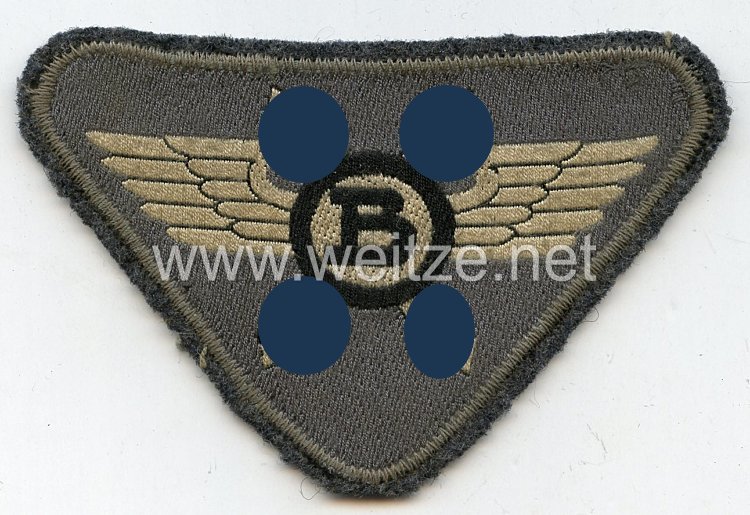
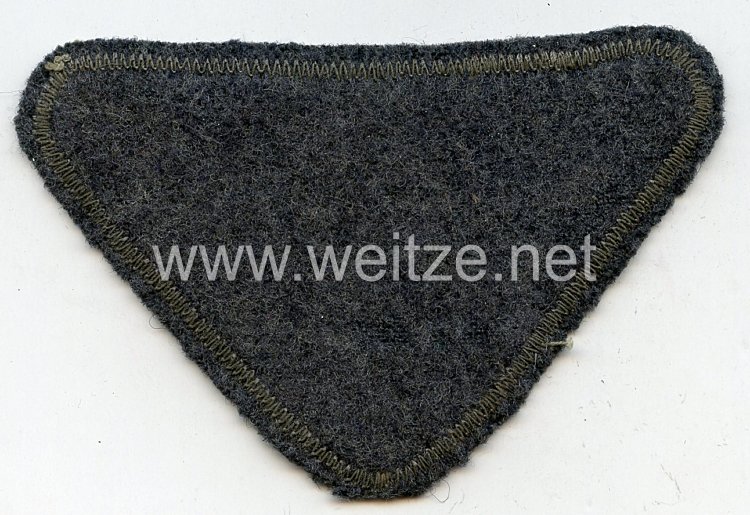
NSFK Sleeve Insignia for Radio Operator
The NSFK sleeve badge for radio operators represents a significant artifact documenting German aviation training during the National Socialist period. The National Socialist Flying Corps (NSFK) was established on April 17, 1937, as the successor organization to the German Air Sports Association, operating under the supervision of the Reich Aviation Ministry led by Hermann Göring.
The primary mission of the NSFK consisted of preliminary and basic flight training, which played a crucial role in developing the next generation of Luftwaffe personnel. During an era when modern aerial warfare became increasingly dependent on technical communication, the training of radio operators gained particular importance. These specialists were responsible for radio communication during flight and formed an indispensable component of aircraft crews.
The badge described here was manufactured in BeVo-woven execution, a high-quality weaving technique produced by Bandfabrik Ewald Vorsteher (BeVo) of Wuppertal. This manufacturing method was characterized by exceptional detail fidelity and durability. The badges were made on Luftwaffe cloth, indicating the close connection between the NSFK and the Air Force.
Particularly noteworthy is the fact that the radio operator certificate could also be obtained by members of the Flieger-HJ (Flying Hitler Youth). The Flieger-HJ was established in 1937 as a specialized formation within the Hitler Youth and worked closely with the NSFK. Boys aged 14 to 18 received their initial aviation and technical training here. After successfully completing the training and passing the examination, they received the corresponding sleeve badge, which was worn on the uniform.
Training as a radio operator encompassed theoretical and practical knowledge in radio technology, Morse telegraphy, and voice radio procedures. The courses were conducted at special NSFK schools and followed standardized training programs. Successful completion of this training represented an important step toward later service in the Luftwaffe.
The sleeve badge served multiple purposes: on one hand, it was a visible achievement award documenting the successful completion of demanding training. On the other hand, it fulfilled a practical function by making the wearer's qualification immediately recognizable. The badges were worn on the left upper arm of the uniform according to NSFK dress regulations.
The system of NSFK badges was complex and differentiated. Besides the radio operator badge, numerous other specialized badges existed for various aviation and technical qualifications, including pilots, observers, flight mechanics, and other specializations. Each badge followed a specific design that symbolized the respective function.
In the context of historical evaluation, it must be noted that the NSFK was an integral part of National Socialist militarization policy. The organization served the systematic preparation of young men for military service and was thus directly integrated into the rearmament plans of the Nazi regime. Aviation training, including radio operator training, had primarily military purposes.
After World War II, the NSFK was dissolved by the Allies and banned as part of the National Socialist organizations. The badges and uniform pieces of this organization are today historical documents that bear witness to a dark chapter of German history. They are preserved in museums and collections and serve historical research and education.
From a collector's and museum perspective, these badges are important material witnesses of contemporary history. They provide insights into the organizational structure, training systems, and visual culture of National Socialism. The BeVo weaving technique itself represents an interesting chapter of German textile history and demonstrates the high craftsmanship quality achieved even in mass-produced military badges.
The study of such artifacts contributes to our understanding of how totalitarian regimes systematically organized and indoctrinated youth, using symbols and awards to create loyalty and motivation. These historical objects serve as tangible reminders of the comprehensive nature of National Socialist control over German society and its youth.