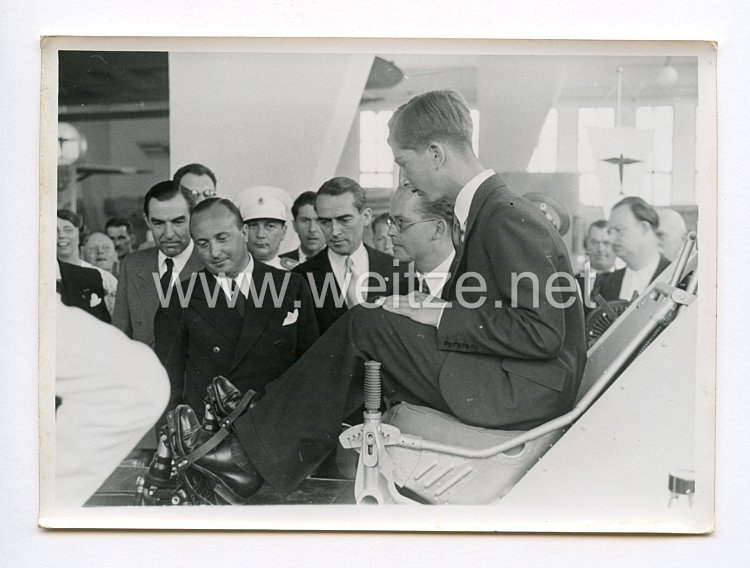
Third Reich Press Photograph. H.M. King Peter at an Aeronautical Exhibition. Belgrade.

Dimensions approx. 13 x 18 cm, verso without description, used condition.
309442
25,00

Third Reich Press Photograph. H.M. King Peter at an Aeronautical Exhibition. Belgrade.

This object is a press photograph from the Third Reich era showing His Majesty King Peter II of Yugoslavia visiting an aeronautical exhibition in Belgrade. With dimensions of approximately 13 x 18 cm, it corresponds to the standard format for press photos of that era, which were produced by news agencies and propaganda offices for distribution to newspapers and magazines.

Historical Context: King Peter II of Yugoslavia

King Peter II was born on September 6, 1923, as the son of King Alexander I and Queen Maria. Following his father's assassination by a Macedonian revolutionary in Marseille on October 9, 1934, the eleven-year-old Peter ascended to the Yugoslav throne. Due to his young age, a Regency Council was established under the leadership of his uncle, Prince Paul, who governed until 1941.

The years of his minority were marked by increasing tensions in Europe and the rise of National Socialism. Yugoslavia found itself in a precarious geopolitical position between the Axis Powers and the Allies. Prince Paul attempted to perform a balancing act between the various powers, which ultimately led to Yugoslavia's accession to the Tripartite Pact in March 1941.

Aviation in the Kingdom of Yugoslavia

Aeronautical development played a significant role in interwar Yugoslavia. The country had its own aviation industry, mainly concentrated in Belgrade and Kraljevo. The Royal Yugoslav Air Force (Vazduhoplovstvo Vojske Kraljevine Jugoslavije) was built up after World War I and modernized during the 1930s. Aviation exhibitions served both for technical education and as demonstrations of national strength and modernity.

Such exhibitions were often occasions for official visits by the young king and were documented by the press. They demonstrated the royal house's interest in technological progress and military modernization. The king's presence at such events was meant to symbolize national unity and forward-thinking orientation.

The Role of Press Photography in the Third Reich

This photograph originates from the archives of the National Socialist press machinery. The Third Reich maintained a sophisticated system of photographic reporting, coordinated through the Reich Ministry of Public Enlightenment and Propaganda under Joseph Goebbels. Press photos were systematically collected, catalogued, and distributed to German and international media.

The documentation of foreign heads of state, especially from countries of strategic importance to Germany, was part of comprehensive news policy. Yugoslavia was of particular interest to German foreign policy due to its geographical position in the Balkans. Photographs like this one served to inform about political developments in neighboring states and were used both for intelligence purposes and public reporting.

The Events of 1941

The coup d'état of March 27, 1941 marked a turning point in Peter's life and in Yugoslav history. Serbian officers, supported by broad segments of the population who opposed joining the Tripartite Pact, overthrew the regency and declared the 17-year-old Peter of age. This led to the famous declaration in Belgrade: “Better war than pact, better death than slavery.”

This decision had fatal consequences. Hitler immediately ordered Operation Punishment, the attack on Yugoslavia, which began on April 6, 1941. Belgrade was bombed without a declaration of war, and within eleven days Yugoslavia capitulated. King Peter II was forced into exile, first to Greece, then to Jerusalem, Cairo, and finally to London, where he formed a government-in-exile.

Significance and Collector Value

Press photographs from the Nazi era are important historical documents today. They offer insights into the propaganda machinery of the Third Reich while simultaneously documenting authentic historical moments. Photographs of King Peter II from the period before the outbreak of war are relatively rare, as his reign before exile was brief.

The used condition and the absence of a description on the reverse are typical of archive photos that may never have been used for publication. Such images often remained in the archives of press agencies or the German News Bureau (DNB).

For collectors of military-historical documents and photographs, such a press photo represents an authentic contemporary witness that documents the complex political conditions in the Balkans on the eve of World War II.