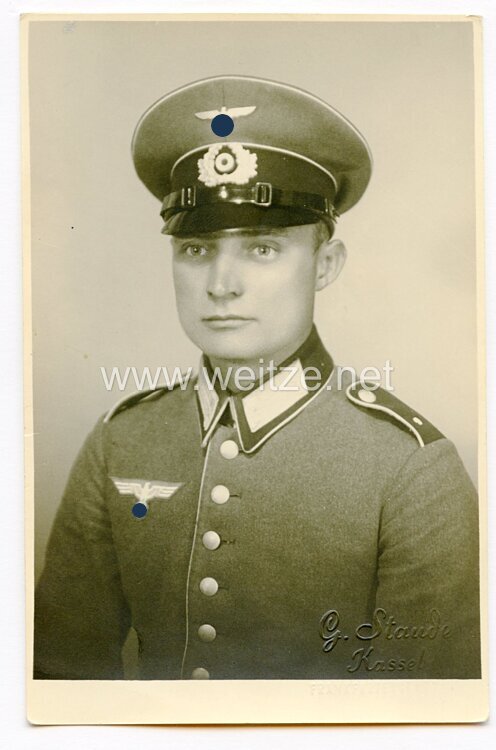
Wehrmacht Portrait Photograph, Soldier of Infantry Regiment 9

Postcard size, condition 2.
400041
10,00

Wehrmacht Portrait Photograph, Soldier of Infantry Regiment 9

Infantry Regiment 9 of the Wehrmacht was one of the traditional units of the German armed forces with roots reaching back to the Prussian army. Portrait photographs like this one in postcard size were an omnipresent medium during World War II through which soldiers maintained their connection to family and home.

Infanterie-Regiment 9 was established in 1935 in Potsdam during the rearmament of the Wehrmacht and was part of the 23rd Infantry Division. The unit could trace its tradition back to the former Prussian Infantry Regiment Count Bülow von Dennewitz (6th Westphalian) No. 55. The garrison was located in Potsdam, a city with strong military traditions.

Throughout the war, the regiment participated in numerous campaigns. During the Polish Campaign of 1939, the 23rd Infantry Division fought as part of the 3rd Army in East Prussia. Subsequently, the division took part in the Western Campaign of 1940, advancing through Belgium and northern France. From 1941, the regiment was deployed on the Eastern Front, initially during Operation Barbarossa as part of Army Group North. The unit fought in the encirclement battles around Demjansk and Cholm, as well as in the grinding positional warfare of the later war years.

The practice of having portrait photographs taken in uniform was deeply rooted in German military tradition. Soldiers typically had themselves photographed on various occasions: upon conscription, after completing basic training, upon promotion, or before deployment to the front. These photographs were produced in professional photo studios or by regimental photographers. The postcard format (approximately 9 x 14 cm) was particularly popular because it was suitable both for sending and for keeping in family albums.

The photographs typically showed soldiers in their best uniform, often the walking-out uniform, with all insignia and decorations. For members of Infantry Regiment 9, this meant the standard Wehrmacht field tunic with the characteristic Waffenfarbe insignia in white, the branch color of the infantry, and the shoulder strap with the regimental number 9. Soldiers often also wore the Infantry Assault Badge or other combat awards if already earned.

These photographs fulfilled several important functions: they served as mementos for the family, as documents of military career, and as expressions of soldierly self-image. For many families, these pictures were often the last photographs of fallen relatives and became treasured memories. The reverse of the photographs frequently contained handwritten dedications, dates, or location information.

From a military-historical perspective, such photographs are today valuable sources for the study of uniforms, social history, and everyday history of World War II. They document the development of uniforms, insignia, and equipment throughout the war years. The varying quality of photographs and uniforms also reflects the economic development and increasing material shortages in the German Reich.

Infantry Regiment 9 suffered considerable losses during the course of the war, particularly during heavy fighting on the Eastern Front. The 23rd Infantry Division was repeatedly reinforced and reorganized. Toward the end of the war, the division was located in the Baltic region and East Prussia, where it was deployed in the final battles.

Today, such photographs are important components of military-historical collections and archives. They help researchers reconstruct the uniforms, organization, and daily life of Wehrmacht soldiers. At the same time, they are moving personal documents that remind us of the individual fates of the millions of people who went to war.