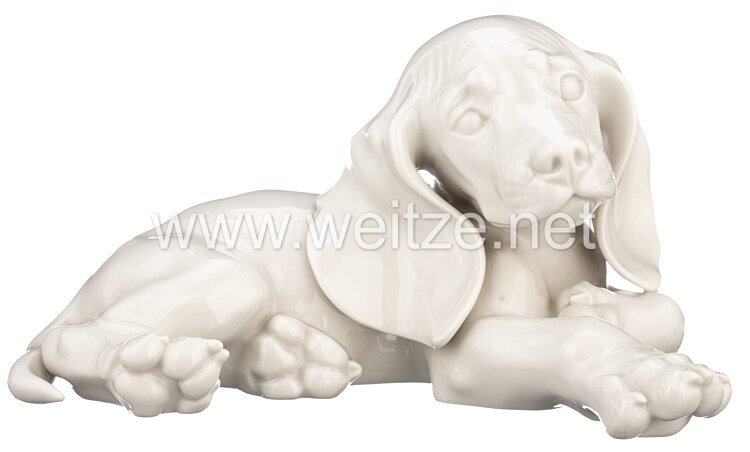
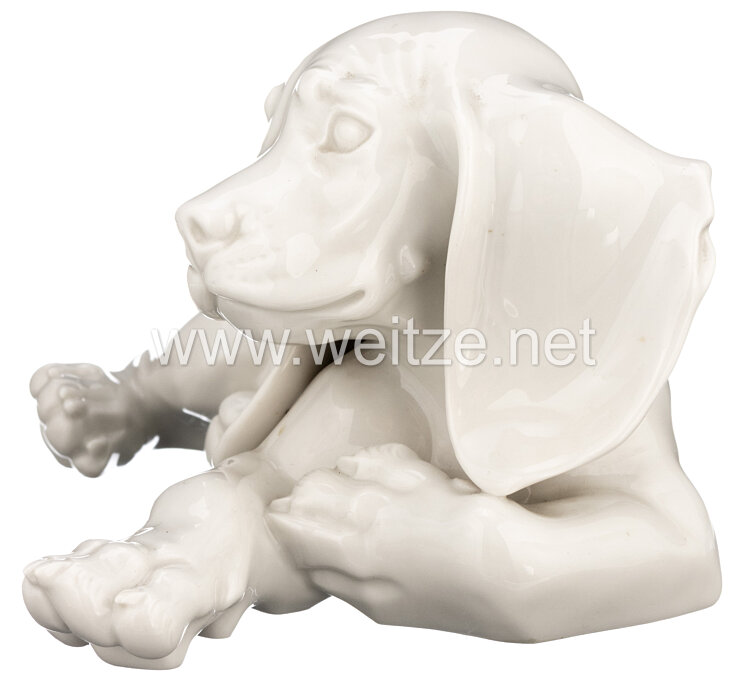
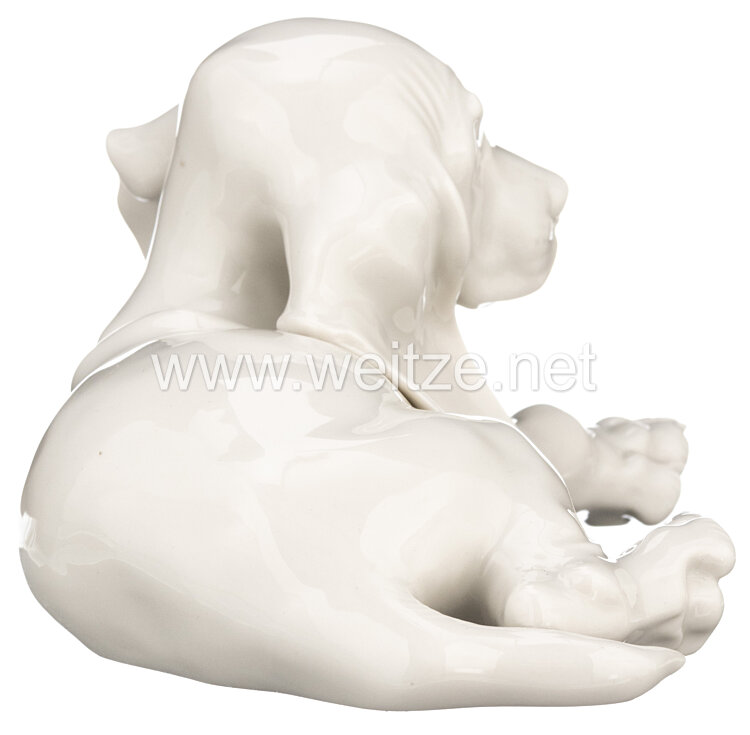
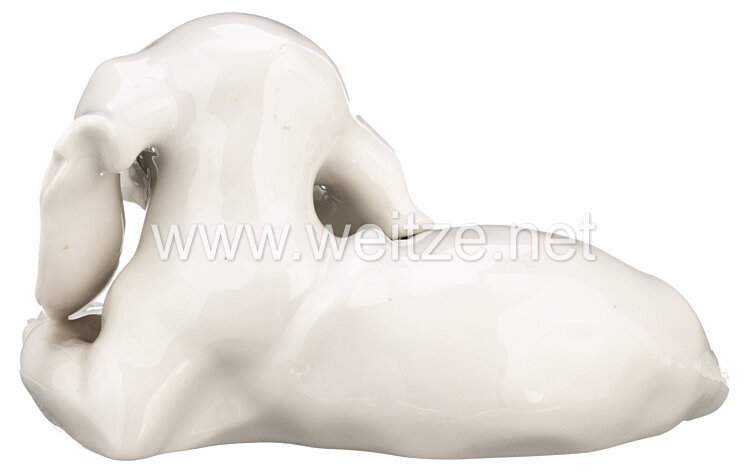
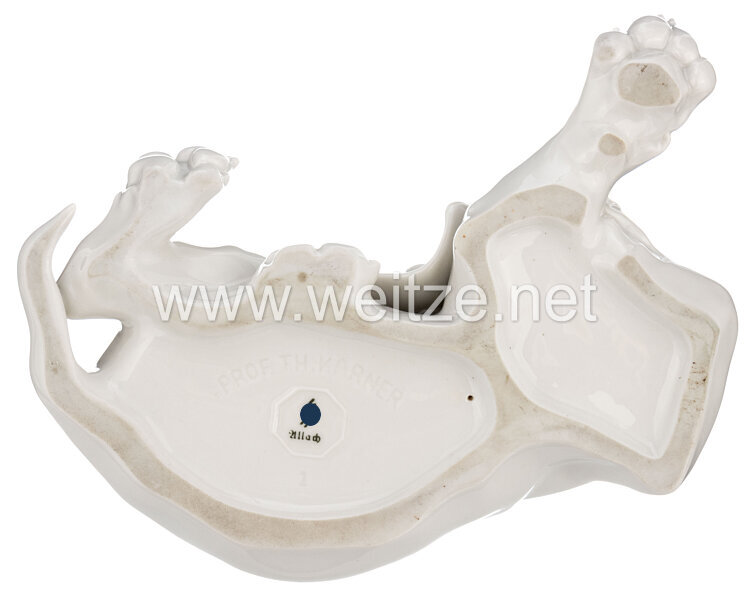
SS Porcelain Manufactory Allach - Young Dachshund Lying Down

Prof Th.Kärner No. 1, green Allach mark in octagon under glaze, undamaged. Condition 2+.
458240

SS Porcelain Manufactory Allach - Young Dachshund Lying Down

The Lying Young Dachshund bearing model number 1 represents one of the earliest and most recognizable designs from the Porzellan-Manufaktur Allach (PMA). This figurine was created by Professor Theodor Kärner (1884-1966), one of Germany's most prestigious porcelain artists, who served as artistic director of the manufactory from 1934 until 1945.

The Porzellan-Manufaktur Allach was established in 1935 in Munich-Allach by industrialist Franz Nagy and porcelain artist Karl Diebitsch. In 1936, the SS acquired the factory under Heinrich Himmler, who envisioned it as a vehicle for producing art representative of Germanic culture and supporting “National Socialist upbringing.” In October 1937, production was relocated to the SS training camp adjacent to Dachau concentration camp.

Theodor Kärner brought considerable expertise to the manufactory. He had previously worked at Nymphenburg (1905-1918) and Rosenthal (1918-1934), establishing himself as one of Germany's foremost porcelain designers. For Allach, he created multiple dachshund models: Model No. 1 (Lying Young Dachshund), Model No. 2 (Sitting Young Dachshund), and Model No. 13 (Lying Dachshund in a larger, adult size). All models were produced in both white glazed and painted or colored versions, with the painted variants being generally rarer and commanding higher prices.

From 1940 onward, the manufactory employed forced labor from Dachau concentration camp prisoners. Initially ten prisoners in 1940, this number rose to over 90 by 1943. During the war years, the factory employed approximately 25-30 civilian workers and about 50 concentration camp prisoners who produced both decorative porcelain such as animal figurines and political figures, as well as utilitarian objects like ointment jars and canteen dishes.

Allach production was distributed primarily to the SS, police, and Wehrmacht, who received two-thirds of total production with large discounts for SS members. Distribution occurred mainly through showrooms in cities like Berlin, Posen, Warsaw, and Lemberg, not through regular retail channels. The pieces also served as city and state gifts to visiting dignitaries. Heinrich Himmler controlled 45 percent of output and frequently gifted Allach pieces to SS officials and friends.

The manufactory produced over 240 ceramic and porcelain models during its nine-year existence from 1936 to 1945. Total production quantities for Model No. 1 are not documented in available sources. Production lists from 1939 onwards are not known to exist. Due to limited production numbers and the factory's brief operational period, Allach pieces are rare today.

Production at the Allach factory ceased with the fall of Nazi Germany in 1945. The factory was abandoned and its molds were destroyed or confiscated by Allied forces. Theodor Kärner was interned in Moosbach camp as part of denazification from 1945 to 1947. After his release, he worked as head of the art department at Eschenbach porcelain factory (1947-1953), then returned to freelance work for Rosenthal from 1954 until his death in Munich on September 6, 1966. Franz Nagy may have attempted to restart limited production at the Allach site after the war, as some post-war stoneware pieces have been found with an Allach mark bearing the letter “N” (for Nagy) instead of SS insignia.

Today, Allach porcelain pieces are rare, controversial collectibles that command high prices due to their limited production numbers, brief operational period, and historical significance. Museums and collectors preserve them as historical evidence of the Nazi era rather than as glorified memorabilia.

r