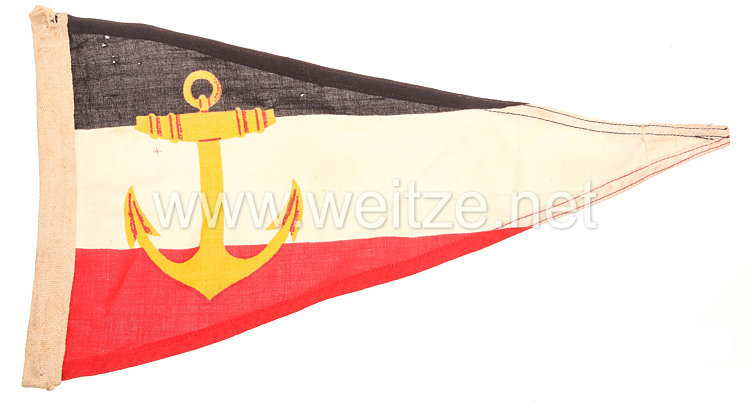
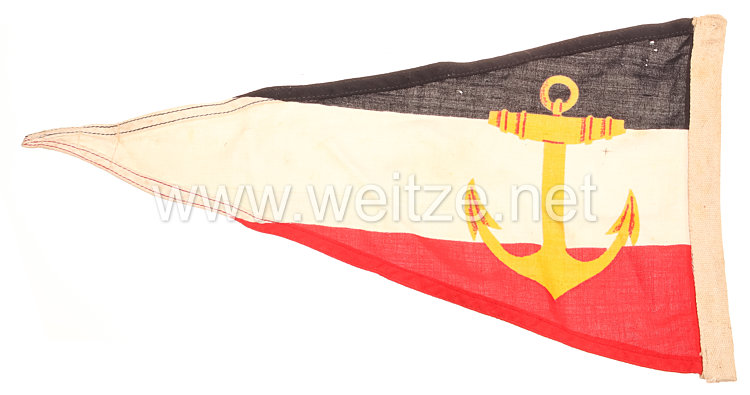
Kriegsmarine Vehicle Pennant and Command Flag for Naval Officers of Admiral Rank as Ground Forces Commander

Double-sided printed version, dimensions approx. 19 x 35 cm, condition 3-.
444040
450,00

Kriegsmarine Vehicle Pennant and Command Flag for Naval Officers of Admiral Rank as Ground Forces Commander

The Kriegsmarine vehicle pennant and command flag for naval officers of admiral rank as land forces commanders represents a rare and highly specialized example of military rank insignia and command symbols from the Third Reich. This double-sided printed flag, measuring approximately 19 x 35 cm, embodies the complex organizational structure of the German Kriegsmarine during World War II, particularly in situations where naval officers commanded land operations.

Historical Context and Development

Following the Nazi seizure of power in 1933 and the rearmament of German forces, the Kriegsmarine developed a comprehensive system of command flags and vehicle pennants. These served for immediate identification of commanders and their authority in the field. The Heeresdienstvorschrift (Army Service Regulations) and corresponding naval service regulations governed the precise use, design, and protocols of these symbols.

During the war, naval officers were increasingly deployed for land operations, particularly in coastal defense zones, with naval infantry units, and in occupied port cities. The coastal artillery, naval fortresses, and specialized units such as the Marine-Stoßtrupp companies (naval assault troops) required clear command structures where admirals also commanded land forces.

Technical Characteristics and Production

The double-sided printing of these flags was characteristic of high-quality executions. The printing process enabled precise reproduction of the Reich war flag or other maritime symbols as well as specific rank insignia for admirals. The compact size of approximately 19 x 35 cm was ideal for mounting on vehicles, typically on the fender or hood of staff cars.

The manufacture of such flags was carried out by specialized military outfitters and subject to strict quality controls. Materials typically included cotton or artificial silk, with printing inks required to be light-fast and weather-resistant to meet the demands of field service.

Admiral Ranks and Command Structures

The Kriegsmarine distinguished several admiral ranks: Konteradmiral (Rear Admiral), Vizeadmiral (Vice Admiral), Admiral, and Generaladmiral. Each rank had specific command flags symbolizing their authority. When an admiral commanded land forces, which occurred increasingly during the war through the mixing of naval and army units, special markings of their vehicles were required.

Such flags were particularly relevant in Norway, Denmark, the Netherlands, and France, where the Kriegsmarine maintained substantial land installations. The Fortress Helgoland, the coastal fortifications of the Atlantic Wall, and the naval garrisons in Oslo, Copenhagen, and other strategic ports required naval commanders with land responsibilities.

Use in Operational Context

Vehicle pennants served several practical purposes: they enabled guards and checkpoints to immediately identify staff vehicles, prevented delays in military movements, and demonstrated command authority. During inspections, troop visits, and operational deployments, correct vehicle flagging according to protocol was mandatory.

Collector Value and Historical Significance

Today, such command flags are rare collector's items that provide important insights into the military organization and hierarchy of the Kriegsmarine. The condition rating of 3- indicates certain signs of use, which is not unusual for a textile item over 75 years old. Authentic examples can be verified through material analysis, printing techniques, and historical comparisons.

The study of such military insignia contributes to understanding the complex command structures that existed in World War II, particularly the increasing merger of traditional service branch boundaries in the later war years. These artifacts serve as tangible evidence of the administrative and organizational complexity of Nazi Germany's military apparatus.

r