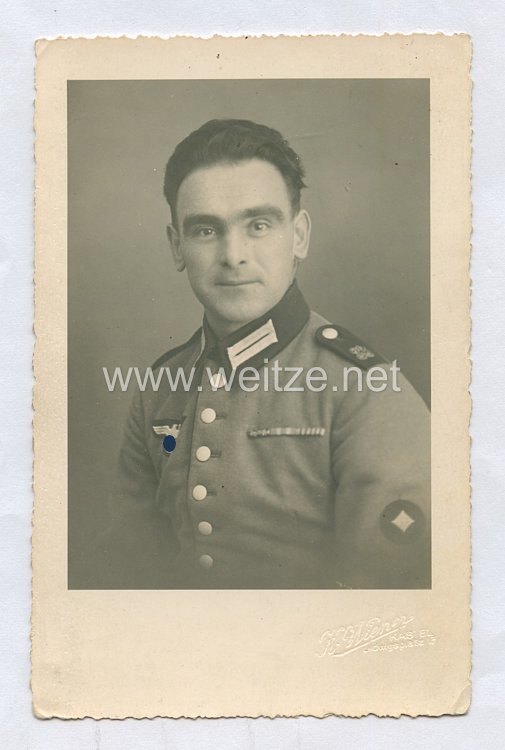
Wehrmacht Heer Portrait Photograph, Rifleman with Medal Bar
This portrait photograph depicts a Schütze (Rifleman) of the Wehrmacht Heer in uniform wearing a Feldspange (ribbon bar), captured on a postcard-sized photographic medium. Such photographs held enormous personal and social significance during World War II (1939-1945) and today document an important aspect of 20th-century military history.
The rank of Schütze was the lowest enlisted rank in the Wehrmacht Heer and corresponded to the civilian concept of a private soldier. According to Army Service Regulation 300/4, this was the entry-level rank for all conscripts and volunteers. The designation “Schütze” was used particularly in infantry, panzergrenadier, and cavalry units, while other branches used their own designations such as Kanonier (gunner), Pionier (pioneer), or Funker (radio operator).
The Feldspange (also called Bandspange or ribbon bar) visible in the photograph is particularly noteworthy. These narrow fabric ribbons were worn on the uniform tunic and represented the awards earned by the soldier in compact form. The Feldspange was introduced to preserve the actual orders and decorations and to offer a more practical alternative for field use. According to the Dress Regulations for the Army of September 4, 1935, and their subsequent amendments, ribbon bars were worn above the left breast pocket of the field tunic. The order of the ribbons followed an established hierarchy, with the highest decorations placed on the left (from the wearer's perspective).
Portrait photographs in postcard size (typically about 9 x 14 cm) were extraordinarily popular during the Nazi period and the war. They fulfilled several important functions: they served as mementos for the soldiers themselves, were sent to family members, friends, and fiancées, and documented the military status and career of the person depicted. Many soldiers had their pictures taken by professional photographers in garrison towns or during basic training. The uniform and especially visible decorations were of central importance, as they demonstrated bravery, length of service, and military rank.
The postcard format was not chosen by chance. It corresponded to the standardized formats of the field post and enabled inexpensive shipment to the home front. The Feldpost (military postal service) was free of charge for German soldiers, and millions of such photographs were sent during the war. They formed an important emotional connection between the front and home at a time when other means of communication were limited.
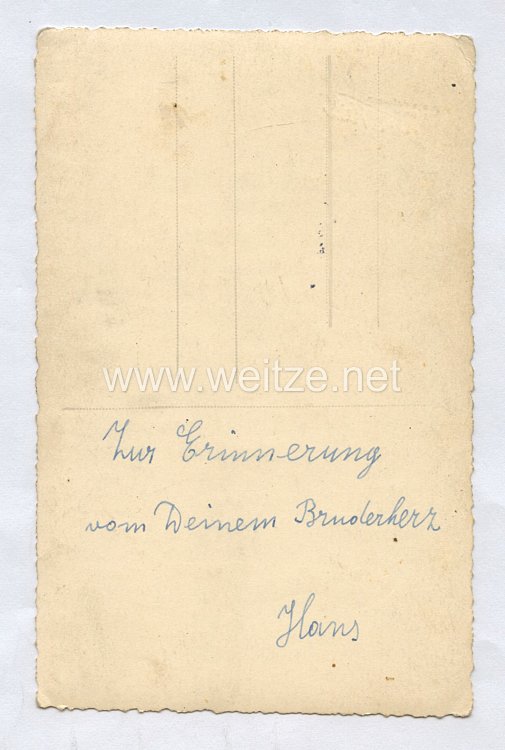
The “used condition” of the photograph is typical for such personal documents. Many of these pictures were carried in wallets, glued into photo albums, hung on walls, or frequently handled. Signs of wear such as creases, discolored corners, or adhesive residue testify to their intensive personal use and the emotional value they held for owners and recipients.
From a military-historical perspective, such photographs are today valuable sources for the study of uniforms (militaria) and social history. They document not only the official regulations regarding uniforming and decorations but also their practical implementation in everyday life. Photographs often show details not captured in official documents, such as regional or temporal variations in wearing practices or individual adaptations.
The Wehrmacht Heer was the land warfare branch of the Wehrmacht and, with several million soldiers, the largest service branch. Most conscripts began their service as Schützen and underwent several months of basic training before being deployed to the front. Wearing decorations, even in the form of ribbon bars, was a source of pride for many soldiers and documented their participation in campaigns or special achievements.
Today, such photographs are preserved by collectors, museums, and researchers. They serve as historical documents of one of the darkest periods in German and European history. Their preservation and scientific contextualization is important for the historical understanding of the Wehrmacht, World War II, and the individual fates of the millions of soldiers who served in this conflict.