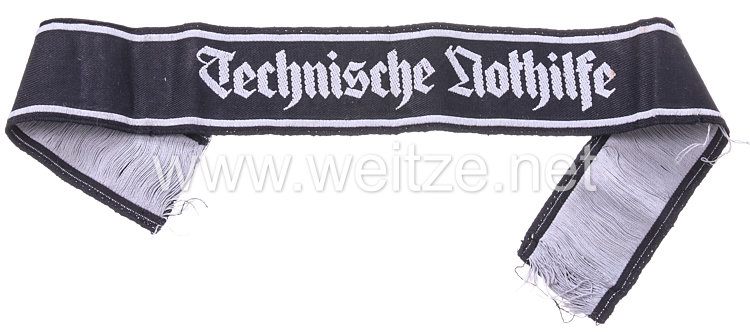
TeNo Enlisted Ranks Cuff Title “Technische Nothilfe”

Woven construction, full length. Worn condition, Grade 2.
388639
185,00

TeNo Enlisted Ranks Cuff Title “Technische Nothilfe”

The Technische Nothilfe (TeNo, Technical Emergency Service) was a paramilitary organization of the Weimar Republic and the Third Reich that existed between 1919 and 1945. The enlisted men's armband of the Technische Nothilfe represents a significant artifact from this important yet often overlooked institution in 20th-century German history.

The TeNo was founded on September 30, 1919 by Reich Defense Minister Gustav Noske, originally as a response to the massive strikes and unrest of the post-war period. Its official mission was to maintain public order and supply services when essential facilities were disrupted by strikes or disasters. The organization quickly developed into a technical emergency service with up to 100,000 members at its peak.

The woven armband was an essential component of the TeNo members' uniform. It was worn on the left upper arm and served for immediate identification of personnel during operations. The woven version for enlisted men differed from the higher-quality, often embroidered variants for leaders and junior leaders. The typical design showed the inscription “Technische Nothilfe” in silver-gray or white lettering on a dark blue background, frequently complemented by the organization's characteristic cogwheel symbol.

The TeNo uniform was strongly influenced by military models, reflecting the paramilitary nature of the organization. Besides the armband, the equipment included a dark blue uniform, belt gear, caps in various styles, and technical equipment. Rank insignia were worn on collar patches and shoulder straps, while the armband was common to all members and identified membership in the organization.

During the Weimar Republic, the TeNo played a controversial role. Welcomed by conservative and nationalist circles as a strike-breaking organization, it was vehemently opposed by trade unions and left-wing parties. Nevertheless, its scope of duties increasingly expanded to civilian disaster relief, including flood relief, technical rescue, and support during industrial accidents.

After the Nazi seizure of power in 1933, the TeNo was incorporated into the NS system. Through the decree of January 28, 1935, it was placed directly under the Reich Aviation Ministry under Hermann Göring. This marked a clear militarization of the organization. The TeNo became an integral part of the air defense organization and the civil defense system of the Third Reich.

During World War II, the TeNo expanded considerably. Its members were deployed during bombing raids on German cities, clearing rubble, repairing supply lines, and supporting fire brigades. The organization also played an important role in rebuilding war-damaged infrastructure in occupied territories. By the end of the war, the TeNo counted an estimated 150,000 members.

The present armband in full length and woven execution represents the standard version for ordinary enlisted men. The fact that it was worn gives it special historical value, as it was actively used in service. The stated condition grade 2 indicates good preservation with normal signs of wear.

After the war's end in 1945, the Technische Nothilfe was dissolved by the Allied control authorities. Its traditions and duties were partially adopted by the Technisches Hilfswerk (THW) founded in 1950 in the Federal Republic of Germany, which was conceived as a purely civilian organization without paramilitary character.

For collectors and historians, TeNo armbands are important historical documents. They document not only the history of a specific organization but also the development of disaster relief, the militarization of society in the 1930s, and the mobilization of the home front during the war. The various designs, variants, and wearing methods allow conclusions about ranks, time periods, and regional peculiarities.

The study of such uniform items contributes to understanding the complex history of German auxiliary organizations and illustrates how technical and humanitarian organizations can be integrated into authoritarian systems. The armband of the Technische Nothilfe thus remains a significant object for military-historical and social-historical research.

r