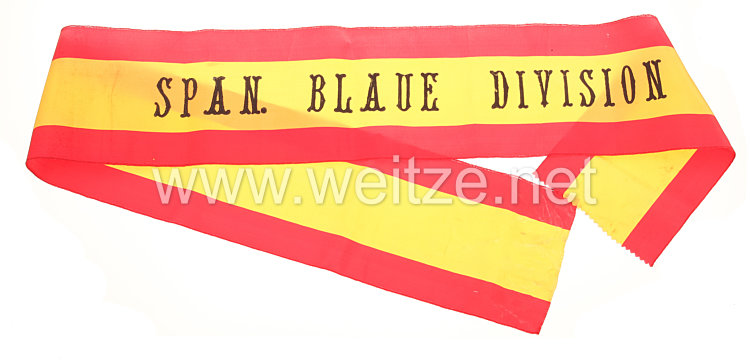
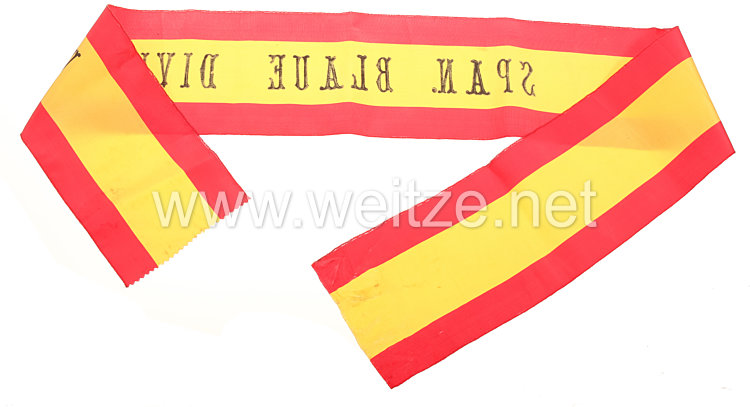
Spain Mourning Sash Spanish Blue Division

printed on red yellow, length 98 cm, condition 2
439639
125,00

Spain Mourning Sash Spanish Blue Division

The mourning sash of the Spanish Blue Division represents a remarkable testimony to one of the most controversial military units of World War II. The División Azul (Blue Division) was a volunteer unit of Spanish soldiers who fought alongside the German Wehrmacht on the Eastern Front between 1941 and 1943.

After the end of the Spanish Civil War (1936-1939), Spain was under the dictatorship of General Francisco Franco. Although Franco officially maintained Spain's neutrality in World War II, he felt indebted to Nazi Germany, which had supported his forces during the Civil War. When Hitler launched Operation Barbarossa against the Soviet Union in June 1941, Franco offered to send a volunteer unit to participate in the fight against Communism.

The division received its name from the blue shirts worn by the Falangists, Spain's fascist party. In July 1941, the unit was integrated into the German Wehrmacht as the 250th Infantry Division. Approximately 18,000 Spanish volunteers formed the original strength of the division, composed mainly of Falangists, monarchists, and anti-communists.

The mourning sash in the Spanish national colors of red and yellow served as an official mourning badge worn at military funerals and memorial ceremonies. Such sashes were an integral part of military mourning protocol and symbolized solidarity with fallen comrades as well as the national identity of Spanish soldiers, even during their service under German command.

The Blue Division fought primarily in the area of the Siege of Leningrad (1941-1944), where it participated in the blockade of the city. The unit experienced particularly fierce fighting at Krasny Bor in February 1943, where the division suffered heavy losses but held its positions against Soviet attacks. In total, the División Azul lost approximately 4,500 men during its deployment through combat, disease, and the extreme climatic conditions of the Eastern Front.

Due to increasing Allied pressure and the deteriorating military situation, Franco ordered the official dissolution of the Blue Division in October 1943. However, many volunteers remained on the Eastern Front as the Legión Azul (Blue Legion) until this unit was also recalled in 1944. Some hundreds of Spaniards even fought until the end of the war in various German units, including the Waffen-SS.

The use of mourning sashes followed Spanish military tradition and distinguished Spanish soldiers from their German comrades. These sashes were worn diagonally across the uniform at official mourning ceremonies and represented continued loyalty to Spain, despite the soldiers serving under foreign command.

After the war, the history of the Blue Division remained a controversial topic in Spain. During the Franco dictatorship, veterans were celebrated as heroes in the fight against Communism. After Franco's death in 1975 and Spain's transition to democracy, the role of the division was viewed more critically, particularly in the context of its participation in a war of aggression and collaboration with the Nazi regime.

Today, objects such as this mourning sash are important historical artifacts that recall a complex and often forgotten aspect of World War II. They document Spanish involvement in the Eastern Campaign and the personal stories of soldiers who served and died in this conflict. Such military-historical objects serve as material connections to a past era and enable a deeper understanding of the political and military dynamics of the time.

r