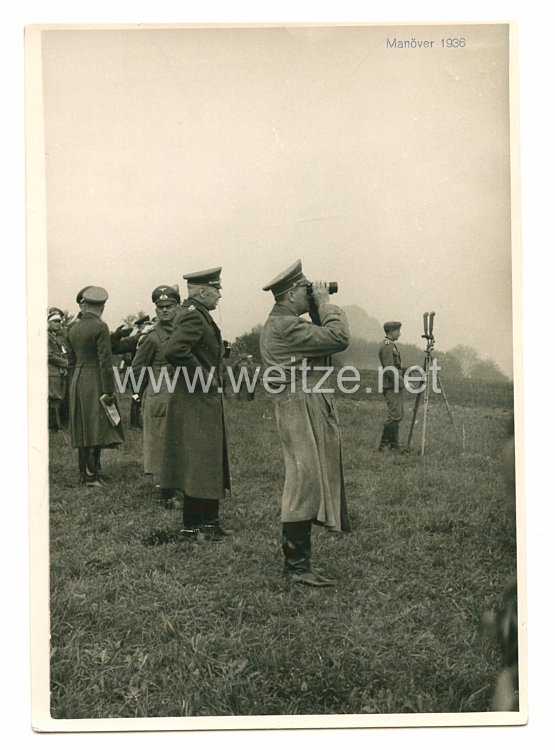
Third Reich Photograph, Adolf Hitler and Wilhelm Keitel at a Military Maneuver 1936

Dimensions approximately 16.8 x 11.8 cm. Used condition.
327939
40,00

Third Reich Photograph, Adolf Hitler and Wilhelm Keitel at a Military Maneuver 1936

Historical Context: Photographic Documentation of Adolf Hitler and Wilhelm Keitel at a Military Exercise in 1936

This photograph from 1936 documents a significant moment in the military history of the Third Reich, showing Adolf Hitler together with Generaloberst Wilhelm Keitel at a military exercise. The year 1936 marked a crucial turning point in German rearmament policy and the increasing militarization of the National Socialist regime.

Wilhelm Keitel (1882-1946) was already an important figure in the Reichswehr and later Wehrmacht at this time. In 1935, he was appointed Chief of the Wehrmacht Office in the Reich War Ministry. His relationship with Hitler developed during these years into a fateful loyalty that would later make him Chief of the Supreme Command of the Armed Forces (OKW) from 1938 onwards. Keitel was known for his unconditional subordination to Hitler's will, which earned him the derisive nickname “Lakeitel” (a wordplay combining his name with “Lakai,” meaning lackey) among his fellow officers.

The year 1936 was marked by several militarily and politically significant events. In March of that year, Hitler ordered the remilitarization of the Rhineland, a direct violation of the Treaty of Versailles and the Locarno Pact. This action, although considered risky by Wehrmacht generals, proceeded without military countermeasures from the Western powers and significantly strengthened Hitler's position. The Wehrmacht conducted intensive exercises that year to demonstrate its growing striking power and test new tactics.

The photographic documentation of military events held special significance in the Third Reich. The Propaganda Ministry under Joseph Goebbels recognized early the power of visual media for mass influence. Photographs of Hitler at military exercises, parades, and maneuvers served multiple purposes: they were meant to portray him as supreme warlord, radiate strength and determination, and demonstrate the supposed superiority of the German Wehrmacht.

The Wehrmacht's Propaganda Companies (PK) were systematically built up to photographically and cinematically record all military activities. Professional photographers accompanied exercises, troop visits, and later combat operations. These images were carefully selected and distributed through newspapers, magazines such as the “Berliner Illustrirte Zeitung” or the “Signal” magazine.

Military exercises in the 1930s served not only tactical training but also the testing of new weapons technologies and strategies. The Wehrmacht developed during these years the concepts of Blitzkrieg, based on rapid, concentrated tank and air attacks. Large autumn maneuvers took place regularly and were often observed by foreign military observers, serving both deterrence and covert demonstration of power.

The relationship between Hitler and his military leaders was still characterized by mutual respect during this phase, though initial tensions were already discernible. Hitler, who had only achieved the rank of corporal in World War I, attempted to establish his authority over the traditional Prussian officer corps. Keitel proved to be a willing supporter of these efforts.

Photographs like this are today important historical sources that provide insight into the staging of power, military culture, and the propaganda machinery of the NS regime. They document not only military-historical aspects but also the visual strategy of a totalitarian system. Collectors and historians value such documents for their significance regarding the period between 1933 and 1945.

After 1945, many of these photographs were confiscated by the Allies and transferred to archives. The Bundesarchiv in Koblenz and Berlin, as well as the National Archives in Washington, hold extensive collections of these pictorial sources. Private collections supplement institutional archives and contribute to historical research.

Critical engagement with such objects is essential for understanding the Nazi period and its mechanisms of power exercise and propaganda.