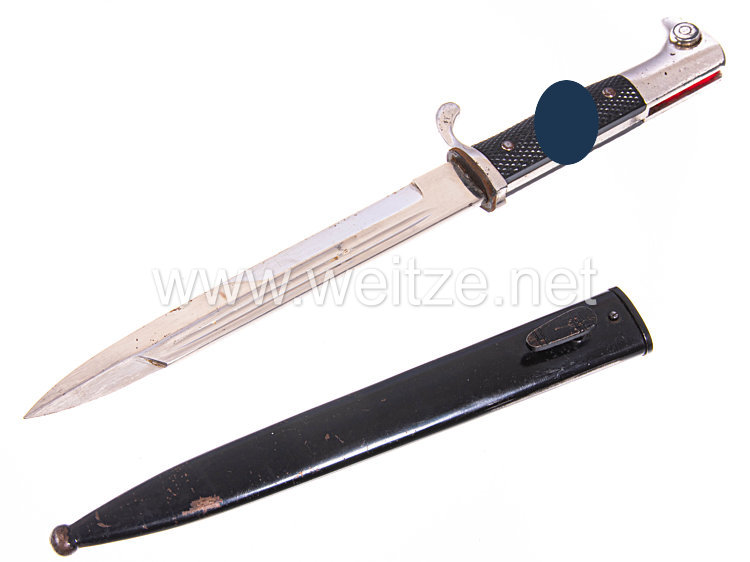
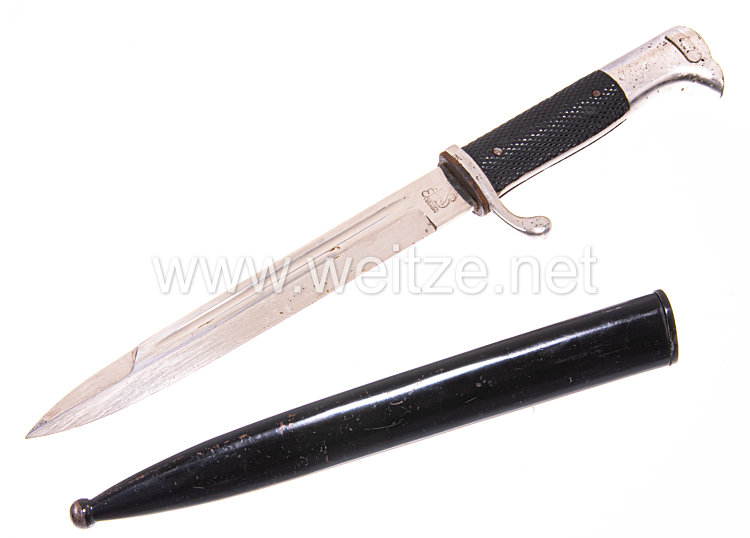
Wehrmacht Heer (WH) Dress Bayonet converted for members of the Studentenbund
The described object represents an interesting example of the repurposing of military equipment during the National Socialist period. It is a Wehrmacht side arm (bayonet) that was subsequently modified for members of the National Socialist German Students' League (NSDStB).
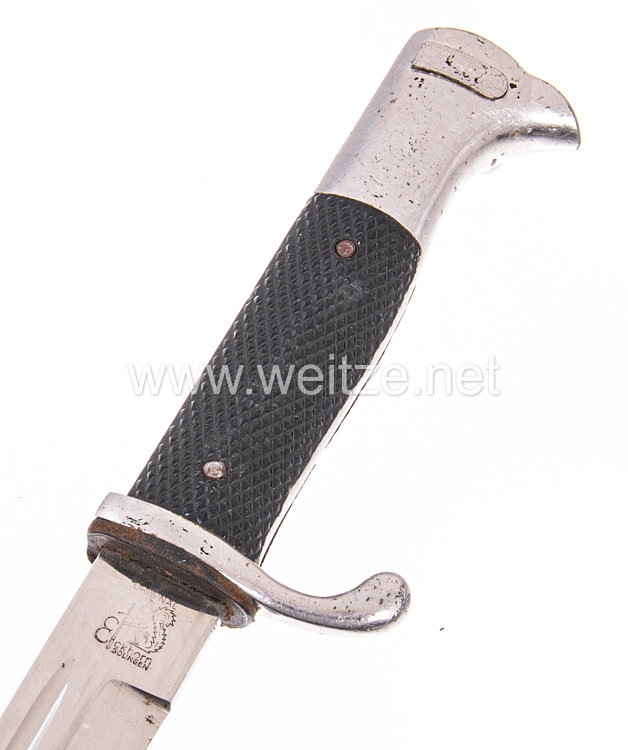
The original bayonet was manufactured by the renowned Solingen company Eickhorn, one of the most significant producers of edged weapons in the German Reich. The firm Carl Eickhorn, founded in 1865, produced high-quality bayonets, sabers, and other bladed weapons for the German military since the Imperial era. During the National Socialist period (1933-1945), Eickhorn supplied both the Wehrmacht and various divisions of the NSDAP and its subsidiary organizations.
The carbine blade of the bayonet corresponds to the military standard designs of the Wehrmacht. These blades were originally developed for the Karabiner 98k bayonet, the standard bayonet of the Wehrmacht for the 98k rifle. The typical blade length was approximately 25 centimeters, and the weapons were manufactured according to strict military specifications.
The National Socialist German Students' League was founded as early as 1926 and developed into the largest student organization during the NS period. After the seizure of power in 1933, competing student associations were dissolved or brought into line. The NSDStB reached its peak in the mid-1930s with over 100,000 members. The organization played a central role in the ideological orientation of students and the implementation of National Socialist principles at universities.
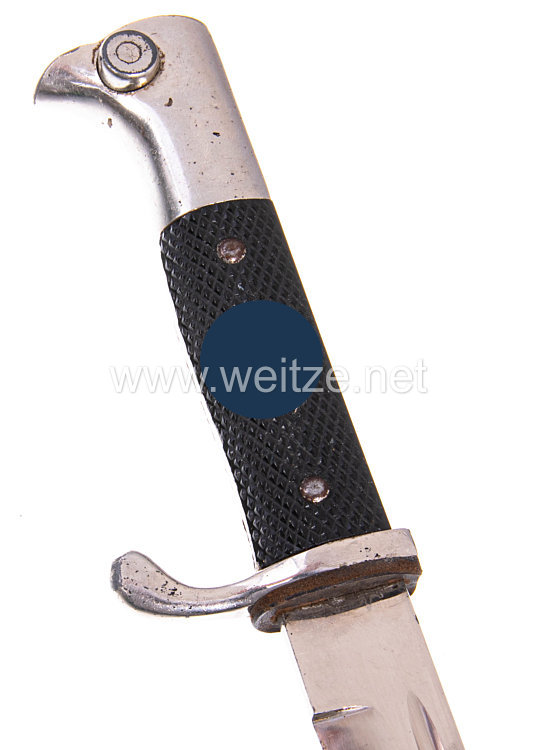
The modification of military bayonets for various NS organizations was common practice. Often, the grips were modified and organization-specific emblems were inserted. In the present case, the emblem of the Students' League was subsequently set into the checkered grip scales. This checkering not only provided better grip but also served as a base for attaching emblems.
The nickel-plated zinc crossguard is characteristic of productions from the later 1930s and early 1940s, when increasingly war-essential materials had to be conserved. While earlier versions were often made of brass or steel, zinc alloys were increasingly used later. The nickel plating served as corrosion protection and gave the object a representative appearance.
The scabbard with its well-preserved original lacquer (approximately 98%) testifies to careful storage over the decades. The black lacquer was standard for Wehrmacht scabbards and was intended both to protect and to ensure a uniform military appearance.
Such modified bayonets were worn at ceremonial occasions, parades, and official events of the respective organization. They served less practical military purposes than representation and expression of the hierarchical structure within National Socialist organizations.
From a historical perspective, such objects document the militarization of all areas of life during the NS period. Even civilian organizations such as the Students' League were structured according to military principles and equipped with corresponding equipment. This reflected National Socialist ideology, which aimed for comprehensive military training and military influence throughout society.
The marking “Original Eickhorn Solingen” on the blade was a quality mark and simultaneously a manufacturer's indication, as required for all regular military productions. Solingen had been considered the center of German blade production for centuries, and this proof of origin was correspondingly significant.
Today, such modified bayonets are of military-historical interest as they document the complex organizational structure of the NS state and the fusion of civilian and military spheres. They serve as material witnesses to a time when military symbolism and hierarchy permeated all areas of society.
The condition description indicating that the piece was “worn” (getragen) suggests actual use during the period, making it a primary source for understanding how these ceremonial weapons functioned in the daily life of NS organizations. The excellent preservation of approximately 98% of the original scabbard lacquer is remarkable and indicates that despite being worn, the piece was maintained with care.