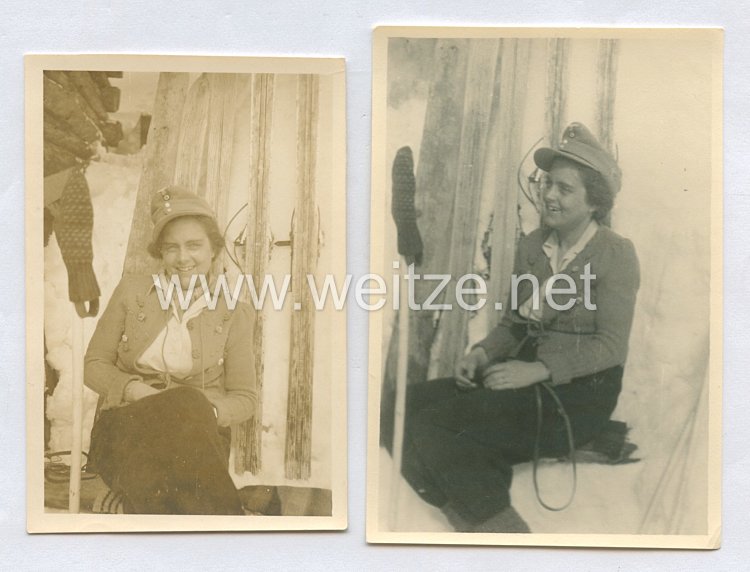
Wehrmacht Heer Photographs, Woman with Unit Field Cap
The photographs described here show a woman wearing a Einheitsfeldmütze (standard field cap) of the Wehrmacht Heer (German Army) and document a fascinating phenomenon of German military history during World War II. Such photographs provide valuable insights into the home front and the role of women in German wartime society between 1939 and 1945.
The Einheitsfeldmütze, also known as the M43 field cap, was officially introduced on June 25, 1943, and replaced the previous peaked cap (Schirmmütze) as the standard headgear for most military personnel. This practical piece of headgear was made from field-gray wool and could be produced more simply and cost-effectively than earlier models. The M43 was characterized by its distinctive shape with ear flaps that could be tied down in cold weather.
The existence of photographs showing women in uniform parts or with military equipment items was not uncommon during the war. These images emerged from various contexts: women in Wehrmacht auxiliary positions, family members of soldiers who wore their uniform parts for commemorative photos, or women in war-essential industries. From 1940 onwards, increasing numbers of women were employed as signals auxiliaries, staff auxiliaries, and in other auxiliary services of the Wehrmacht.
The Reich Labor Service (Reichsarbeitsdienst, RAD) and later various military auxiliary services employed hundreds of thousands of German women. By 1945, an estimated 500,000 women served as Wehrmacht auxiliaries in various functions. These auxiliaries often wore their own uniforms modeled after male examples, but male uniform items such as field caps were occasionally worn, especially in informal situations or during material shortages.
Private photographs like these were important documents of memorial culture during the war. They served to maintain connections between the front and home and were frequently exchanged between family members. The size of the described photographs (approximately 9.7 x 6.6 cm) corresponds to the then-common postcard format, suggesting that these images may have been sent through the mail.
Photography itself was strictly regulated during the National Socialist period. Professional and amateur photographers were subject to various restrictions, especially regarding military subjects. Nevertheless, private photography was widespread, and millions of photographs documented daily life during the war.
The used condition of the photographs testifies to their authentic use over decades. Such documents are today important historical sources for researching the everyday history of World War II. They complement official documents and propaganda material through personal perspectives and provide insight into the lived reality of people of that time.
From a military-historical perspective, such photographs document the increasing militarization of German society during the war. The boundaries between civilian population and military increasingly blurred, especially as total war mobilized more and more resources and people. Women took on not only roles in the armaments industry but also in directly military functions, increasingly assuming tasks previously reserved for men.
The Einheitsfeldmütze itself became a symbol of the late war years. Its simple construction and reduced material requirements reflected the increasing economic difficulties of the German Reich. In contrast to the representative peaked caps of the early war years, the M43 stood for an army that had to concentrate on essentials.
For collectors and historians, authentic photographs from this period are of particular value because they represent unstaged snapshots and often show details that are missing in official photographs. They document not only uniforms and equipment but also social relationships, emotions, and the atmosphere of the time. These historical documents help us today to gain a more comprehensive picture of those dramatic years and to understand the human dimension behind the great historical events.