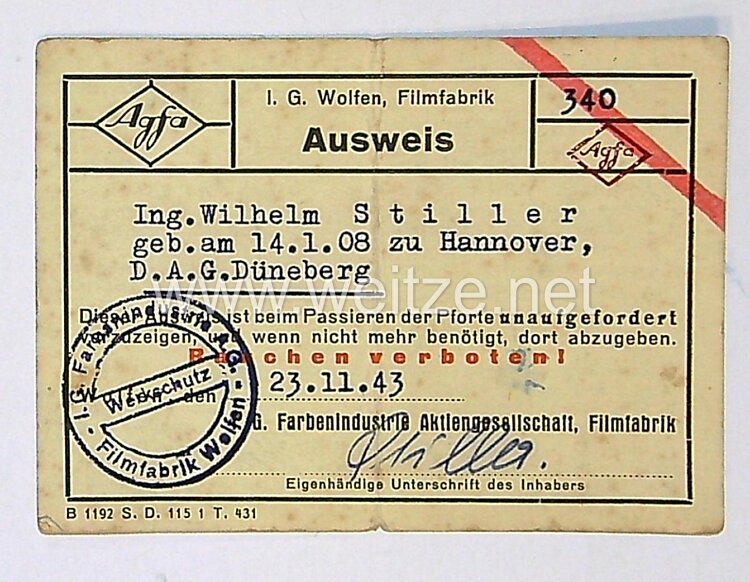
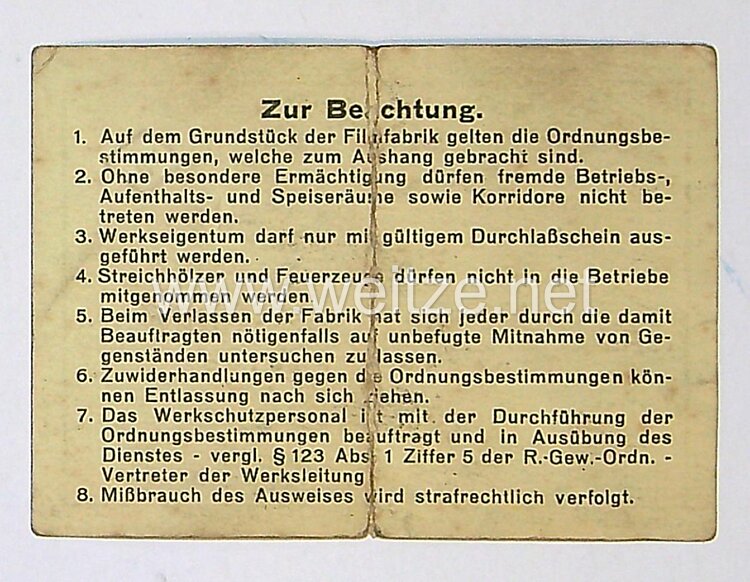
Third Reich - Identity Card AGFA I.G. Wolfen - Film Factory

for a man, issued on November 23, 1943, condition 2.
466737
40,00

Third Reich - Identity Card AGFA I.G. Wolfen - Film Factory

This factory identification card from AGFA I.G. Wolfen Film Factory dated 1943 represents a significant historical document of German armaments and war economy during World War II. Such identification cards were not merely simple identity documents but symbolized the central role that certain industrial enterprises played in the Third Reich's war effort.

AGFA (Actien-Gesellschaft für Anilin-Fabrikation) in Wolfen, Saxony-Anhalt, had been part of I.G. Farbenindustrie AG since 1925, the largest chemical conglomerate in Nazi Germany. The Wolfen film factory was among the most important production facilities for photographic materials in Europe and played a vital role during the war in supplying the Wehrmacht with film materials for reconnaissance, documentation, and propaganda purposes.

The issuance of this specific identification card on November 23, 1943 falls during a critical phase of World War II. Following the devastating defeat at Stalingrad in February 1943 and the failed Operation Citadel in the summer of that year, Germany found itself increasingly on the defensive. Allied bombing raids on German industrial facilities were intensifying, which heightened the importance of factory passes and identification documents.

Factory identification cards like this fulfilled several important functions: they served for access control to war-essential facilities, documented the reserved occupation status (UK-Stellung) of workers who were protected from military service, and regulated freedom of movement during frequent air raid alerts. The I.G. Farben works, as war-essential facilities, were strictly guarded and subject to special security regulations of the Wehrmacht and the Reich Security Main Office.

Film production in Wolfen during the war encompassed both civilian and military applications. Militarily relevant products included highly sensitive aerial reconnaissance films for reconnaissance aircraft, special film materials for night photography and infrared photography, as well as X-ray films for military hospitals and field hospitals. Production was carried out under the strictest secrecy.

Possession of such an identification card meant both privileges and obligations for the holder. On one hand, the reserved occupation status protected one from front-line service – an increasingly valuable position in 1943. On the other hand, workers in war-essential facilities were subject to strict work regulations, extended working hours, and compulsory labor. Unauthorized absence from work could be prosecuted as “undermining military morale” and result in drastic penalties.

The I.G. Farben works, to which AGFA belonged, also employed masses of forced laborers and concentration camp prisoners during the war. While German skilled workers were equipped with identification cards like the one at hand, thousands of foreign workers had to labor under inhumane conditions in the production facilities. I.G. Farben was held accountable for its role in the National Socialist system of injustice in the Nuremberg follow-up trials after the war.

The material design of such identification cards followed standardized guidelines from Reich authorities. They typically contained a photograph, personal data, signatures of factory management, often an official seal, and sometimes fingerprints. The documents were printed on special paper designed to make forgery difficult – an important aspect given the advantages such an identification card conferred.

After the war's end, the Wolfen plant was occupied by Soviet troops and partially dismantled. The remaining facilities were later integrated into the GDR economy as VEB Filmfabrik Wolfen. The AGFA brand was continued in both East and West after German partition, leading to decades of legal disputes.

Today, such factory identification cards are important sources for researching the German war economy, the social history of World War II, and the corporate history of I.G. Farben. They document the penetration of all areas of life by the National Socialist regime and the total mobilization of German society for war. The condition rating of 2 for this specimen indicates good preservation, which is remarkable for an everyday document from the war period and enhances its documentary value.