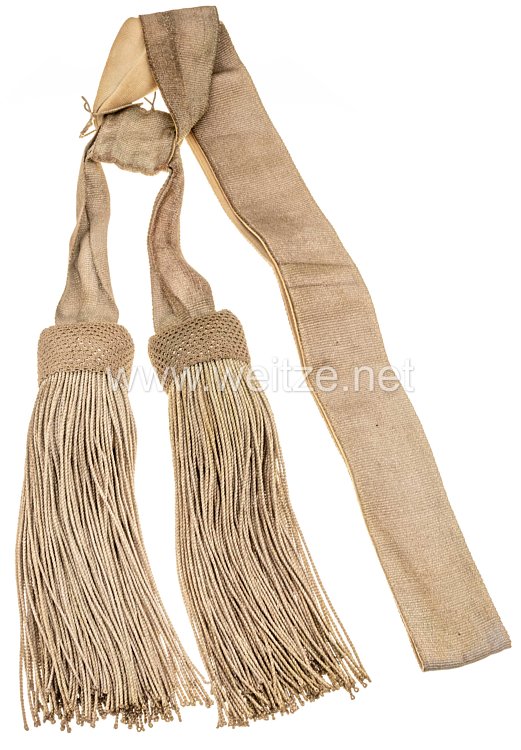
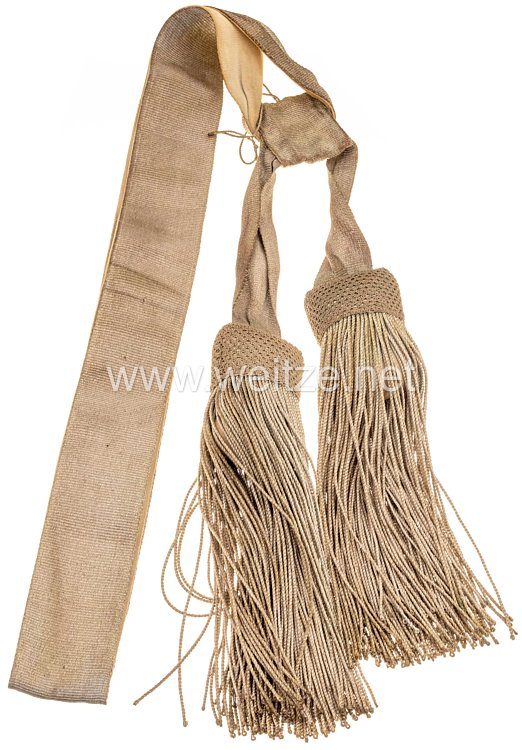
German Empire Minor States Sash for a Court Official or Page
This silver sash from around 1900 represents a fascinating testimony to the ceremonial culture at courts in the German Empire and its smaller states. Such ceremonial pieces served not military but primarily representative purposes and were an integral part of the elaborate court etiquette that characterized social life at German princely courts until the end of the monarchy in 1918.
Function and Manner of Wearing
Sashes of this type were worn diagonally across the shoulder, typically running from the right shoulder to the left hip. The characteristic width of 6 centimeters and the silver execution with tassels identify this specimen as part of a court uniform for court officials or pages. Unlike military order sashes, which were often held in more vibrant colors, the silver coloring symbolized the civil yet high-ranking position of the wearer within the court hierarchy.
Historical Context of the Small States
The German Empire, founded in 1871, consisted of a complex structure of federal states, including the Kingdoms of Bavaria, Saxony, and Württemberg, the Grand Duchies of Baden, Hesse, and Mecklenburg, as well as numerous smaller principalities and duchies. Each of these states maintained its own court until 1918 with specific ceremonies, uniform regulations, and hierarchies. Court establishments varied considerably in size and splendor, yet even smaller princely courts placed great emphasis on appropriate representation.
The Role of Court Officials
Court officials formed the administrative backbone of princely households. Among them were chamberlains, master hunters, masters of ceremonies, and various administrative officials. Their positions were often hereditary or granted to nobles and meritorious commoners. The court uniform, which included sashes, served as a visible sign of their position and privileged access to the ruler. At court ceremonies, receptions, and festive occasions, wearing the complete uniform including all insignia was obligatory.
Pages at Court
Pages were young nobles, typically between 12 and 18 years of age, who were educated at court and accompanied the ruler as well as high-ranking courtiers at ceremonial occasions. Page education was considered a desirable privilege and offered training in courtly manners, languages, and social conduct. Pages wore particularly splendid uniforms that frequently featured historicizing elements and included silver or gold accessories.
Materiality and Production
The manufacture of such sashes required the highest level of craftsmanship. Silver threads were woven into a wide band that had to be both flexible and representative. The tassels at the ends were elaborately crafted and often wrapped with silver wire. Production took place in specialized workshops that frequently served as court suppliers and had to maintain strict quality standards. The complete binding of the sash indicates that it was finished and ready to wear immediately.
Chronological Context
The dating around 1900 falls into the late Wilhelmine era, a period characterized by particular displays of splendor and conservative emphasis on monarchical traditions. Under Emperor Wilhelm II, court ceremonial culture experienced a renaissance, and the smaller German courts also oriented themselves toward the Berlin model. At the same time, this was a period of social change in which traditional court structures increasingly came into conflict with modern state administration.
The End of an Era
With the November Revolution of 1918 and the abdication of the German princes, the tradition of court establishments ended abruptly. The elaborate court uniforms and their insignia lost their practical function and became historical relics. Many pieces were lost, sold, or transferred to museum collections. Preserved specimens like the described sash are today important testimonies to a vanished culture and provide insights into the representative practices and social hierarchies of the German monarchy.
Collector Value and Preservation
For collectors of court uniforms and insignia, such sashes represent sought-after objects. The condition rating of 2 indicates a well-preserved piece with minor signs of wear. The silver threads may tarnish over time, but precisely this gives the object its authentic patina. The complete preservation including both tassels significantly increases its historical and material value.