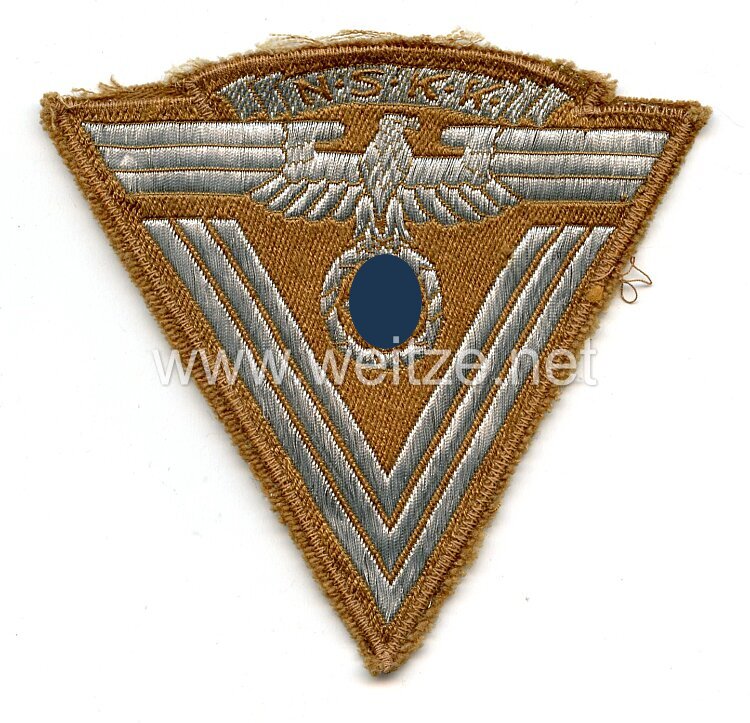
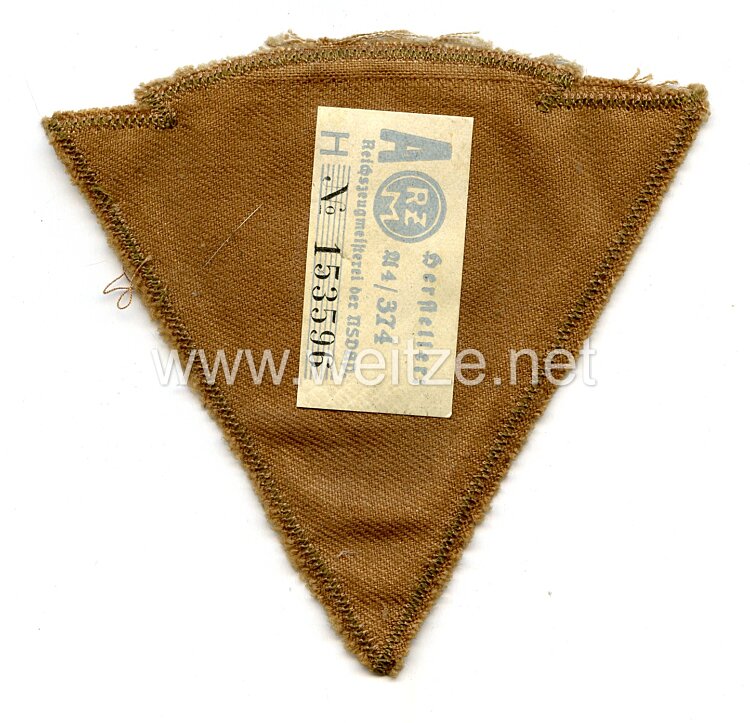
National Socialist Motor Corps (NSKK) Sleeve Eagle for Brown Shirt
The Nationalsozialistische Kraftfahrkorps (NSKK) sleeve eagle for the brown shirt represents a characteristic insignia of a paramilitary organization of the Third Reich that existed between 1931 and 1945. The NSKK evolved from the Nationalsozialistisches Automobilkorps (NSAK), which was founded on April 1, 1930, as a motorized sub-unit of the SA.
The transformation into the independent NSKK occurred on August 23, 1934, shortly after the so-called “Röhm Affair,” when the organization received its formal independence from the SA, although it remained closely connected to the National Socialist apparatus of power. Under the leadership of Adolf Hühnlein, who led the corps from 1931 until his death in 1942, the NSKK developed into a significant organization with over 500,000 members at the height of its existence.
This example displays the typical execution of a sleeve eagle in metal thread embroidery on brown base fabric, designed for the characteristic brown shirt of the NSKK. The brown shirts had been the hallmark of the National Socialist movement since the early 1920s and were adopted by the NSKK as part of its uniform. The eagle itself followed National Socialist iconography with outstretched wings and the swastika in its talons, a symbol that emphasized the connection to the NSDAP.
Particularly noteworthy about this piece is the chevron marking it as belonging to an “Alter Kämpfer” (Old Fighter). This designation was awarded to party members who had joined the NSDAP before the seizure of power on January 30, 1933, or who had participated in the failed Hitler Putsch of November 9, 1923. The chevron, typically in silver or aluminum execution, was worn on the right upper arm and represented a visible sign of early party membership. These “Old Fighters” enjoyed special recognition and privileges within the National Socialist hierarchy.
The present RZM label is of considerable historical significance. The Reichszeugmeisterei (RZM) was established in 1929 as the central procurement office of the NSDAP and controlled the manufacture and distribution of all party insignia, uniform parts, and equipment items. From the mid-1930s onward, RZM certification was mandatory for all official NS insignia. The RZM system employed a complex numbering system that identified manufacturers, materials, and production periods. The presence of such a label confirms the authenticity and official character of the insignia.
The main tasks of the NSKK included the pre-military motor vehicle training of German men, the organization of motorsport events, and the promotion of motorization in Germany. During World War II, the NSKK assumed important logistical functions, particularly in transportation and in training drivers for the Wehrmacht. NSKK units were deployed both at the front and in occupied rear areas, where they undertook transport and supply duties.
The uniform regulations of the NSKK were detailed in various service regulations. The sleeve eagle was worn on the right upper arm of the brown shirt, in a standardized position that was precisely regulated. The metal embroidery execution was of higher quality than simpler woven or embroidered versions and was worn predominantly by leaders and non-commissioned officers, while ordinary members often used less expensive versions.
The manufacture of such insignia was carried out by various authorized manufacturers throughout the German Reich. Quality varied depending on the manufacturer and production period, with earlier executions generally displaying higher craftsmanship than later wartime productions, when material shortages and accelerated manufacturing affected standards.
Following Germany's unconditional surrender on May 8, 1945, the NSKK was banned and dissolved along with all other National Socialist organizations by Control Council Law No. 2 of October 10, 1945. The possession, manufacture, and wearing of such insignia were strictly regulated in the occupation zones and later in the Federal Republic of Germany. Today, such objects may only be collected and displayed for purposes of historical research, museum presentation, or civic education, with laws against the use of symbols of unconstitutional organizations (§86a StGB) to be observed.
This sleeve eagle serves as material testimony to a dark period of German history and reminds us of the comprehensive penetration of German society by National Socialist organizations that encompassed all areas of life and were instrumentalized for war preparation and prosecution.