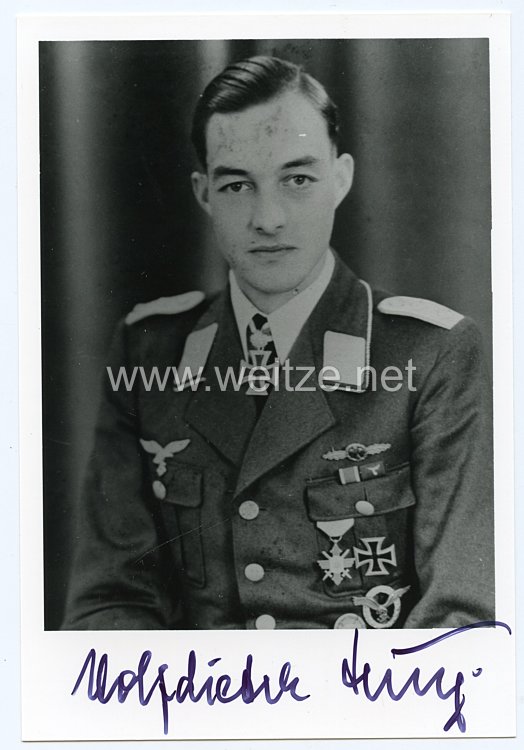
Luftwaffe - Post-war Signature of Knight's Cross with Oak Leaves Recipient Wolf-Dieter Huy
The described postwar signature of Wolf-Dieter Huy, a recipient of the Knight's Cross of the Iron Cross with Oak Leaves, represents a fascinating testament to the postwar military-historical culture of remembrance. Such signed photographs are important documents that chronicle both military history and the handling of this history after 1945.
Wolf-Dieter Huy (1918-2006) was a highly decorated fighter pilot of the German Luftwaffe during World War II. He was born on September 15, 1918, in Kolberg and joined the Luftwaffe in 1937. During his military career, Huy achieved 40 confirmed aerial victories, most of them on the Eastern Front. His military achievements led to his decoration with the Knight's Cross of the Iron Cross on September 4, 1942, which he received as Oberleutnant and Staffelkapitän of 5./Jagdgeschwader 77. The further honor of the Oak Leaves to the Knight's Cross followed on March 2, 1944 as Major and Commander of I./Jagdgeschwader 77, making him one of the 882 recipients of this highest bravery decoration.
The Knight's Cross of the Iron Cross was instituted on September 1, 1939, by Adolf Hitler as a reintroduction and expansion of the Iron Cross. It represented the highest award for military merit during World War II. The Oak Leaves grade, introduced on June 3, 1940, was the first enhancement level of the Knight's Cross and was awarded for further extraordinary achievements. The design consisted of a silver oak leaf wreath worn on the ribbon of the Knight's Cross.
After the war's end, an extensive collector culture developed around military memorabilia during the 1950s through the 1990s. Many former award recipients were contacted by collectors and military historians to sign photographs. These postwar signatures served multiple purposes: they authenticated historical photographs, created personal connections to history, and enabled collectors to own documented memorabilia. The practice of signing photographs by former soldiers became particularly popular in the 1970s and 1980s, when historical interest in World War II increased.
The present photograph in the format of 10.1 x 14.7 cm corresponds to a common standard format for portrait photographs of this era. The indicated condition grade 1 suggests very good preservation, which is of considerable importance for such documents. The signature was evidently made well after the war's end, which is typical for this type of collectible.
For military-historical research, such signed photographs have multiple values. They document not only the military career of the person depicted but also the culture of remembrance in the postwar period. The fact that former soldiers were willing to sign photographs, and that collectors sought them, reflects the complex societal handling of military history. In Germany, this was particularly sensitive, as a balance had to be found between historical documentation and appropriate coming to terms with the past.
Wolf-Dieter Huy survived the war and lived until 2006. Like many former Luftwaffe pilots, he occasionally made himself available for signatures and interviews after the war. The fighter pilots of the Luftwaffe occupied a special position in postwar memory, as their military activity was often viewed separately from the political dimension of the war, which was historically and ethically problematic but culturally widespread.
Today, such objects are considered contemporary historical documents that chronicle both military history and reception history. They are important sources for historians dealing with the culture of remembrance, military history, and societal coming to terms with World War II. The collector value and historical significance of such pieces lie in their authenticity, their state of preservation, and their documentary quality.