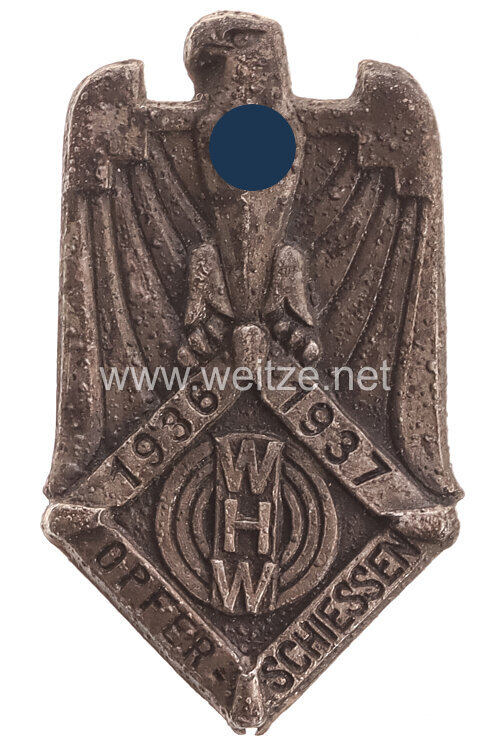
Third Reich - WHW - “Opferschiessen 1936/1937”
This badge from the Third Reich era documents participation in a charity shooting competition (Opferschießen) organized by the Winter Relief Organization (Winterhilfswerk or WHW) during the 1936/1937 season. These pin badges represent a fascinating example of the fusion of charitable events, military tradition, and National Socialist propaganda.
The Winter Relief Organization of the German People was founded in September 1933 as the central welfare organization of the Nazi regime. Under the patronage of Joseph Goebbels and the Reich Ministry of Public Enlightenment and Propaganda, the WHW developed into one of the largest charitable organizations of its time. Officially, it was meant to help needy German families during winter months, but simultaneously served as an instrument of social control and propaganda.
The charity shooting competitions (Opferschießen) were sporting events connected to traditional German marksmanship associations, which had a long tradition in Germany. Within the WHW context, these events were regularly conducted between 1933 and 1945. The 1936/1937 season was particularly significant as it took place immediately after the 1936 Berlin Olympic Games, during which the Nazi regime sought to present Germany as a modern, sports-enthusiastic nation.
The described badge is made of silver-plated fine zinc, a typical material for WHW badges of this period. The use of base metals was characteristic, as precious materials were reserved for armaments production. Nevertheless, the silver plating gave the badge a dignified appearance. Manufacturing was typically carried out by specialized firms working under contract for the Reichszeugmeisterei (Reich Equipment Office) or local WHW organizations.
Participants in charity shoots paid a donation fee and received such badges as acknowledgment. These served not only as receipts for donations made but also as visible signs of membership in the Volksgemeinschaft (people's community) and support for the regime. While wearing these badges was formally voluntary, social pressure to participate in WHW activities was considerable. Those not wearing badges could quickly be regarded as enemies of the people or politically unreliable.
The 1936/1937 season occurred during a phase of economic consolidation and intensive rearmament in the German Reich. The Four Year Plan under Hermann Göring had been announced in October 1936 and aimed at economic war preparation. WHW collections, including charity shoots, contributed to financing social programs but also relieved the state budget for military purposes.
The shooting events themselves typically took place in shooting clubs, rifle ranges, or at organized folk festivals. They were organized by local shooting associations, SA units, the Wehrmacht, or other Nazi organizations. The events combined sporting competition with comradeship and ideological indoctrination. They were often associated with speeches, propaganda films, or other Nazi events.
The design of such badges usually followed traditional motifs of German marksmanship, combined with Nazi symbolism. Typical elements included rifles, targets, oak leaves, or swastikas. The specific execution varied depending on region and organizing body.
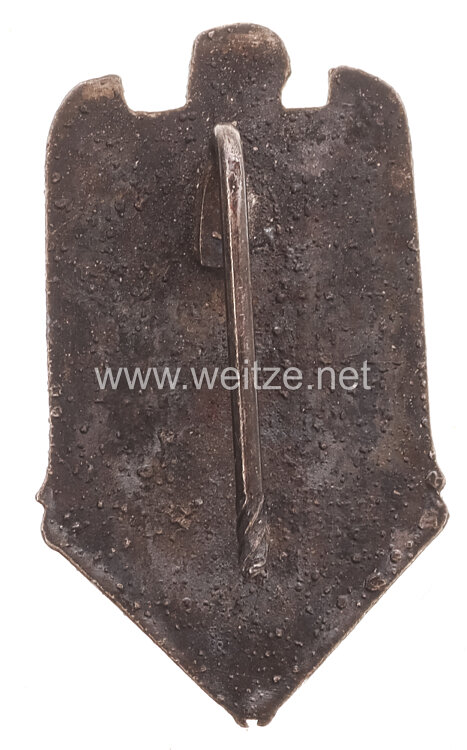
The condition description “Condition 2” corresponds to the standard grading scale for military antiques, indicating a well-preserved piece with minor signs of use. The shortened pin is a commonly encountered modification, made either for practical reasons or to adapt to different wearing methods.
After 1945, WHW badges were treated differently during denazification. While objects with explicit Nazi symbolism were banned, many WHW pieces were considered less problematic. Today they are collectible objects that document everyday life in the Third Reich and illustrate the penetration of all areas of life by the Nazi regime.