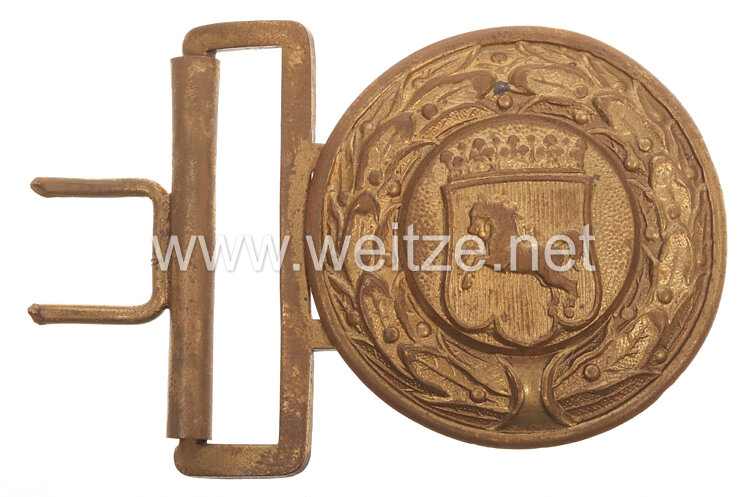
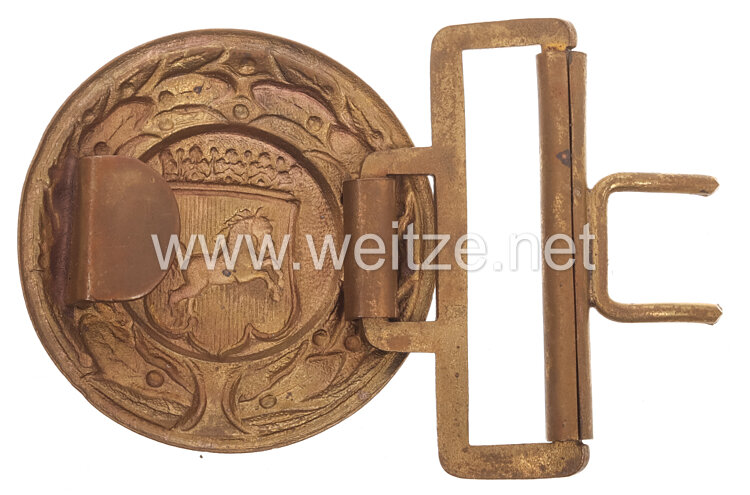
Weimar Republic Fire Brigade Province Hannover Field Belt Buckle for Commanders
This field belt buckle for fire brigade commanders from the Province of Hanover represents a remarkable testament to fire service history during the Weimar Republic (1918-1933). Crafted from gilt brass, this object embodies the hierarchical structures and distinct uniform culture of German fire brigades during the interwar period.
Following the end of World War I and the collapse of the German Empire, Germany entered a phase of fundamental political and social transformation. The Weimar Republic inherited not only state institutions but also municipal and provincial organizations, including the fire brigades. The Province of Hanover, which had been an independent kingdom until 1866 before becoming a Prussian province, maintained a well-organized fire service with its own uniform regulations and rank insignia.
The field belt (Feldbinde) was an important distinguishing feature for fire brigade leadership personnel. Worn diagonally across the uniform, it served to immediately identify commanders and senior officers during operations. The buckle that fastened the two ends of the field belt was not merely functional but also representative. The use of gilt brass underscores the special status of commanders and follows a long tradition of military and paramilitary uniform design.
During the Weimar Republic, fire brigades largely retained their traditional structures despite democratic reorganization. The organization remained strongly hierarchical, and uniforms continued to follow military models. This was partly due to practical necessity - clear command structures and recognizable rank orders were vital during firefighting operations. However, it also reflected the social importance attributed to the fire service. Fire commanders enjoyed high esteem in their communities and represented municipal authority.
The Province of Hanover was one of the largest Prussian provinces, encompassing both urban and rural areas. Accordingly, the fire service landscape was diverse: from professional career fire brigades in larger cities like Hanover itself to volunteer fire brigades in smaller communities. All, however, followed provincial regulations regarding training, organization, and uniforming. The standardization of uniform components and insignia facilitated cooperation during major operations and created a common identity.
The manufacture of such field belt buckles was carried out by specialized craftsmen and military equipment suppliers. The gilding of brass was accomplished through galvanic processes or fire-gilding and was intended to ensure lasting resistance to weather conditions. These buckles frequently bore emblems or coats of arms - in the case of the Province of Hanover, often the Hanoverian horse emblem or provincial sovereign symbols. The craftsmanship of such pieces was generally of very high quality, as they served representative functions and were worn for many years.
The political turbulence of the Weimar Republic - from the hyperinflation of 1923 through the relative stabilization of the middle years to the Great Depression from 1929 onward - also affected fire brigades. Budget cuts and economic difficulties often hampered equipment modernization. Nevertheless, traditional uniform components such as field belts and their buckles remained important identifying features that were maintained even under difficult conditions.
With the Nazi seizure of power in 1933, the Weimar Republic ended, and the fire service was integrated into the coordinated structures of the Nazi state. Old provincial particularities were increasingly standardized. Objects from the Weimar era such as this field belt buckle thus document a specific historical epoch of German fire service history between imperial tradition and Nazi coordination.
Today, such historical fire brigade insignia are sought-after collectibles that provide insight into organizational history, uniform studies, and local identities of the interwar period. They bear witness to a time when municipal institutions maintained their continuity and cultivated local traditions despite political upheavals.