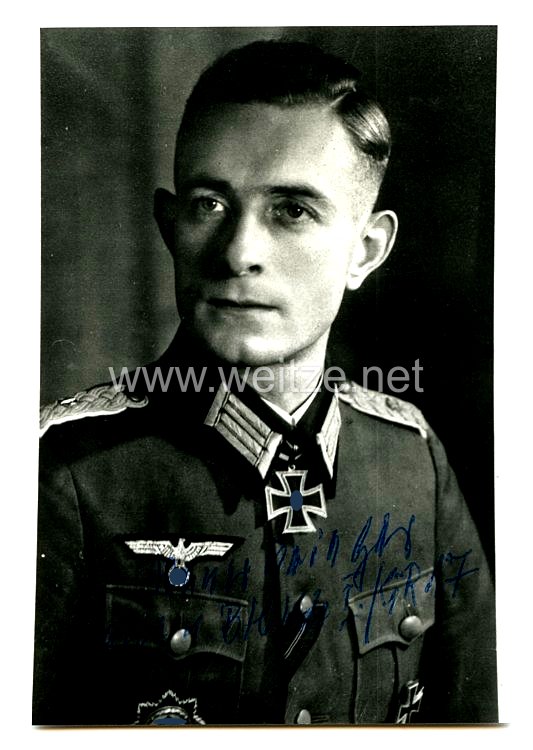
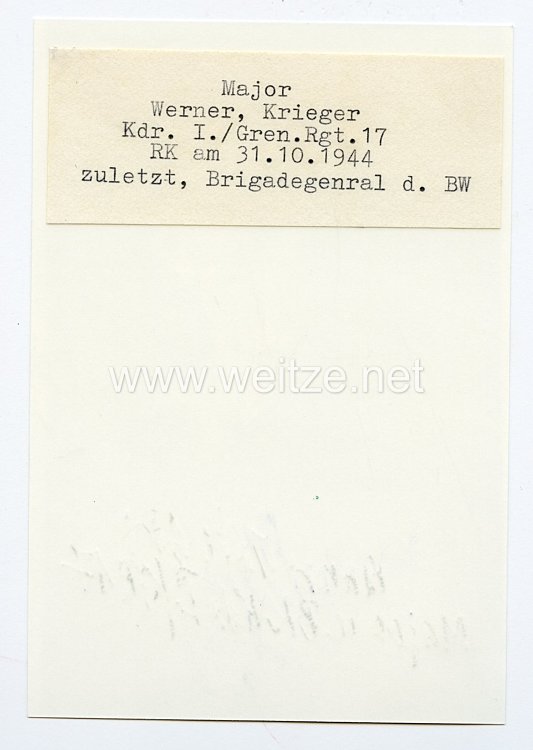
Army - Post-War Signature of Knight's Cross Recipient Werner Krieger

Postcard size. The photograph is a print made after 1945. Condition 2.
413035
30,00

Army - Post-War Signature of Knight's Cross Recipient Werner Krieger

The present object is a post-war signature of Knight's Cross recipient Werner Krieger on a postcard-sized photograph. The photograph itself is a print made after 1945, representing a special category of military historical collectibles from the Second World War era.

Werner Krieger was one of the numerous soldiers of the German Wehrmacht who were decorated with the Knight's Cross of the Iron Cross during World War II. This highest bravery decoration of the German Reich was awarded from September 1939 and represented an expansion of the Iron Cross already awarded during World War I. The Knight's Cross recognized exceptional military achievements and was awarded in various grades, with the Knight's Cross itself being the first level, followed by Oak Leaves, Swords, and Diamonds.

The practice of collecting autographs of Knight's Cross recipients developed into a significant aspect of military historical collecting both during and especially after the war. In the post-war period, many former soldiers organized themselves into veterans' associations and met regularly at comradeship gatherings. On such occasions, photographs were frequently signed, which then served as memorabilia or were incorporated into private collections.

The present photograph is explicitly marked as a post-war print, meaning it was not produced during the war itself but only after 1945. This distinction is of considerable importance for collectors and historians, as it affects the authenticity and historical context of the object. Post-war prints were often made from original negatives or from preserved war photographs and presented for signature at veterans' meetings.

The Heer designation in the title indicates that Werner Krieger served in the German Army, the land forces of the Wehrmacht. The Heer formed the largest part of the Wehrmacht and was deployed in numerous combat operations on all theaters of war during World War II. Knight's Cross recipients of the Heer came from various branches, including infantry, armored troops, artillery, and other specialized units.

The stated condition 2 suggests a well-preserved state of the object, which is particularly significant for documents and photographs from this period. Paper-based memorabilia are susceptible to aging, moisture, and improper storage, making the state of preservation an essential factor for historical and collector value.

In historical context, such signed photographs represent a complex field of tension. On one hand, they document individual military biographies and serve as primary historical sources for researching World War II. On the other hand, they raise questions about appropriate memorial culture and the handling of German military history from this period.

The systematic collection of autographs from former Wehrmacht soldiers began intensively in the 1950s and 1960s, when numerous publications about Knight's Cross recipients appeared and veterans' organizations became active. Collectors specifically sought signatures of known military figures, creating a veritable market for such objects. This development must be seen in the context of West German post-war society and its confrontation with the recent past.

For military historical research, such documents offer valuable insights into the post-war biographies of former soldiers and the development of veterans' culture. They show how military memory was constructed and transmitted, and document the networks of former Wehrmacht members in the Federal Republic of Germany and beyond.

Today, such objects are preserved in military historical collections, archives, and museums, serving as research objects for historians engaged in the social and military history of the twentieth century. They contribute to understanding how military decorations, individual memories, and collective historical narratives are interwoven.

The study of autographed materials from this period requires careful contextual analysis and critical evaluation. Modern scholarship emphasizes the importance of examining not only the individuals represented but also the broader social and political circumstances that shaped both their wartime service and post-war commemoration. Such artifacts serve as tangible connections to historical events while simultaneously reflecting the evolving ways societies remember and interpret their past.

r