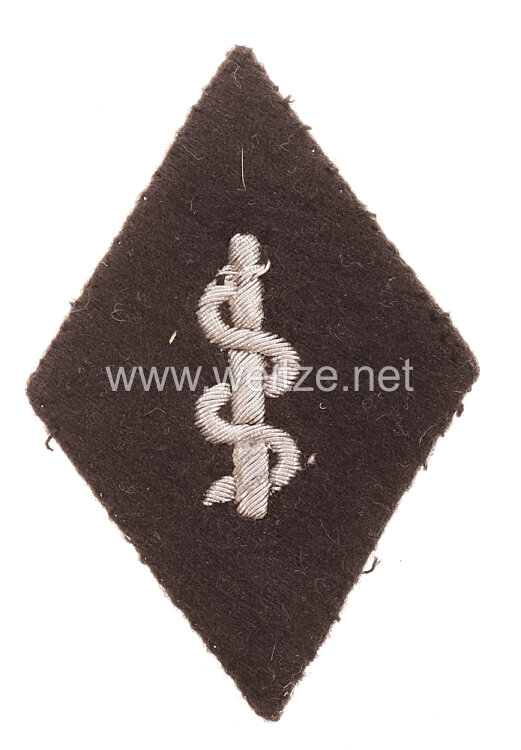
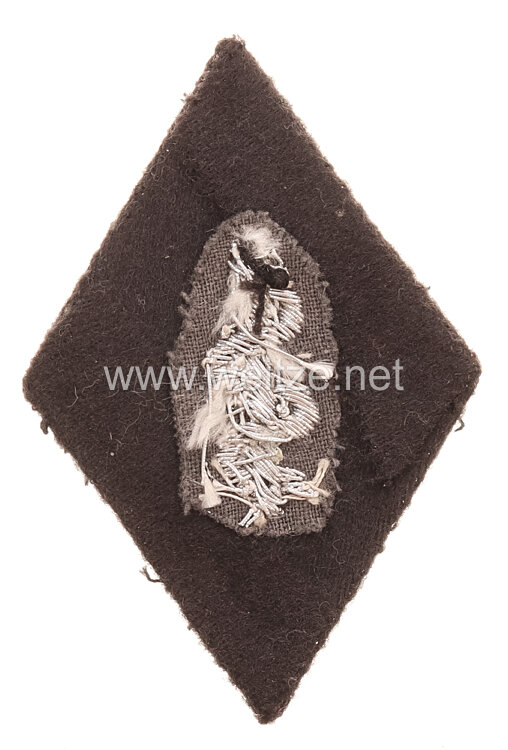
German Red Cross DRK Sleeve Insignia for a Physician

Hand-embroidered metallic thread on gray backing, worn condition, Condition 2-
459335
185,00

German Red Cross DRK Sleeve Insignia for a Physician

The German Red Cross (Deutsches Rotes Kreuz, DRK) sleeve badge for physicians represents a significant artifact of medical service structures in the German Reich during World War II. These hand-embroidered badges made of metal thread on a gray base identified medical personnel and were an essential component of the uniform.

The German Red Cross had a long tradition dating back to its founding in 1864. After the Nazi seizure of power in 1933, the DRK was integrated into the National Socialist organizational structure and came directly under the Reich Ministry of the Interior from 1937. The organization played a central role in medical care both at the front and on the home front.

The sleeve badges served the immediate identification of medical personnel. The badge for physicians typically displayed the red cross as an international protective symbol, often combined with additional elements to indicate medical rank or function. The use of metal thread in hand embroidery was characteristic of higher-quality uniform badges and differed significantly from the simpler cloth badges for lower ranks.

The gray base of the badge corresponds to the coloring of Wehrmacht uniforms, particularly the field uniform (feldgrau). This indicates that the badge was intended for military or para-military service. DRK personnel were frequently deployed in military hospitals, field hospitals, and with medical units, where they worked closely with the Wehrmacht.

The wearing regulations for DRK badges were governed by various uniform regulations and service instructions. The sleeve badge was usually worn on the left upper arm and was thus clearly visible. This placement enabled both superiors and patients to quickly identify medical personnel, which was particularly crucial in emergency situations.

The production of such badges was carried out by specialized craftsmen and manufacturers. The use of metal thread – typically made of aluminum or silver-plated copper wire – required special craft skills. The embroidery was executed on a carrier fabric and then applied to the gray base. The quality of execution varied depending on the manufacturer and time of production, with early war years often showing better material quality than later productions.

The DRK during World War II mobilized hundreds of thousands of helpers, including doctors, nurses, paramedics, and auxiliary personnel. Physicians with DRK affiliation worked in both military and civilian care. They served in hospitals, hospital trains, hospital ships, and home hospitals. Their identification through corresponding badges was not only organizationally important but was also meant to signal protection under the Geneva Conventions.

The Geneva Conventions, which Germany had signed, theoretically protected medical personnel from direct combat operations. The red cross as an internationally recognized protective symbol was meant to identify these persons as non-combatants. In practice, however, this protection was not always respected, especially in the later war years and on various fronts.

After the war ended in 1945, DRK badges and uniforms were confiscated by the Allies or destroyed by the wearers themselves. Surviving examples are today historical documents that provide insight into the organization and identification of medical personnel during this period. The condition of such badges varies greatly; worn examples often show signs of wear, oxidation of the metal thread, or damage to the base.

In military historical research and among collectors, such badges are now regarded as important material witnesses. They document not only uniform-technical aspects but also the comprehensive mobilization of society and the integration of civilian organizations into warfare. The German Red Cross itself had to refound after 1945 and distance itself from its National Socialist past.

These artifacts serve as tangible reminders of a complex period in medical and military history, illustrating the intersection of humanitarian principles and wartime realities. The careful craftsmanship evident in hand-embroidered examples reflects both the importance placed on proper identification and the skilled labor available for such production even during wartime.

r