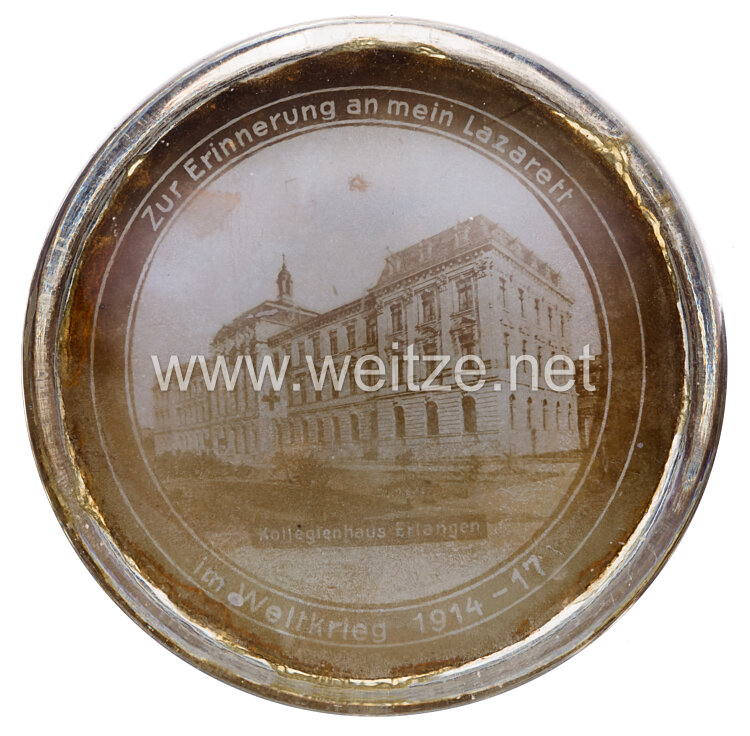
World War I Paperweight “In Memory of My Lazarett in the World War 1914-17 - Kollegienhaus Erlangen”
This glass paperweight from the First World War bears the inscription “In Memory of My Hospital During the World War 1914-17 - Kollegienhaus Erlangen” and represents a significant testament to German military hospital history during the Great War. With a diameter of 67mm and an embedded photograph, this object exemplifies the culture of remembrance that developed among medical personnel, doctors, and nurses.
The Kollegienhaus in Erlangen was, like many public buildings, schools, and university structures in the German Empire during World War I, converted into a military hospital. The city of Erlangen, known for its Friedrich Alexander University, played an important role in the medical care of wounded soldiers. The Kollegienhaus, originally a university building, served as a reserve hospital from 1914 until at least 1917.
The organization of military hospitals during the First World War presented an enormous logistical challenge. The German Empire had to care for millions of wounded and sick soldiers. In addition to field hospitals at the front, numerous reserve hospitals were established in the hinterland. These were frequently located in requisitioned public buildings, hotels, schools, and spa facilities. Erlangen, as a university city, possessed medical expertise and suitable facilities.
Such paperweights were popular memorabilia and keepsakes from the war years. They were often commissioned as personal souvenirs or given as farewell gifts. Production was carried out by specialized craftsmen who embedded photographs under convex glass. The photograph might show the hospital building itself, the staff, patients, or symbolic motifs.
The temporal limitation “1914-17” on this piece is noteworthy. It suggests that the owner either ended their service in 1917, was transferred, or that the hospital itself was reorganized. Many members of the medical service collected such mementos as testimony to their service time and their important humanitarian work under the most difficult conditions.
The medical service of World War I faced unprecedented challenges. Modern warfare with artillery, machine guns, and poison gas caused casualties on an unprecedented scale. Simultaneously, medical advances such as improved surgical techniques, antisepsis, and X-ray diagnostics enabled higher survival rates. Hospitals like the one in Erlangen were part of a tiered system: the wounded were first treated in field hospitals, then transported to war hospitals, and finally to reserve hospitals in home territory.
The nursing staff in these facilities often belonged to nursing associations such as the Red Cross, the Patriotic Women's Association, or religious orders. Additionally, doctors who were exempted from front service or considered too old for field deployment served, along with volunteer helpers. The work was physically and psychologically demanding, characterized by long shifts, scarce resources, and the daily sight of human suffering.
Erlangen itself developed into an important hospital location during the war. Besides the Kollegienhaus, additional buildings were requisitioned. The university provided medical personnel and training capacities. The civilian population supported the hospitals through donation campaigns and voluntary assistance.
Such memorabilia gained additional significance after the war's end. In a time marked by mourning, defeat, and social upheaval, they served as material anchors for personal memories. They documented individual contributions to the war effort and the experiences of a generation profoundly changed by the war.
Today, such objects are important historical sources. They complement official documents and statistics with personal perspectives. For military historians, medical historians, and local researchers, they offer insights into the everyday history of World War I beyond the battlefields. They remind us that the war was sustained not only by fighting soldiers but also by countless people in medical service whose work saved lives and alleviated suffering.