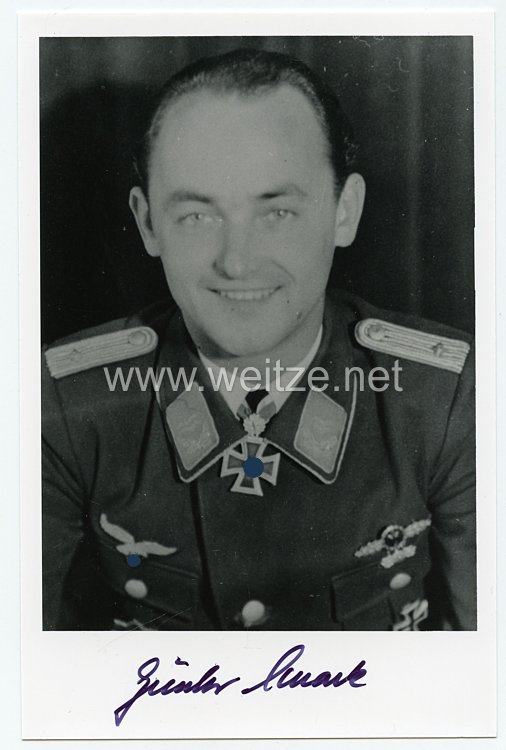
Luftwaffe - Post-War Signature of Knight's Cross with Oak Leaves Recipient Günther Schack
This post-war signature of Knight's Cross with Oak Leaves recipient Günther Schack on a photograph represents a typical example of military-historical collector's items from the period after World War II. Such signed photographs were generally created decades after the war's end, when former members of the Wehrmacht provided autographs for collectors and history enthusiasts at veterans' meetings or through private correspondence.
Günther Schack was born on November 5, 1917, in Mühlhausen and developed into one of the most successful fighter pilots of the Luftwaffe during World War II. His military career began after joining the Luftwaffe in 1936. Following his training as a fighter pilot, he was assigned to various units and initially gained combat experience on the Western Front.
However, Schack flew his most notable missions on the Eastern Front, where he achieved the majority of his confirmed aerial victories. He served in Jagdgeschwader 51 and later in Jagdgeschwader 3, both elite units of the German fighter force. By war's end, Schack had recorded 174 confirmed aerial victories, making him one of the most successful German fighter pilots of the war.
For his exceptional flying achievements, Schack received the Knight's Cross of the Iron Cross on July 8, 1942. This highest decoration of the German Reich was only awarded to soldiers who distinguished themselves through particular bravery or outstanding military leadership. The Knight's Cross was awarded in various grades during the war, with higher grades being distinguished by additional emblems.
On July 26, 1944, Schack was decorated with the Oak Leaves to the Knight's Cross, the second-highest grade of this decoration. The Oak Leaves, worn as a silver emblem, were awarded only 882 times during the entire war and marked exceptional military achievements far beyond the level of the basic Knight's Cross.
After the war's end, Schack survived the capitulation and returned to civilian life. Like many former Luftwaffe pilots, he became part of a veterans' community in the post-war period that held regular meetings and engaged in historical reappraisal. In this context, numerous signed photographs and other memorabilia were created, which today represent important contemporary historical documents.
The collecting of autographs from former military personnel developed into a widespread hobby, particularly from the 1970s onwards. Veterans like Schack were frequently contacted by collectors who sent photographs for signing. This practice was common in Germany but also internationally. The photographs usually showed the bearer in uniform, often with visible decorations, or in connection with their aircraft.
The historical significance of such signed photographs lies less in their material value than in their documentary worth. They connect the personal level of an eyewitness with the major historical events of World War II. For military-historical research, they provide starting points for biographical research and for examining commemorative culture.
The format of 9.7 x 14.7 cm corresponds to a common postcard format frequently used for such signed memorabilia. The stated condition 1 indicates excellent preservation, which is particularly remarkable for paper objects from this period.
Günther Schack died on February 14, 2003, at the age of 85. His signed photographs from the post-war period are now sought-after collector's items that not only document the person of the pilot but also reflect, as contemporary documents, the engagement with German military history in the second half of the 20th century. They serve historical research as authentic primary sources and help reconstruct the biographies of those involved and place them in the larger historical context.