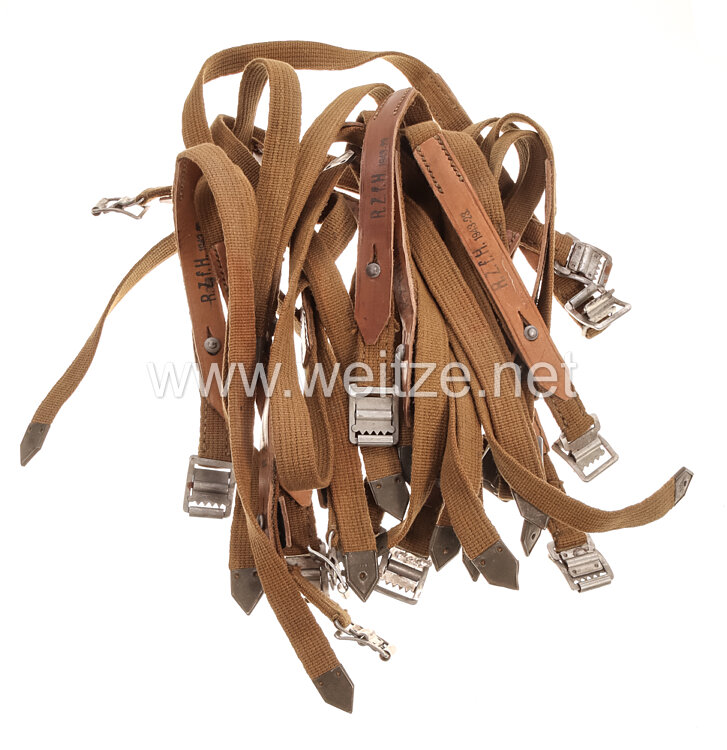
Wehrmacht Backpack Straps in Tropical Pattern
Condition may vary.
Price per piece: 75 Euro.
The Wehrmacht Tornisterriemen in Tropical Execution represents a characteristic piece of equipment used by German forces during World War II, specifically developed for deployment in North African and Southern European theaters of war.
From 1941 onwards, German armed forces faced the necessity of adapting their standard equipment to the extreme climatic conditions of desert and tropical regions. The Deutsche Afrikakorps, dispatched to Libya under General Erwin Rommel in February 1941, required equipment capable of withstanding high temperatures, intense solar radiation, and sandy conditions.
This backpack strap differs from standard issue equipment through its material composition. While regular Wehrmacht equipment was predominantly manufactured from brown or black leather, the tropical version consisted of olive-colored linen with leather reinforcements at particularly stressed points. This material combination offered several advantages: linen was lighter than full leather, dried faster after becoming wet, and was more comfortable to wear in scorching heat. The leather reinforcements at buckles and attachment points nevertheless ensured the necessary durability and functionality.
The marking “R.Z.f.H. 1943-23” refers to the Reichs Zentrale für Handwerkslieferungen (Reich Central Office for Craft Deliveries), an organization that coordinated the production and distribution of equipment items during the war. This designation enables precise dating of the piece to 1943, a time when the Wehrmacht was fighting in North Africa, on the Eastern Front, and in the Mediterranean region. The year 1943 falls within a critical phase of the African campaign: in May 1943, German-Italian troops capitulated in Tunisia, marking the end of hostilities in North Africa.
The Tornister itself was the Wehrmacht soldier's backpack, used to transport personal items, rations, and additional equipment. The Tornisterriemen served to attach the backpack to the belt and distribute weight across the soldier's shoulders. A well-adjusted carrying system was essential for troop mobility, especially under the arduous conditions of the desert.
Production of tropical equipment followed specific guidelines from the Army Administration. The olive-green or sand-colored dye served not only practical purposes of camouflage in desert environments but was also part of comprehensive tropical uniform and equipment regulations. The conversion to tropical versions affected nearly all equipment items, from uniforms to headgear to carrying systems and belts.
The use of linen as the primary material also reflects increasing resource shortages in the German Reich. Leather became increasingly scarce as the war progressed, and alternative materials had to be found. The textile industry could provide the required quantities more readily than leather processing. These economic constraints led to innovative solutions in equipment manufacturing.
Tropical equipment was not used exclusively in North Africa. After the capitulation in Tunisia, corresponding equipment pieces were also employed in the defense of Italy, in the Balkans, and in southern regions of the Eastern Front, where climatic conditions in summer could be similarly demanding.
The preservation of such equipment pieces today holds significant historical value. They document not only the military logistics and material economy of World War II but also the adaptability of armies to different operational conditions. The Condition 2 designation indicates a well-preserved example that shows typical signs of use from field deployment but has remained structurally intact.
For collectors and historians, such objects offer authentic insights into soldiers' daily lives and the material culture of the Wehrmacht. The clear marking and dating enables precise historical classification and makes the piece a valuable study object for military history research.