WHW - Reichsstrassensammlung No. 001b, October 1933

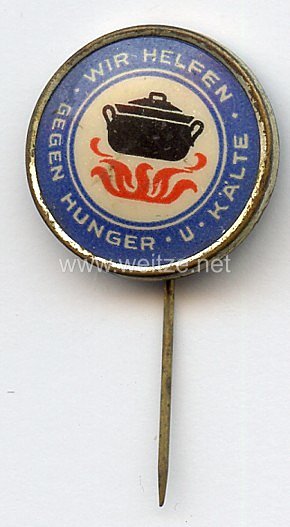
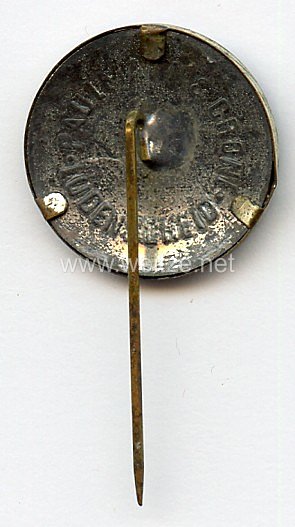
“We Help Against Hunger and Cold”, tinplate badge with colored paper image covered with celluloid, maker: Paulmann & Crone Lüdenscheid, on long pin, condition 2.
304933
40,00

WHW - Reichsstrassensammlung No. 001b, October 1933

The Winterhilfswerk (WHW), or Winter Relief Organization, represented one of the most extensive National Socialist propaganda organizations and played a central role in the regime's social-political staging. The badge described here from the Reich Street Collection No. 001b of October 1933 represents one of the earliest examples of these systematic donation campaigns initiated immediately after the Nazi seizure of power.

The Winter Relief Organization of the German People was officially established on September 13, 1933, through an appeal by Adolf Hitler, although similar relief organizations had already existed during the Weimar Republic. The slogan “We Help Against Hunger and Cold” embodied the organization's propagandistic core promise: the National Socialist “Volksgemeinschaft” (people's community) would care for its needy members. The first collection period began as early as October 1933, confirming the temporal classification of this badge.

The technical execution of the object is characteristic of early WHW badges. It consists of a tinplate badge with a colored paper image protected by a celluloid layer. This construction was typical for the cost-effective mass production necessary to manufacture millions of badges. The manufacturer Paulmann & Crone from Lüdenscheid was among the significant producers of WHW badges. Lüdenscheid had already established itself as a center of German metal industry in the 19th century and was therefore predestined for manufacturing such mass-produced items.

The Reich Street Collections were systematically organized donation campaigns in which voluntary and often pressured collectors went through the streets with collection boxes. In return for a donation, citizens received a small badge to be worn visibly on their clothing. This served a dual purpose: on one hand, it was “proof” of the donation made; on the other hand, it exerted social pressure on those not wearing a badge, who could be stigmatized as “community aliens.”

The numbering as “No. 001b” indicates that this belonged to the very first systematically catalogued collection campaigns. The “b” suggests a variant within the first collection series, typical of the early experimental phase with various designs and manufacturing processes.

The WHW quickly developed into a gigantic organization. Between 1933 and 1945, an estimated several billion Reichsmarks were collected. Participation was formally voluntary, but the social and later political pressure to participate was considerable. Employers kept lists of their employees' willingness to donate, and lack of engagement could have professional consequences.

The propaganda machinery under Joseph Goebbels skillfully used the WHW to stage the National Socialist “Volksgemeinschaft.” Prominent figures were enlisted for collections, elaborate advertising measures organized the campaigns, and the press reported extensively on the alleged successes. The badges themselves became sought-after collectibles, with various series featuring different motifs – from historical personalities to traditional costumes to fairy tale figures.

It should be critically noted that the actual use of collected funds often remained non-transparent. While undoubtedly some needy people were supported, considerable funds flowed into rearmament and other state purposes. The WHW was thus not merely a charitable organization but an integral instrument of National Socialist rule consolidation and war preparation.

From a military-historical perspective, these early WHW badges are of particular interest as they document the mobilization of the home front already in peacetime. They demonstrate how the Nazi regime from the very beginning integrated the civilian population into a system of obligations and control that would later become essential for the war economy.

The condition grade 2 (very good) of this exhibit is remarkable for a nearly 90-year-old object made from perishable materials such as paper and celluloid, indicating proper storage.