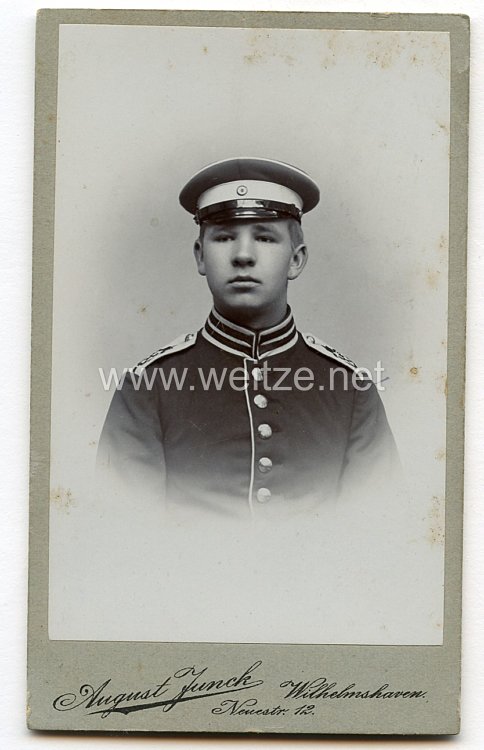
Photograph Imperial Navy: Naval Battalion Small Cabinet Photo of a Naval Infantry Soldier

in “Carte de Visite” format, photo studio in Wilhelmshaven, condition 2
346733
25,00

Photograph Imperial Navy: Naval Battalion Small Cabinet Photo of a Naval Infantry Soldier

Historical Context: Cabinet Photograph of a Sea Soldier of the Imperial Sea Battalion

This carte de visite format photograph of a sea soldier from the Imperial Sea Battalion (Kaiserliches Seebataillon), taken in a photographic studio in Wilhelmshaven, represents a fascinating aspect of German naval history from the late 19th and early 20th centuries.

The Sea Battalion of the Imperial Navy

The Sea Battalion (Seebataillon) was founded in 1852 as part of the Prussian Navy and represented a unique type of military unit that combined both naval and infantry capabilities. After the founding of the German Empire in 1871, it was integrated into the Imperial Navy (Kaiserliche Marine). The sea soldiers were specially trained naval infantrymen who could be deployed both aboard warships and on land. They undertook guard and security duties on ships, formed landing parties for amphibious operations, and served in German colonial territories.

The main responsibilities of the Sea Battalion included protecting German interests overseas, suppressing uprisings in the colonies, and reinforcing ship crews in combat. The Sea Battalion became particularly well-known for its deployments during the Boxer Rebellion in China (1900-1901) and in the African colonies, especially during the Herero Uprising in German Southwest Africa.

Wilhelmshaven as a Naval Base

The fact that this photograph was taken in Wilhelmshaven is of particular significance. Wilhelmshaven was founded in 1869 as Germany's first naval port on the North Sea and was named after the Prussian King Wilhelm I. The city rapidly developed into the most important naval base of the German Empire on the North Sea coast. It housed not only extensive shipyard facilities and naval arsenals, but also barracks and training facilities for various naval units, including the Sea Battalion.

Numerous photographic studios were located in Wilhelmshaven, specializing in military portraits. These studios profited from the large number of naval personnel who wanted to be photographed in uniform – whether as a memento for family, as a gift for relatives, or simply out of pride in their membership in the Imperial Navy.

The Tradition of Cabinet Photography in the Military Context

The carte de visite format, patented in the 1850s by French photographer André Adolphe Eugène Disdéri, revolutionized portrait photography. These small photographs, typically about 6 x 9 cm in size and mounted on cardboard, became extremely popular and developed into an important medium of self-representation. In the military context, these photographs acquired special significance: they served as visual documentation of service time, as testimony of belonging to a prestigious unit, and as personal mementos.

Soldiers and sailors typically had themselves photographed in their parade uniforms, with the photographic staging following certain conventions. The photographs were usually made in professional studios that had appropriate props and backgrounds. The uniforms were carefully arranged to make rank insignia, decorations, and unit badges clearly visible.

The Uniform and Equipment of the Sea Battalion

Members of the Sea Battalion wore a characteristic uniform that combined elements of naval and infantry dress. The parade uniform typically consisted of a dark blue jacket with characteristic collar patches and cuff facings, matching trousers, and headgear that could vary depending on the period and occasion – from the sailor's cap with its distinctive collar to the Tschapka (a tall helmet with a spike).

The uniforms of the Sea Battalion underwent several changes over time, regulated by various uniform regulations. The trim and insignia in particular made it possible to identify rank, company affiliation, and any overseas deployments.

Social and Cultural Significance

Such photographs had an important social function in the German Empire. Military service, especially in the prestigious Navy, signified social advancement and was displayed with pride. The photographs were kept in family albums, sent to relatives and friends, or arranged in special collecting albums. They documented not only individual biography but also reflected the militaristic culture of the Empire.

Today, such photographs are important historical sources for military, social, and cultural history. They provide insights into uniform studies, the everyday culture of the military, and the visual self-representation of soldiers in the Wilhelmine era. For collectors and historians, they represent authentic testimonies of a bygone era that are particularly valuable due to their attention to detail and documentary character.

r