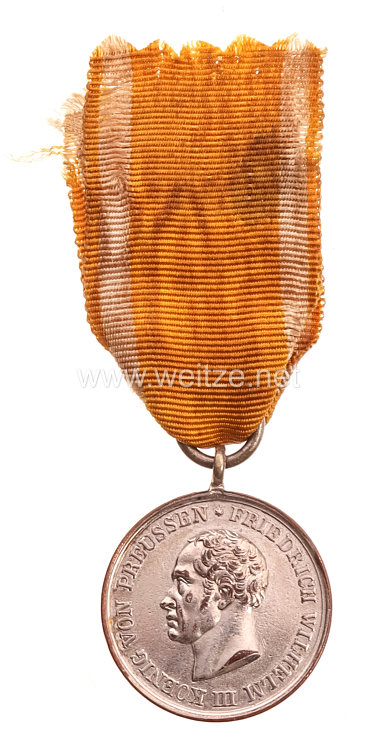
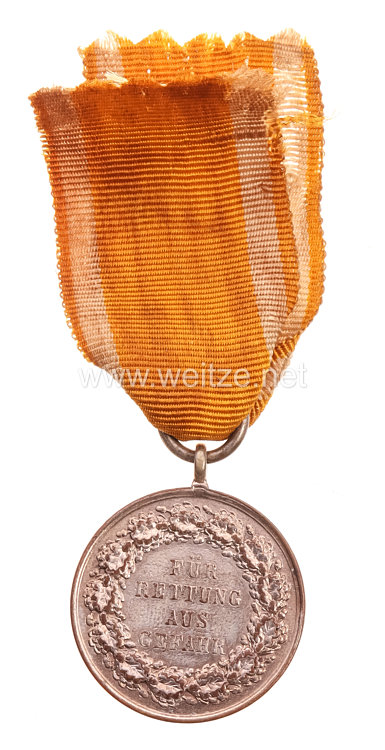
Prussian Merit Honor Decoration "For Rescue from Danger"

Version with "Koenig" (King), silver-plated, on long original ribbon, condition 2
444432
200,00

Prussian Merit Honor Decoration "For Rescue from Danger"

The Prussian Merit Honor Badge “For Rescue from Danger” (Verdienst-Ehrenzeichen "Für Rettung aus Gefahr") represents a significant decoration of the Kingdom of Prussia, awarded for exceptional acts of rescue. This decoration embodies Prussian values of courage, selflessness, and civic duty during an era when the kingdom was one of Europe's leading powers.

The establishment of this award was authorized by King Friedrich Wilhelm III on October 29, 1833. The monarch recognized the necessity of honoring civilians who risked their own lives to rescue others from mortal danger. This was part of a broader 19th-century development in which European states increasingly acknowledged civic merit alongside military achievements.

The honor badge was awarded in two classes: a higher class in gold and a second class in silver. The present example bearing the inscription “König” (King, rather than “Kaiser” or Emperor) clearly dates the decoration to the period before the founding of the German Empire in 1871, or refers to the continuation of traditional Prussian designations even after the empire's establishment in certain contexts.

The design of the honor badge follows classical Prussian traditions. The silver-plated medallion typically displays the royal crown on the obverse along with the characteristic inscription. The reverse usually bears the dedication “Für Rettung aus Gefahr” (For Rescue from Danger), clearly communicating the reason for the award. The medal was worn on the original ribbon, whose colors reflected the Prussian state colors of black and white.

The award criteria were strictly defined. The honor badge was exclusively granted to individuals who had rescued other people from imminent mortal danger at the risk of their own lives. This could include rescues from fire, water, collapses, or other life-threatening situations. Each case was individually examined, and it had to be proven that the rescuer had actually assumed considerable personal danger.

Unlike military decorations, the Merit Honor Badge was open to all social classes, regardless of rank or profession. Craftsmen were honored alongside officials, farmers alongside city dwellers. This democratic component was remarkable for hierarchically structured Prussian society and underscored the universal value of human bravery.

The historical significance of this award extends beyond its immediate function. It documents the growing awareness of the Prussian state for civic virtues and the recognition of individual heroic acts outside the military context. In an era marked by wars and military conflicts, this decoration set an important marker for the value of civilian courage.

After the founding of the German Empire in 1871, Prussia, as the largest federal state, retained its own decorations, including the rescue honor badge. The awarding practice continued, with administrative processing becoming increasingly professionalized. Detailed records of awards were maintained, which today represent important historical sources.

The manner of wearing was precisely regulated. The honor badge was worn on the left breast on the ribbon, with the gold class taking precedence over the silver class. Bearers were permitted to wear the decoration at official occasions and celebrations, which brought them public recognition and respect.

The end of the Kingdom of Prussia in 1918 also meant the end of new awards of this honor badge. The Weimar Republic created its own rescue decorations, but the Prussian original remained of particular interest to collectors and historians. It represents an important aspect of Prussian social and administrative history.

Today, originally preserved examples of this honor badge are sought-after collectibles that provide insight into the Prussian order landscape. The state of preservation, the authenticity of the ribbon, and the precision of the striking are important factors for collectors and historians. Such pieces serve not only as material witnesses but also tell stories of courage and selflessness of ordinary people in extraordinary situations.

The silvered execution indicates the second class of this decoration, though it remained a prestigious award that brought its bearer considerable social recognition. The fact that it was awarded “with long original ribbon” emphasizes its authentic character and proper presentation according to contemporary regulations.