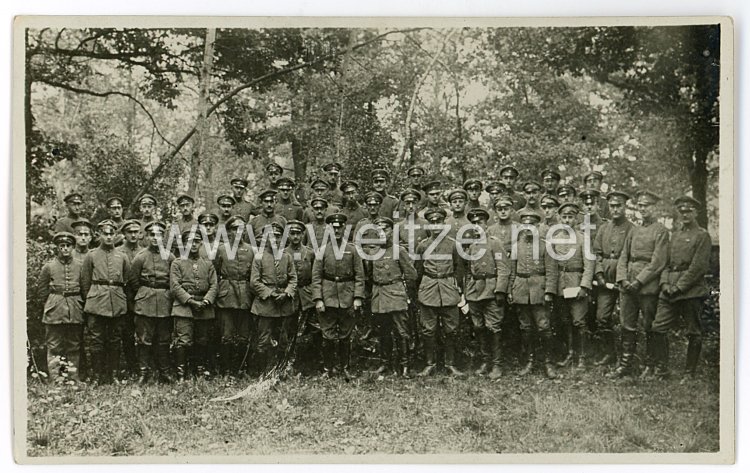
German Army Group Photograph
The German Army group photograph in postcard format represents a significant aspect of military culture and documentation during the first half of the 20th century, particularly during the era of World War I (1914-1918), the Weimar Republic, and the period of World War II (1939-1945).
The tradition of military photography developed rapidly in the late 19th century as photographic techniques became more accessible and affordable. The postcard format, standardized at approximately 9 x 14 cm, established itself as an ideal medium for personal correspondence and memorabilia. For soldiers of the German Army, such photographs became important connections between the front and home.
Group photographs of military units served multiple purposes. Primarily, they documented the composition of companies, platoons, or other military formations at a specific point in time. They strengthened esprit de corps and camaraderie among soldiers and provided families at home with visual testimony of their relatives' military experience. Photographers, both military and civilian, regularly operated in barracks, training camps, and even areas near the front lines.
The uniform and equipment details visible in such photographs often enable chronological classification. The German Army underwent several significant uniform reforms. During World War I, there was a transition from colorful peacetime uniforms to field-gray combat uniforms. The Pickelhaube, the characteristic leather helmet with spike, was replaced in 1916 by the more practical Stahlhelm M1916, which became the iconic symbol of the German soldier.
During the Weimar Republic (1919-1933), the German Army was limited to 100,000 men by the Treaty of Versailles and was known as the Reichswehr. Photographs from this era often show smaller, more professional units with modernized uniforms. After 1935, with rearmament under the National Socialist regime, the military, now designated as the Wehrmacht, expanded dramatically.
Photographic practice in the military was regulated. Official photographers had to maintain certain standards, and the distribution of images was subject to military censorship, especially during wartime. Nevertheless, private photographs were widespread, and many soldiers owned their own cameras or had themselves photographed by local photographers.
The postcard format was particularly practical as it could serve both as a photograph and as a medium for correspondence. Often the backs were inscribed with personal messages and sent to family members. These documents today offer valuable insights into the personal experiences, emotions, and everyday realities of soldiers.
For collectors and historians, such photographs are invaluable. They document not only military equipment and uniforms but also social structures, hierarchies, and the diversity of persons serving in the German Army. Details such as rank insignia, unit emblems, decorations, and weapons can contribute to the identification of specific units and time periods.
The used condition of such photographs is typical and often lends them additional historical authenticity. Signs of wear, discoloration, or inscriptions testify to their actual use and personal significance for their original owners. Many of these photographs were preserved in family albums for decades and are important components of commemorative culture.
The preservation of such military-historical documents is of great importance for understanding German military history and the life experiences of ordinary soldiers. They complement official military records and offer a more human, personal perspective on historical events that shaped entire generations.