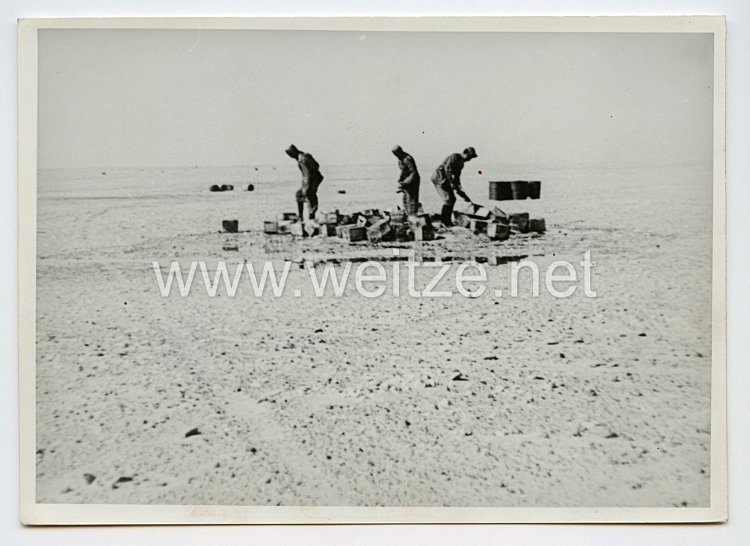
Wehrmacht Press Photograph: Members of the Deutsches Afrikakorps

Dimensions approximately 18 x 13 cm, verso without inscription, condition 2.
402431
15,00

Wehrmacht Press Photograph: Members of the Deutsches Afrikakorps

The Wehrmacht press photograph at hand documents members of the German Afrika Korps (DAK) and belongs to a category of visual material produced during World War II for press reporting and propaganda purposes. With its dimensions of approximately 18 x 13 cm, it corresponds to the standard format used by the Wehrmacht's Propaganda Companies for distribution to newspapers, magazines, and news agencies.

The German Afrika Korps was established in February 1941 as an expeditionary corps of the Wehrmacht to support Italian allies in North Africa. Under the command of Lieutenant General Erwin Rommel, who was later promoted to Field Marshal, the DAK operated primarily in Libya and Egypt between 1941 and 1943. The unit became legendary, and its commander earned the nickname “Desert Fox” due to his tactical abilities in desert warfare.

The Wehrmacht's Propaganda Companies (PK - Propaganda-Kompanien) were specialized units tasked with documenting military operations. These companies consisted of trained photographers, cameramen, journalists, and artists who operated at the front lines. Several PK units were assigned to the Afrika Korps for the North African campaign, including PK 621 and PK 680. Their mission was to produce visual material that could be used for both press reporting and propaganda purposes.

Photographs were typically produced in multiple prints and marked with stamps, captions, and censorship numbers. The absence of any inscription on the reverse of this specimen could indicate that it is a work print, an archive copy, or a photograph intended for personal use. Many press photos were also reprinted after the war from original negatives without the official stamps.

Life for soldiers in the Afrika Korps was characterized by extreme conditions. The scorching temperatures of the North African desert, often exceeding 50 degrees Celsius, presented an enormous challenge. Water shortages, sandstorms, and the great distance from supply bases in Europe made logistics a constant problem. Soldiers wore special tropical uniforms in olive-green or sand-colored versions that were better suited to the climate than the Wehrmacht's standard uniform.

Photographically, certain motifs were frequently preferred: portraits of soldiers in characteristic tropical uniforms, tank crews with their vehicles, scenes of desert life, and combat action. The images were intended to convey the bravery, comradeship, and fighting spirit of German troops while simultaneously documenting the harshness of conditions. Many of these photographs were published in magazines such as the “Berliner Illustrirten Zeitung,” “Signal,” and other publications.

The North African campaign reached its peak in the summer of 1942 when Rommel's troops advanced to El Alamein in Egypt, only 100 kilometers from Alexandria. The Battle of El Alamein in October and November 1942, however, marked the decisive turning point. The British 8th Army under General Bernard Montgomery defeated the Afrika Korps, which had to retreat westward in a long withdrawal. In May 1943, the last German-Italian troops surrendered in Tunisia, ending the North African campaign.

Today, such press photographs have significant historical and collectible value. They serve as important primary sources for historians researching the North African campaign and offer visual insights into the daily lives of soldiers, their equipment, and the circumstances under which they fought. Museums such as the Imperial War Museum in London, the Bundesarchiv in Koblenz, and the National Archives in the United States preserve extensive collections of such photographs.

Caution is advised when evaluating and collecting Wehrmacht press photos, as modern reproductions also exist. Original period photographs exhibit typical characteristics such as the characteristic paper quality of the 1940s, age-related yellowing, development traces, and often archive stamps or handwritten notes. The indicated condition grade 2 suggests a well-preserved specimen with minimal signs of use.

r