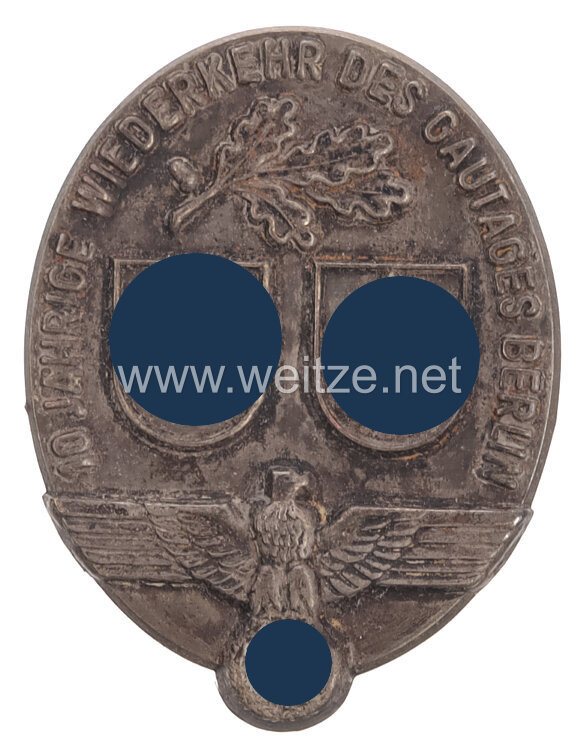
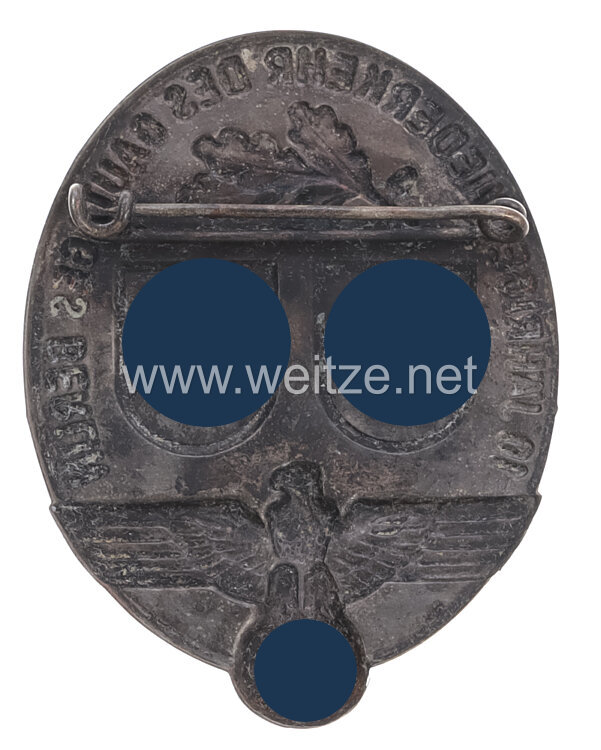
SS / SA - 10th Anniversary of the Gautag Berlin

Tinplate badge, with pin fastener, condition 2.
453431
320,00

SS / SA - 10th Anniversary of the Gautag Berlin

This tin badge commemorating the 10th Anniversary of the Gautag Berlin represents a significant chapter in the organizational history of the National Socialist movement. This type of badge was issued on the occasion of the jubilee of the Gautag in Berlin, a central event of the NSDAP Gau organization in the Reich capital.

The Gaue (districts) formed the most important regional administrative units of the NSDAP. Berlin as a Gau had special significance, as it was both the Reich capital and the seat of the supreme party leadership. The Gautag was an annual major event at which the party organization demonstrated its strength, political speeches were delivered, and the local party leadership presented its achievements.

The connection between the SS (Schutzstaffel) and SA (Sturmabteilung) on this badge is historically interesting. The SA, founded in 1921, was the paramilitary combat organization of the NSDAP during the Weimar Republic and played a decisive role in the party's rise to power. The SS, originally founded in 1923 as an elite unit and reformed in 1925 as Hitler's bodyguard, developed under Heinrich Himmler from 1929 into a powerful organization within the Nazi state.

The relationship between the SA and SS was complex and not free of tensions. After the so-called Röhm Affair of June 30, 1934, also known as the “Night of the Long Knives,” in which the SA leadership around Ernst Röhm was liquidated, the SA lost considerable influence while the SS rose to become the dominant formation. The joint mention on this badge suggests an event at which both organizations still or again appeared together.

Such tin badges were a characteristic feature of National Socialist commemorative culture and propaganda. They were produced in large quantities and distributed on various occasions: party rallies, Gautage, sporting events, anniversaries, and other political events. The badges served several purposes: they were participant badges, souvenirs, and simultaneously propaganda tools. Wearing such badges demonstrated allegiance to the movement and participation in important events.

The technical execution as a tin badge with pin fastening was typical for the period. These badges were generally manufactured from stamped and embossed sheet metal, often enameled or painted to display various color elements. The mass production of such badges was part of the comprehensive penetration of public space with National Socialist symbolism.

Gau Berlin held a special position in the Nazi hierarchy. Joseph Goebbels became Gauleiter of Berlin in 1926 and used this position to make the capital a stronghold of the NSDAP. The Berlin Gautage were correspondingly large propaganda events, often held at the Sportpalast or other large assembly venues. At such events, SA and SS formations marched, speeches were delivered, and participants frequently received commemorative badges like the present one.

The formulation “10-year anniversary” indicates a jubilee celebrated ten years after a significant event or the founding of the Gautag in Berlin. Such anniversaries were important occasions for Nazi propaganda to emphasize the supposed historical continuity and success of the movement.

From today's perspective, such badges are important historical documents that provide insight into the organizational structures, propaganda methods, and commemorative culture of National Socialism. They are preserved in museums, archives, and collections and serve historical research and education. Handling such objects requires historical sensitivity and critical contextualization, as they were part of a criminal system responsible for World War II and the Holocaust.