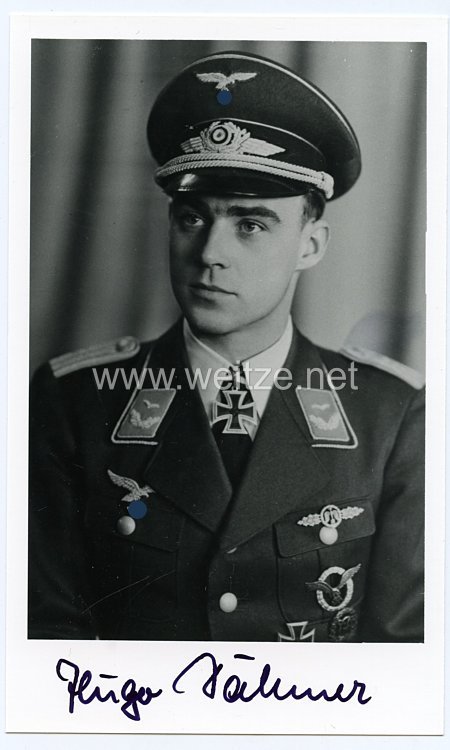
Luftwaffe - Post-War Signature of Knight's Cross Recipient, Hugo Dahmer
This postwar signature of Knight's Cross recipient Hugo Dahmer on a photograph represents a fascinating collector's item from the category of military historical autographs. Hugo Dahmer was a significant Luftwaffe fighter pilot during World War II, who was awarded the Knight's Cross of the Iron Cross on August 23, 1944.
Hugo Dahmer was born on October 20, 1919, and served during the war as Oberleutnant and Staffelkapitän in the famous Jagdgeschwader 3 “Udet”. He achieved 49 confirmed aerial victories during his active service, most of them on the Eastern Front. His military career was characterized by exceptional flying skills and tactical acumen, which made him one of the recognized fighter pilots of his unit.
The Knight's Cross of the Iron Cross was one of the highest military decorations of the German Reich and was awarded for extraordinary bravery in combat or outstanding military leadership achievements. The award was granted according to strict criteria and required personal approval from the highest leadership levels. During the entire war, approximately 7,300 members of the Wehrmacht received this prestigious decoration.
After the war's end, a significant collecting culture developed around autographs and photographs of former military personnel. Many veterans, including Knight's Cross recipients, signed photographs for collectors and military historians in the postwar period. This practice began as early as the 1950s and continued into the 1990s. The authenticity of such postwar signatures is generally well-documentable, as many of these signings occurred at veteran reunions or through direct correspondence with collectors.
The present photograph with dimensions of 8.7 x 14.3 cm corresponds to a common postcard format of the postwar period. Such formats were frequently used for collector autographs as they were handy and easy to archive. The indicated condition 1 suggests, according to standard collector nomenclature, an excellent state of preservation, which is of particular importance for historical documents of this type.
The historical classification of such autographs requires differentiated consideration. They primarily serve military-historical documentation and are important historical documents for research. Collectors and historians value these objects as personal connections to historical figures and as supplements to archival sources. A veteran's signature on a photograph represents a direct, tangible connection to history.
In academic examination, such autographs are of interest for prosopography, the study of collective biographies of historical persons. They complement military files, war diaries, and official documents with a personal dimension. Simultaneously, they document postwar history and society's handling of military past.
Authentication of postwar autographs is accomplished through various methods: comparison with known signatures, analysis of writing materials used, examination of provenance, and forensic investigations when necessary. Reputable dealers and auction houses place great importance on careful verification of the authenticity of such historical documents.
Hugo Dahmer survived the war and passed away on December 24, 1985. His postwar signatures are thus limited to a period of approximately 40 years, making them finite historical objects. For collectors of military-historical autographs, signatures of Knight's Cross recipients represent coveted collector's items due to their historical significance and relative rarity.
The collecting of military autographs exists within a complex framework of historical remembrance and documentation. While these items serve legitimate historical and educational purposes, they must be contextualized within broader historical narratives that acknowledge the full complexity of World War II history.