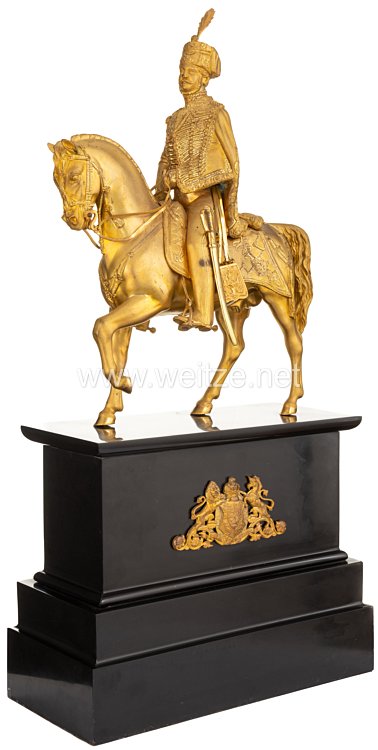
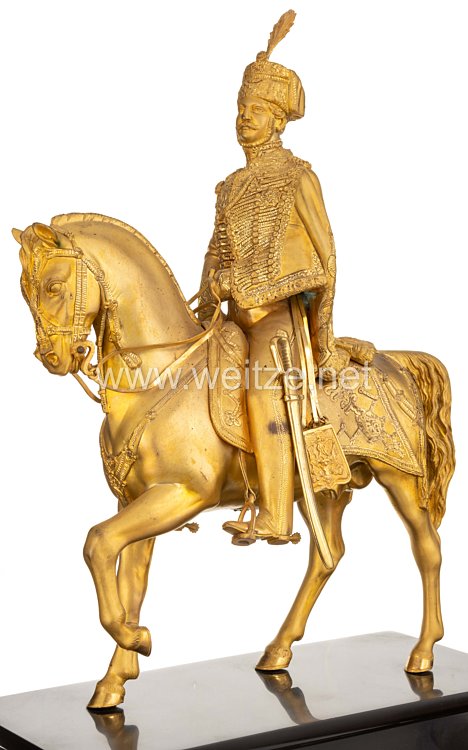
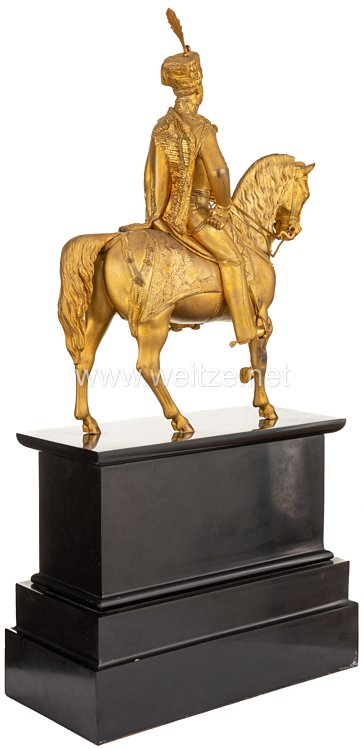
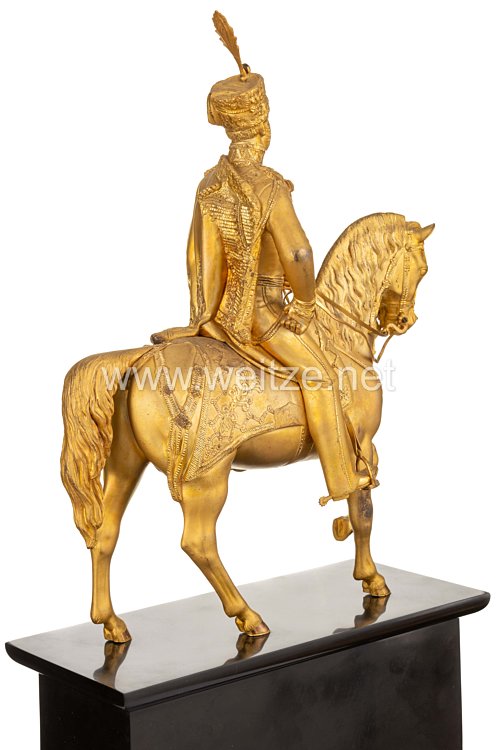
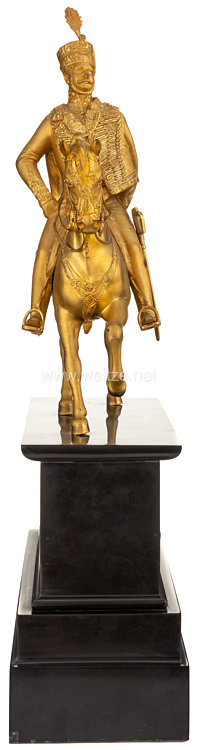
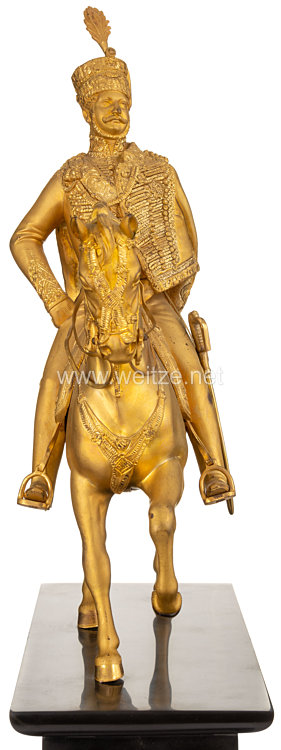
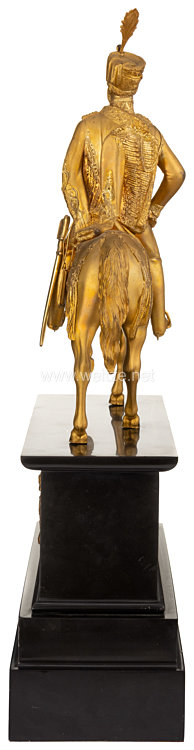
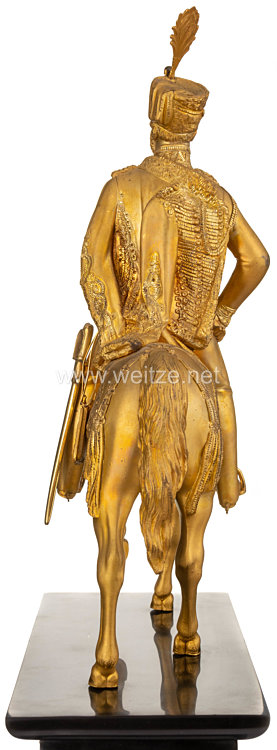
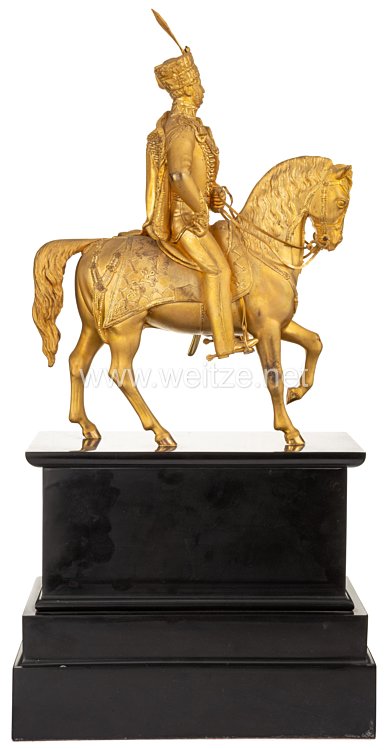
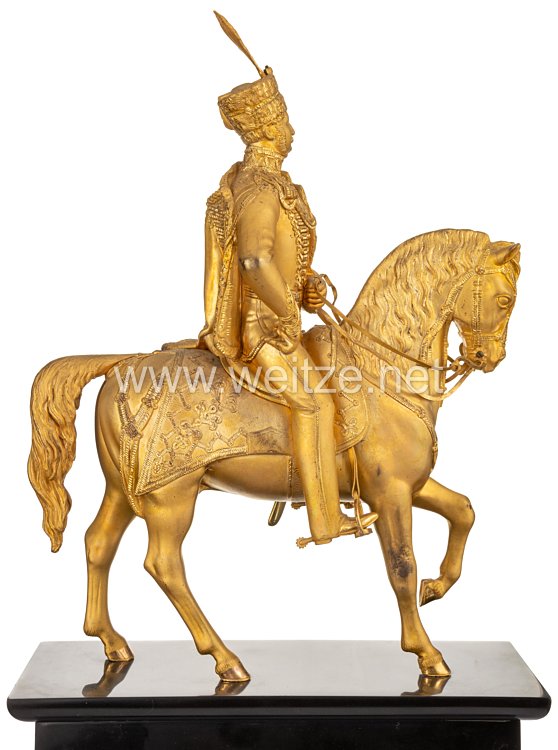
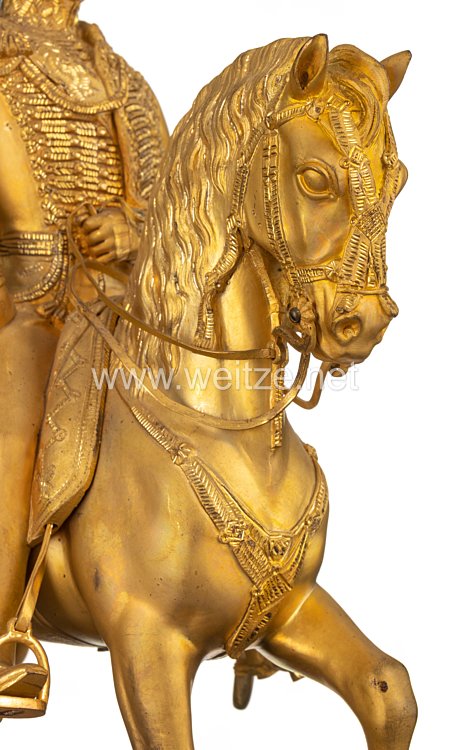
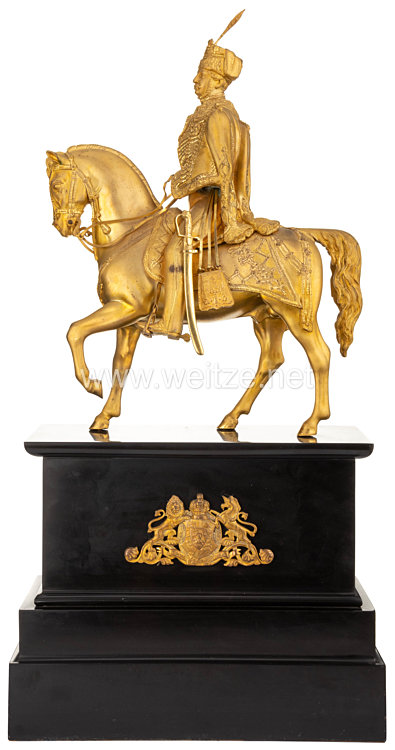
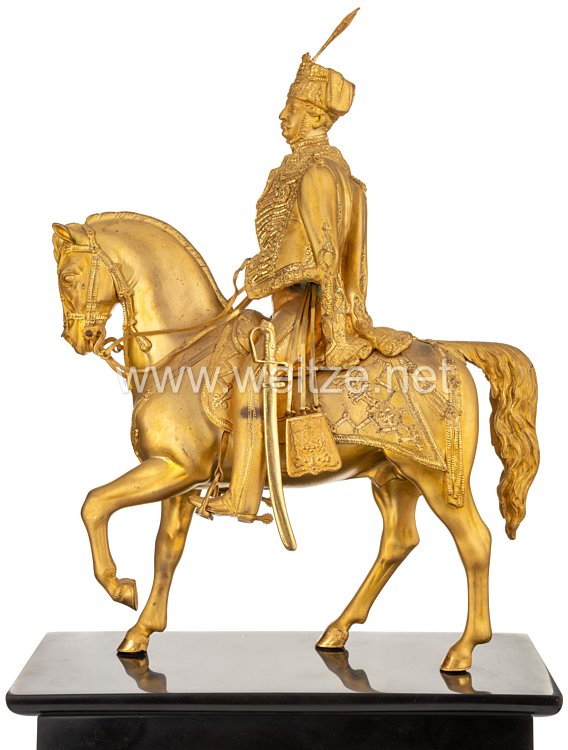
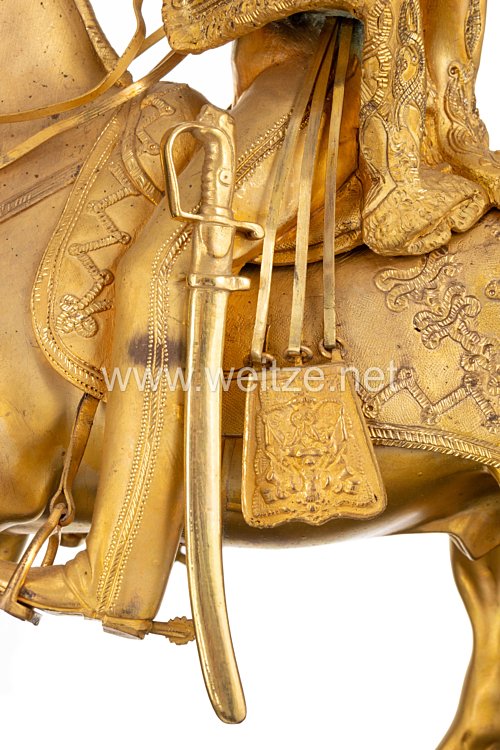
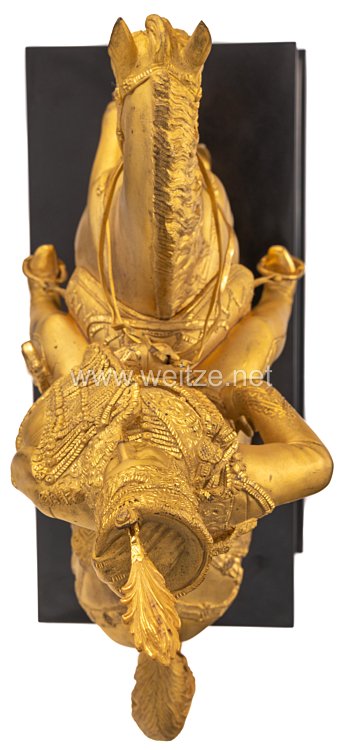
This magnificent gilded bronze equestrian statuette stands as one of the most remarkable surviving artifacts of the Kingdom of Hanover's court culture. Depicting King Georg V (1819–1878), the last monarch to rule Hanover before its annexation by Prussia, the work combines superb craftsmanship with profound dynastic symbolism, offering collectors an extraordinary window into the representational art of a 19th-century German royal court.
The Last King of Hanover
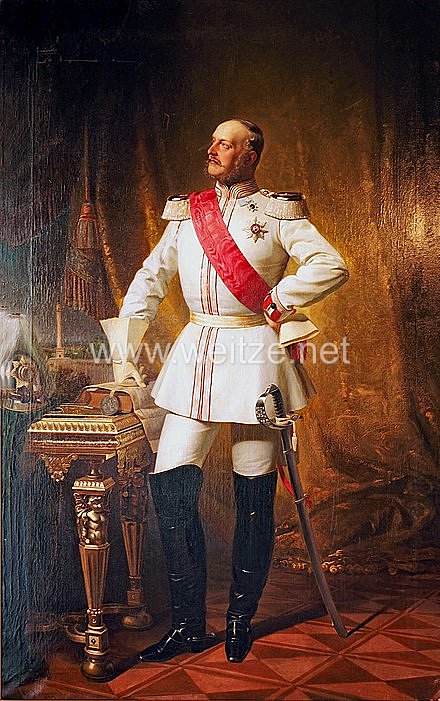
Georg V was born on 27 May 1819 in Berlin, the only son of King Ernst August I of Hanover. Tragedy struck early in his life: he lost the sight of one eye to disease and the other to an accident in 1833, becoming completely blind at the age of thirteen. Despite this severe disability, Georg V ascended to the Hanoverian throne in 1851 and ruled for fifteen years until the kingdom's dissolution.
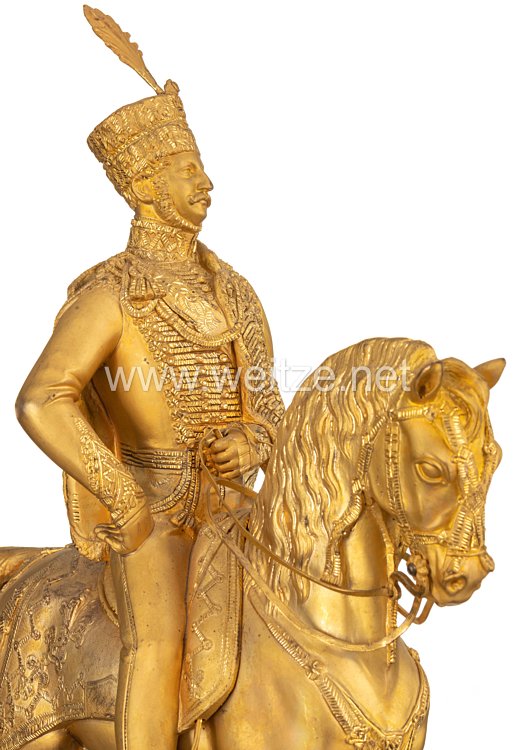
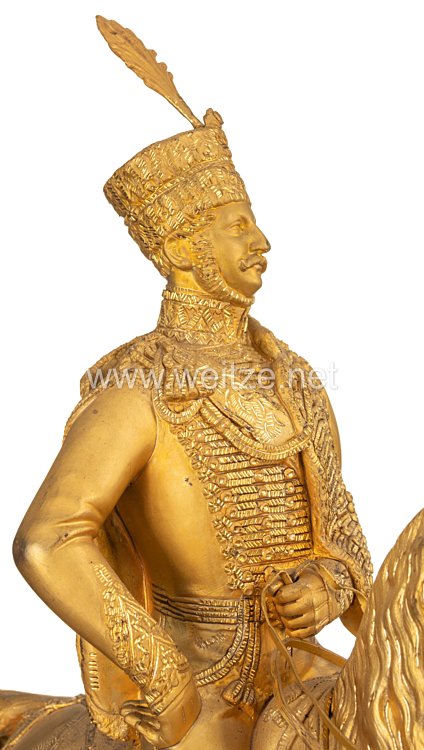
The statuette portrays the king in the uniform of Colonel of the Hanoverian Guard Hussars. The Guard Hussar Regiment had been re-established in 1838 during the reign of his father, Ernst August, and represented one of the most elite formations in the Hanoverian military. Georg V's depiction in this prestigious uniform speaks to the close bond between the sovereign and his guard troops.
Artistic Execution and Symbolic Details
The statuette is executed as a multi-part gilded bronze cast mounted on a black polished marble base. The extraordinary fineness of execution is evident throughout: the ornamentation of the pelisse (fur jacket), the shabraque (saddle cloth), and the sabretache are rendered with remarkable precision. The cipher “GR” (Georg Rex) appears on both the sabretache and shabraque, identifying the king's personal monogram. The monarch is shown wearing the breast star of the Hanoverian Order of St. George, emphasizing his role as sovereign of this house order.
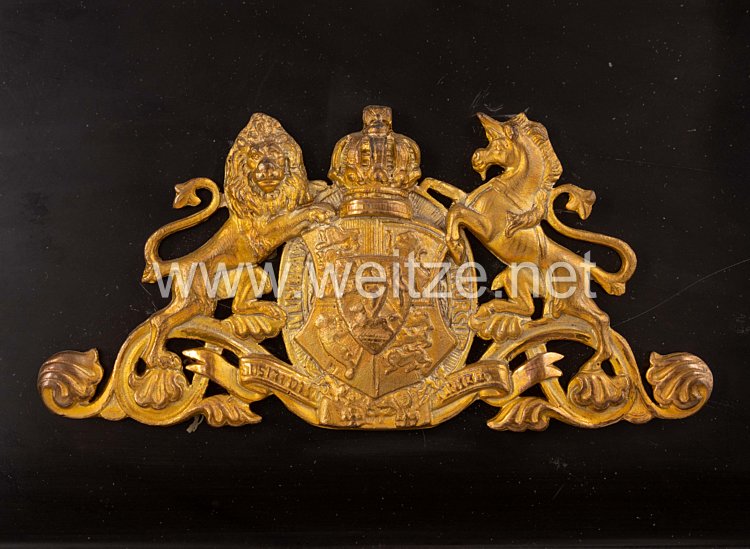
On the front of the marble base, the coat of arms of the Kingdom of Hanover is applied in gilded brass. The composition features the crown surmounting the main shield, flanked by a lion on the left and a unicorn on the right. Below appears the motto of the Order of St. George: “Nunquam retrorsum” – “Never backward.”
The Order of St. George
The Hanoverian Order of St. George was founded on 23 April 1839 by King Ernst August I, Georg V's father, as the House Order of the Crown of Hanover. Its motto, “Nunquam retrorsum,” embodied the Guelph dynasty's commitment to steadfastness and forward progress. The prominent display of this motto on the base of the statuette connects the king's portrait to the broader dynastic identity of the House of Hanover, making the piece not merely a portrait but a statement of royal legitimacy.
The Sculptor Heinrich Hesemann
A documented version of this equestrian statuette was created by the sculptor Heinrich Hesemann (1814–1856), who served as court sculptor to both King Ernst August and King Georg V. Hesemann's signed and dated version from 1855 was cast at the Bernstorff und Eichwede foundry in Hanover and bears the inscription “H. Hesemann fec. 1855. Bernstorff u. Eichwede fud.” This version is now held in the National Trust Collections at Osterley Park, London. Another similar version has been documented by The Armoury St James's. The 1855 Hesemann statuette is thought to be a maquette connected with a monumental equestrian statue of Ernst August that was completed in 1861 and still stands outside Hanover's main train station today.
The Fall of the Kingdom
The historical resonance of this statuette is deepened by the dramatic fate of the man it depicts. In the Austro-Prussian War of 1866, Georg V sided with Austria against Prussia and personally led his troops at the Battle of Langensalza. Although the Hanoverian forces achieved an initial victory, Georg V was ultimately compelled to surrender. In September 1866, Prussia annexed the Kingdom of Hanover, bringing to an end the centuries-old Guelph rule. Georg V spent the remainder of his life in exile, first in Austria and later in France, tirelessly seeking support for the re-establishment of his kingdom. He died in Paris on 12 June 1878. He was laid to rest in St George's Chapel, Windsor Castle – a poignant final connection to the British-Hanoverian dynastic ties that had shaped European history.
Significance for Collectors
This equestrian statuette brings together several qualities that make it an object of exceptional interest to collectors of military and royal memorabilia. The superb quality of the gilded bronze casting, the painstaking accuracy of the hussar uniform's details, the dynastic symbolism of the Hanoverian coat of arms and Order of St. George, and the intimate connection to the last ruler of a major German kingdom all contribute to its outstanding historical and artistic significance. As a witness to a vanished monarchy and a masterwork of 19th-century bronze art, it occupies a place of genuine museum-quality importance.