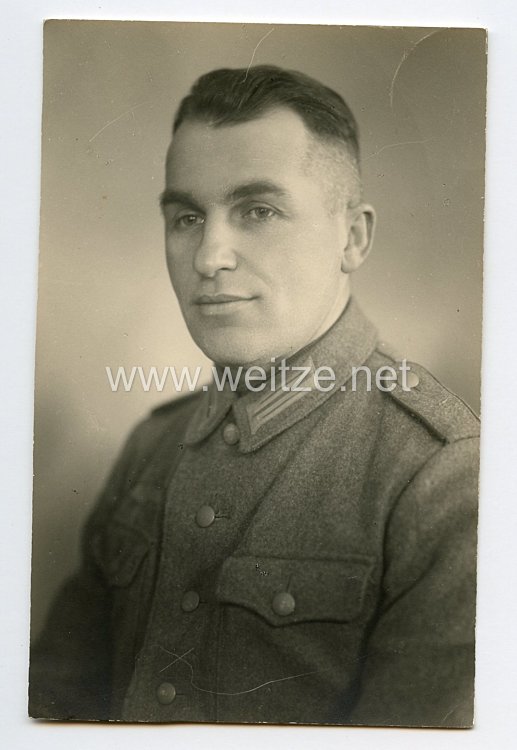
Wehrmacht Portrait Photograph, Army Soldier
The object in question is a Wehrmacht portrait photograph of an army soldier from the period of the Second World War (1939-1945). Such photographic documents represent important historical sources today, providing insights into the lives and appearance of German soldiers during this era.
Historical Context and Significance
Portrait photographs of Wehrmacht soldiers were widespread during World War II and served multiple purposes. Soldiers frequently had themselves photographed in uniform to send these images to family members, wives, fiancées, or friends. These photographs were intended to document military duty on one hand, while maintaining emotional connections to the home front on the other. In an age without digital communication, such portrait photos were often the only visual link between the front and home.
Photographic Practice in the Wehrmacht
Most of these photographs were taken in professional photo studios in garrison towns, larger cities in occupied Europe, or directly in field hospitals and troop quarters by mobile photographers. The postcard format (approximately 9 x 14 cm) was the standard format for such portrait shots, as it was practical to send and could be transported cost-effectively in the field post. The Wehrmacht maintained an extensive field postal system that transported millions of letters and postcards between the front and home daily.
Uniforms and Representation
Army soldiers typically wore their service uniforms in such photographs, often supplemented with visible rank insignia, branch colors, and possibly decorations. The army uniform underwent various modifications and simplifications during the war, due to material shortages and the necessity of mass production. Typical elements included the field-gray uniform (M36, M40, M43), peaked caps or field caps, and various badges identifying unit and rank.
Social Historical Significance
These photographs possess considerable social historical value today. They document not only military aspects but also personal fates. Millions of German soldiers served in the Wehrmacht, many of whom never returned. For their families, often only such photographs remained as final memories. The images frequently show young men from all social classes who were conscripted through universal military service.
Condition and Collector Aspects
The described specimen shows typical signs of use, including creases, which is not unusual for objects of this age and type of use. Such photographs were often kept in wallets, uniform pockets, or family albums and thus subjected to mechanical stress. The indicated condition grade 2 suggests visible but moderate signs of wear. Many of these photographs only survived the decades because they were preserved in family possession.
Source-Critical Consideration
From a historical perspective, such photographs must be examined critically as sources. They were often staged and intended to convey a certain image of the soldier – dutiful, orderly, militarily correct. The reality of daily military life, especially at the front, usually looked different. Nevertheless, they are valuable period documents providing information about military clothing, equipment, photographic practices, and the mentality history of the time.
Research Relevance
For military historical research, such photographs are of interest for documenting uniform developments, identifying units, and reconstructing ways of wearing equipment. Genealogical research uses them for family history, while cultural historical studies employ them as sources for mentality and everyday history.
Ethical Considerations
Handling such objects requires historical sensitivity. They document a time of criminal warfare and unprecedented crimes. At the same time, they show individual people who were often involved in historical events without personal choice. An objective, contextualizing consideration is therefore essential.
Conclusion
Wehrmacht portrait photographs like this one serve as tangible connections to a complex and tragic period of history. While they represent personal mementos of individuals and families, they also stand as documents of a military system that participated in aggressive war and genocide. Modern historical engagement with such artifacts must balance respect for individual human stories with acknowledgment of the broader historical context in which they were created.