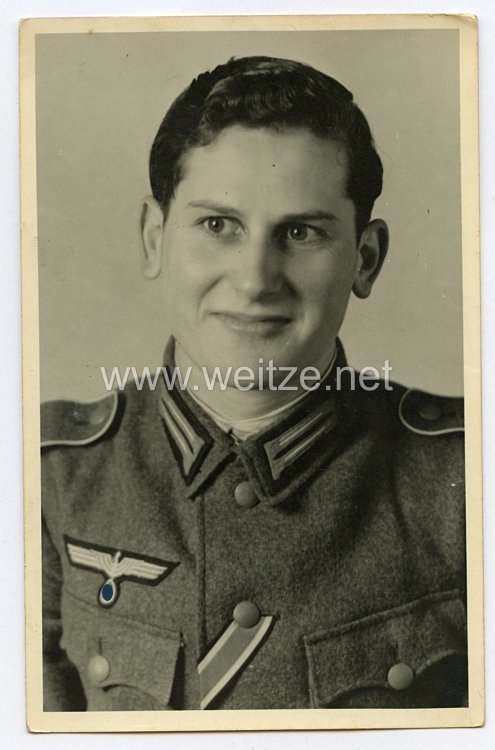
Wehrmacht Heer Portrait Photograph, Soldier with Iron Cross Ribbon
Wehrmacht Army Portrait Photo: Documentation of Military Decoration in World War II
This object represents a typical example of the photographic portrait culture of the Wehrmacht during World War II. It is a portrait photograph in postcard size showing a soldier of the Heer (Army) wearing the characteristic Iron Cross (E.K.) ribbon. Such photographs were widespread during the years 1939 to 1945 and served both personal and propaganda purposes.
The Iron Cross and Its Significance
The Iron Cross was originally instituted in 1813 by the Prussian King Friedrich Wilhelm III and developed into one of the most recognized German military decorations. On September 1, 1939, the day of the German invasion of Poland, Adolf Hitler renewed this decoration by establishing the Iron Cross 1939. The award was conferred in several classes: the Iron Cross 2nd Class (EK II), the Iron Cross 1st Class (EK I), the Knight's Cross of the Iron Cross, and its higher grades.
The ribbon visible in the photo indicates the award of the Iron Cross 2nd Class. According to regulations, the EK II was worn on a ribbon threaded through the second buttonhole of the uniform tunic. The ribbon featured black-white-black stripes, with the colors representing the Prussian national colors. The actual cross was worn only on the day of presentation; thereafter, the recipient wore exclusively the ribbon as a sign of his valor.
Photographic Practice in the Wehrmacht
Portrait photographs of soldiers were extraordinarily popular during the war. They were produced in professional photo studios in garrison towns, in occupied territories, or by mobile photographers directly at the front. The postcard format (typically 9 x 14 cm or 10.5 x 14.8 cm) was the standard for such images and enabled soldiers to easily send these pictures or preserve them in albums.
These photographs fulfilled multiple functions: they served as personal mementos, were sent to family members and fiancées, and documented military achievements through the displayed decorations. For many young men, wearing the uniform and displaying medals was an expression of pride and perceived honor. From today's perspective, these photographs are important historical documents that provide insight into uniformology, the decoration system, and the everyday culture of the Wehrmacht.
Historical Context and Source Value
Such photographs must be viewed in the context of their time. The Wehrmacht was the military of Nazi Germany and was involved in wars of aggression as well as numerous war crimes. The Iron Cross was awarded for military achievements rendered within the framework of a criminal war. Nevertheless, these objects today possess significant historical and documentary value for the study of military history, uniformology, and social history of World War II.
The preservation of such photographs in condition 2 (according to the usual grading scale for military antiques, where 1 is mint condition and 5 is heavily damaged) shows slight signs of use, which is quite normal for a document over 80 years old. This patina of time lends additional authenticity to the object.
Collector Value and Ethical Considerations
Today, such photographs are valued by militaria collectors and historians. They serve scholarly research, assist in identifying uniform details and decorations, and contribute to understanding the material culture of the Wehrmacht. At the same time, sensitivity is required when handling such objects, as they originate from a period marked by unprecedented crimes against humanity. Serious collectors and institutions always emphasize the historical-documentary character of such objects and clearly distance themselves from any glorification of the Nazi past.