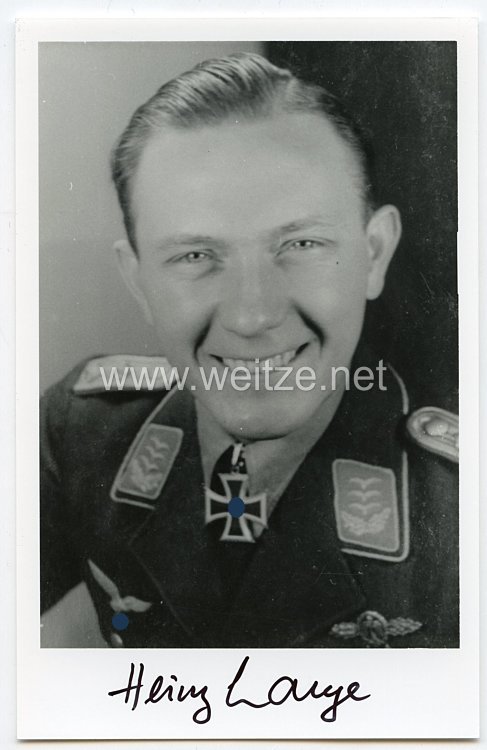
Luftwaffe - Post-War Signature of Knight's Cross Recipient, Fighter Pilot (FW-190) Heinz Lange

on a photograph, dimensions: 9.5 x 14.5 cm, condition 2
439130
20,00

Luftwaffe - Post-War Signature of Knight's Cross Recipient, Fighter Pilot (FW-190) Heinz Lange

Heinz Lange - Luftwaffe Fighter Pilot and Knight's Cross Recipient

This object documents the memory of Heinz Lange, a notable German fighter pilot of World War II who was decorated with the Knight's Cross of the Iron Cross for his achievements as a pilot of the Focke-Wulf Fw 190. The post-war signature on a photograph represents a typical collectible from the field of military historical memorabilia and testifies to the continuing engagement with aerial warfare history.

The Focke-Wulf Fw 190

The Focke-Wulf Fw 190 was one of the most significant fighter aircraft of the German Luftwaffe during World War II. Designed by Kurt Tank, the aircraft made its first flight on June 1, 1939, and was delivered to front-line units beginning in 1941. The Fw 190 was distinguished by excellent flight performance, robust construction, and powerful armament. With its air-cooled BMW 801 radial engine, it achieved speeds exceeding 650 km/h and represented a considerable surprise to Allied air forces upon its introduction.

Fighter pilots operating the Fw 190 particularly appreciated its roll rate, firepower, and resilience to combat damage. The aircraft was produced in numerous variants, including fighter-bomber, ground-attack, and reconnaissance versions. More than 20,000 examples of all versions were built in total.

The Knight's Cross of the Iron Cross

The Knight's Cross of the Iron Cross was instituted on September 1, 1939, by Adolf Hitler as the highest decoration for exceptional merit in combat. It represented the continuation of the Prussian Iron Cross and could be augmented with additional grades such as Oak Leaves, Swords, and Diamonds. During World War II, the Knight's Cross was awarded approximately 7,300 times, with around 1,800 awards going to Luftwaffe personnel.

For fighter pilots, the award of the Knight's Cross was typically tied to a specific number of enemy aircraft shot down, with requirements increasing as the war progressed. At the beginning of the war, the decoration could be awarded after 20 confirmed aerial victories, while later 40 or more kills were required. However, the exact criteria varied depending on the theater of operations and strategic situation.

Luftwaffe Fighter Pilots

German fighter pilots of World War II operated under extreme conditions on various fronts. During the Defense of the Reich campaign from 1943 onward, they had to fight against increasingly overwhelming Allied bomber formations protected by numerous escort fighters. Casualty rates were extraordinarily high, and many experienced pilots were killed in action or wounded.

Fighter pilot training occurred in several stages, beginning with basic flight instruction at flying schools, followed by specialized training at fighter pilot schools. As the war progressed, however, training time was drastically shortened, leading to a deterioration in pilot quality. Experienced Knight's Cross recipients like Heinz Lange played an important role as squadron and group commanders who led and trained younger pilots.

Post-War Signatures and Collector Culture

After the end of World War II, an extensive collector culture developed around military historical objects. Particularly sought after were and remain autographs from recipients of high decorations such as the Knight's Cross. Many former soldiers were willing to sign photographs requested at collector meetings, by mail, or at special events.

This practice began as early as the 1950s and intensified in subsequent decades. Veterans' organizations and traditional associations organized regular meetings where collectors had the opportunity to obtain autographs. Post-war signatures were typically placed on reproductions of historical photographs or on specially prepared cards.

For military historical research, such objects possess documentary value as they make the biographies and careers of individual soldiers traceable. At the same time, they raise questions about commemorative culture and dealing with military history. Academic engagement with such collectibles always requires critical contextualization and placement within the broader historical contexts of World War II and its consequences.

Historical Context

Objects such as this signed photograph are testimonies to a complex culture of remembrance. On one hand, they document the military achievements of individual soldiers, but on the other hand, they must be viewed in the context of the criminal character of the Nazi regime and the war of aggression initiated by Germany. Military historical research today strives for a nuanced presentation that documents individual experiences without ignoring the political and moral dimensions of the war.

r