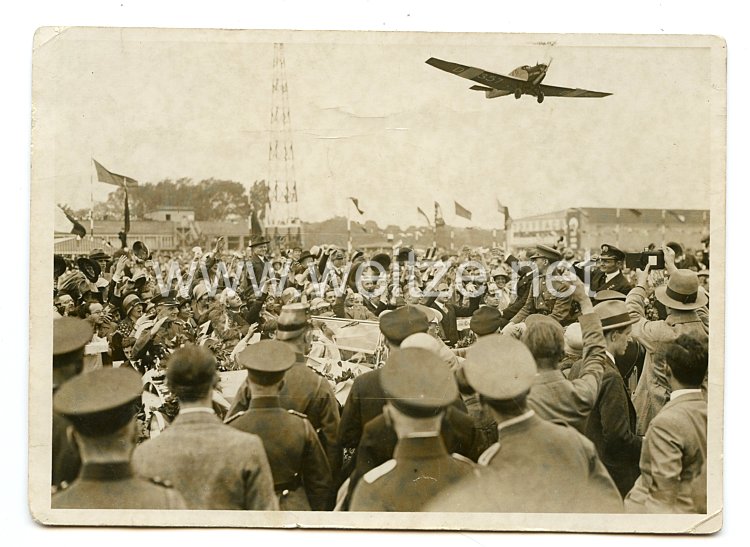
Weimar Republic Press Photograph: Foreign Politician Visits Germany
This press photograph from the Weimar Republic documents a visit by a foreign politician to Germany and represents an important testament to international diplomatic relations during the interwar period. Such photographs were an essential component of political reporting and public documentation of state events between 1919 and 1933.
The Weimar Republic, Germany's first democratic state form, existed from 1919 to 1933 and was characterized by intensive diplomatic efforts to reintegrate Germany into the international community of nations after World War I. Following the Treaty of Versailles in 1919, Germany was initially diplomatically isolated, but from the mid-1920s onwards, relations increasingly normalized.
Significant diplomatic events of this era included the Treaty of Rapallo (1922) with the Soviet Union, the Locarno Treaties (1925), which brought détente with the Western powers, and Germany's admission to the League of Nations in 1926. High-ranking foreign politicians regularly visited Berlin and other German cities to cultivate bilateral relations and discuss economic and political issues.
Press photography developed into a professional and influential medium during the 1920s. With the proliferation of illustrated newspapers and magazines such as the Berliner Illustrirte Zeitung, the Münchner Illustrierten Presse, and other publications, photographic documentation of political events gained considerable importance. Press agencies such as Scherl, Ullstein, and international agencies employed professional photographers who documented state visits, conferences, and diplomatic receptions.
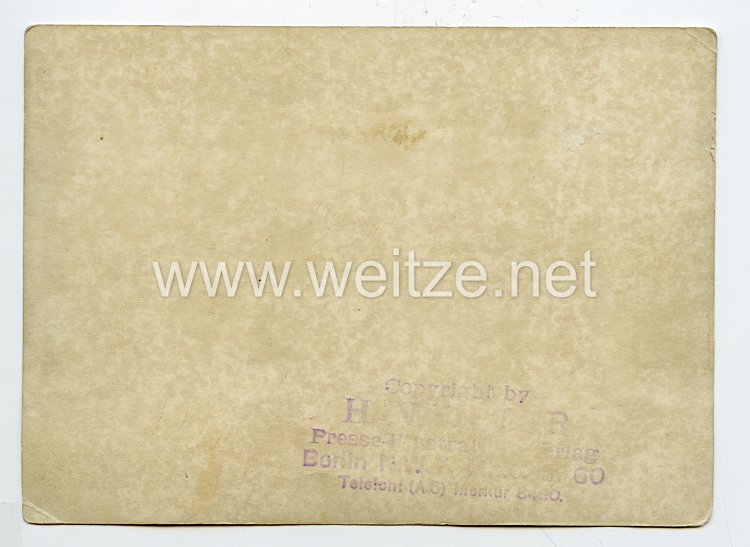
The typical formats of such press photos were approximately 13 x 18 cm or 16 x 12 cm, corresponding to the present object. This size allowed easy handling in editorial offices and archives. On the reverse, photographs frequently bore stamps from press agencies, handwritten notes, captions, or censorship marks, although not all prints were annotated.
The photographic technique of the 1920s was predominantly based on glass plate or film negatives developed in darkrooms. Silver gelatin prints on baryta paper were the standard for press photographs. The quality and sharpness of the images varied depending on the camera used and lighting conditions during exposure.
State visits and diplomatic events followed established protocol. Typically, foreign dignitaries were received at railway stations or airports, followed by military honors, meetings with the Reich President (Friedrich Ebert 1919-1925, Paul von Hindenburg 1925-1934) and the Reich Chancellor, as well as official banquets and public appearances. Press photographers were accredited for these occasions and documented events for national and international reporting.
The political significance of such visits was considerable. They served not only bilateral diplomacy but also the domestic political legitimization of Weimar governments. In times of economic crises, particularly during the hyperinflation (1923) and the Great Depression (from 1929), international support and diplomatic recognition were of existential importance for the young democracy.
Prominent foreign visitors to the Weimar Republic included British, French, American, and Soviet politicians as well as representatives of smaller European states. French Foreign Minister Aristide Briand and his German counterpart Gustav Stresemann were jointly awarded the Nobel Peace Prize in 1926 with British Foreign Secretary Austen Chamberlain for their peace efforts.
The condition of historical press photographs varies considerably. Many examples show typical signs of use such as creases, edge damage, or discoloration, attributable to their intensive use in editorial offices. Such traces do not diminish historical value but rather underscore authentic use as working material.
Today, press photographs from the Weimar Republic are important historical sources. They are held in archives such as the German Federal Archives, the Ullstein Picture Archive, regional state archives, and private collections. They document not only political events but also visual culture, fashion, architecture, and social life of the interwar period.
For collectors and historians, such photographs are of particular interest as they provide insights into diplomatic history, the development of press photography, and the political iconography of the Weimar Republic. They complement written sources and enable visual reconstruction of historical events.