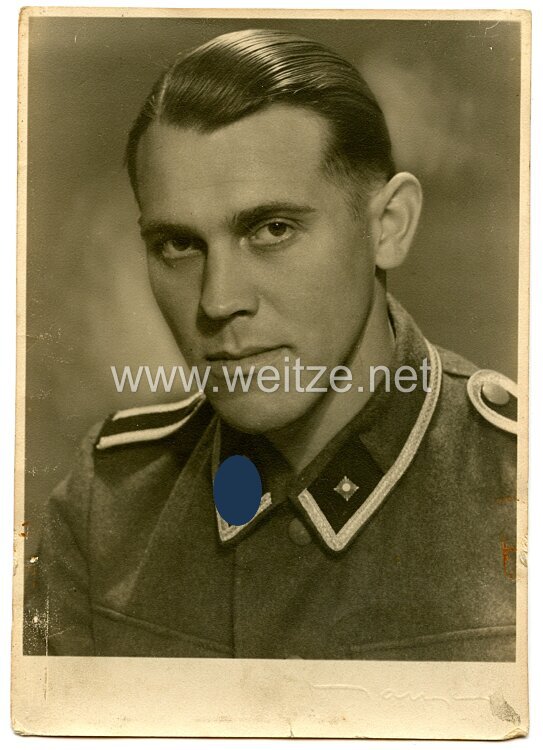
Waffen-SS Portrait Photograph, SS-Unterscharführer
This portrait photograph of a Waffen-SS Unterscharführer represents a significant aspect of military documentation during World War II. With dimensions of approximately 10 x 14.5 cm, it corresponds to the standardized formats used in the German Wehrmacht and SS for official portrait photographs.
The rank of SS-Unterscharführer was introduced in 1934 in the SS-Verfügungstruppe and corresponded to the rank of a non-commissioned officer in the Wehrmacht. In the military hierarchy, this rank stood between SS-Rottenführer and SS-Scharführer. The rank insignia consisted of two chevrons on the left upper arm of the uniform, which in the Waffen-SS were worn in field-gray execution on a black background.
Photographic documentation of soldiers had a long tradition in German military history. During World War II, portrait photographs were produced for various reasons: as personal mementos for family members, as official identification documents for military passes and pay books, or as propaganda material. The standardized formats allowed for easy storage in military files and personal documents.
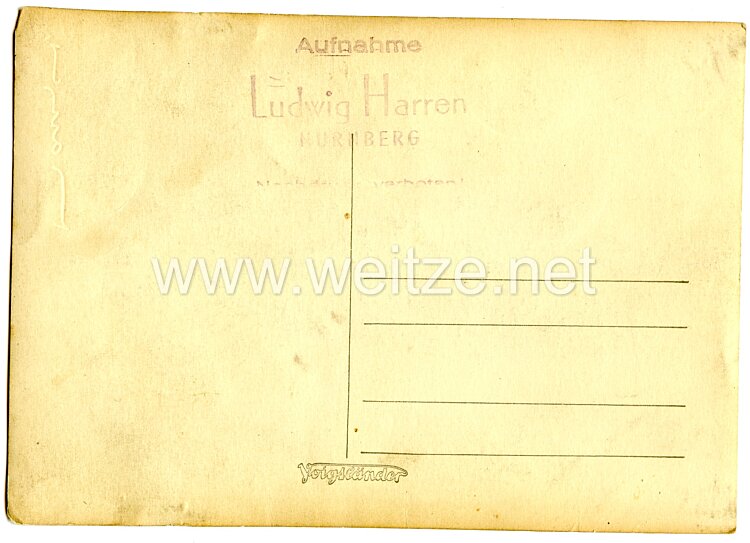
Photographic studios in Germany and occupied territories specialized in military portrait photography. These studios were often located near barracks and training facilities. The photographers were familiar with military regulations and knew how uniforms, insignia, and decorations had to be properly displayed. The photographs were usually taken in classic frontal or three-quarter view against a neutral background.
The Waffen-SS developed from 1939 onwards from the SS-Verfügungstruppe and SS-Totenkopfverbände into a military formation that operated parallel to the Wehrmacht. By the end of the war, it comprised approximately 38 divisions with around 950,000 men. The organization was responsible for numerous war crimes and was classified as a criminal organization at the Nuremberg Trials.
The Waffen-SS uniform differed in details from the Wehrmacht uniform. Characteristic were the SS runes on the right collar patch, while the rank insignia were attached to the left collar patch. The peaked cap bore the SS death's head and the Reich eagle. Photo studios took special care to clearly depict these insignia, as they were identity-forming for the wearers.
The stated format of approximately 10 x 14.5 cm corresponds to the so-called cabinet format, which had been used for portrait photography since the late 19th century. This format was larger than standard passport photos but smaller than large-format studio photographs. It was ideal for presentation in family albums or as gifts to relatives.
The preservation of such photographs over nearly eight decades is remarkable. The stated condition 2 on the usual collector's grading scale indicates minimal signs of wear, suggesting careful storage. Photographs from this period were typically developed on baryta paper, a coated paper that has high durability when properly stored.
From a historical perspective, such photographs are important contemporary documents that provide insight into the self-representation and iconography of the Nazi regime. They document the uniforming, rank structures, and appearance of military formations of this era. At the same time, they raise ethical questions regarding the handling of objects from this troubled period.
Academic research uses such photographs for various purposes: for identifying uniform variants, for dating based on rank insignia and decorations, for researching photography studios and their distribution, and as sources for social history investigations into the self-perception of soldiers.
For collectors and historians, authentic photographs from this period represent both a challenge and a responsibility. Correct historical classification, avoidance of glorification, and factual documentation are essential. Such objects should always be viewed in the context of the crimes of the Nazi regime.
The production of military portrait photographs was part of a broader culture of remembrance and documentation that existed in all armed forces of the period. However, in the context of the SS, these photographs gain additional significance as documents of an organization that was centrally involved in implementing the Holocaust and other Nazi crimes against humanity.