Tin Toy - Heavy Field Howitzer
This tin toy heavy field howitzer represents a fascinating category of military toys that were particularly widespread in Europe during the first half of the 20th century. Such toys not only reflect the technological development of artillery but also document the societal militarization and the relationship between childhood and military education during this era.
The heavy field howitzer had been a central weapon system of European armies since World War I. Howitzers differ from field guns through their shorter barrels and steeper trajectories, making them particularly effective for indirect fire. The German army deployed various models during World War I, including the famous 15 cm schwere Feldhaubitze 13 and later in World War II the sFH 18. These weapons shaped the image of modern warfare and were accordingly replicated in popular culture and the toy sector.
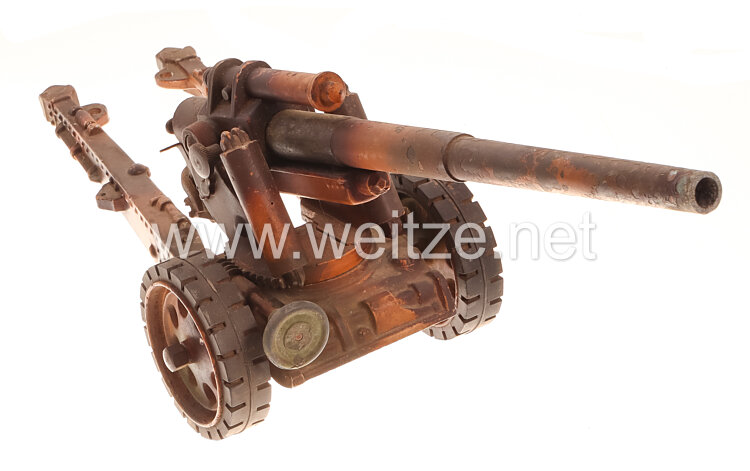
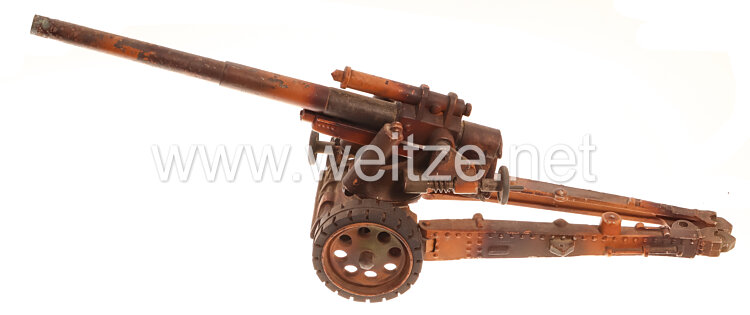
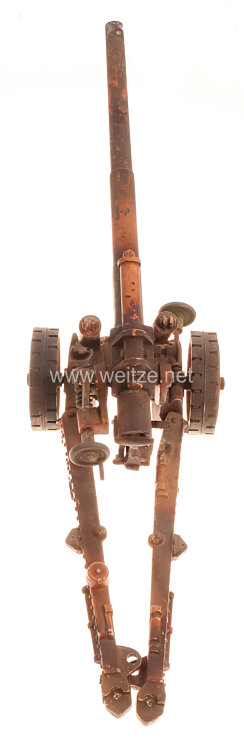
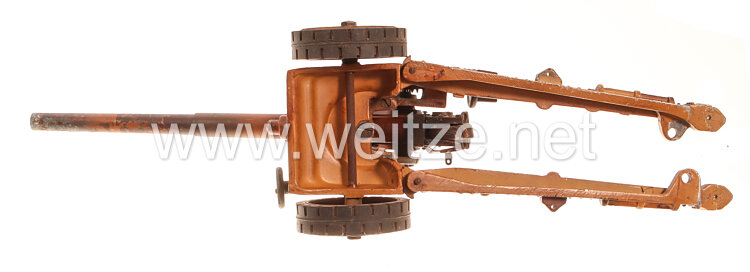
The construction features of the described toy show typical characteristics of authentic artillery pieces: The split trail carriage enabled stable positioning and greater traverse ranges in real guns. The extendable barrel is a remarkable detail that possibly imitates different gun types or transport configurations. The rubber tires reference the modernization of artillery in the 1930s, when mechanical traction increasingly replaced horse-drawn transport.
The mention of the “Amorces cannon” is particularly interesting. Amorces (French for percussion caps) were small cap strips used in toy cannons to produce realistic firing sounds. This technology was widespread in the French and German toy industry since the 1920s and made military toys especially attractive to children. Manufacturers such as JEP (Jouets de Paris), C.R. (Charles Rossignol) from France, or German companies like Märklin and Lineol produced elaborate artillery toys with such features.
The heavy cast construction indicates a high-quality production method. While simpler tin toys were made from stamped and bent sheet metal, manufacturers used die-casting or zinc alloys for more sophisticated models. This manufacturing method enabled more detailed replicas and greater stability, though it was also more costly to produce.
The historical context of such toys is multifaceted. During the interwar period (1918-1939), military toys experienced a golden age despite the horrors of World War I. In Germany, France, and other European countries, military virtues and pre-military education were considered important components of child-rearing, especially for boys. Toy manufacturers responded to this societal demand with increasingly detailed and mechanically sophisticated models.
During World War II, toy production was severely restricted as metal was needed for the armaments industry. Many toy factories converted to war production. After 1945, societal attitudes toward military toys changed fundamentally, especially in Germany. Nevertheless, historical military toys remained highly sought after by collectors.
The condition rating 2-3 in collector assessment (typically on a scale from 1 to 6, where 1 means mint condition) indicates a well-preserved object with light signs of use. Such pieces are now sought-after collector's items that are significant both in toy history and cultural history. They document not only craftsmanship and industrial manufacturing techniques but also the mental history of an era in which military symbols and war toys were a natural part of children's worlds.
For collectors and historians, such objects offer important insights into the everyday culture and educational practices of the early 20th century. They illustrate how technological developments in real military technology were promptly translated into toy form and how societies prepared their children for certain role models and value systems.
The toy industry's relationship with military subjects remained controversial throughout the 20th century. While some viewed such toys as harmless play encouraging technical interest and strategic thinking, others criticized them for glorifying war and normalizing violence. Today, these objects are primarily studied as historical artifacts that provide valuable testimony to the social, cultural, and educational philosophies of their time.