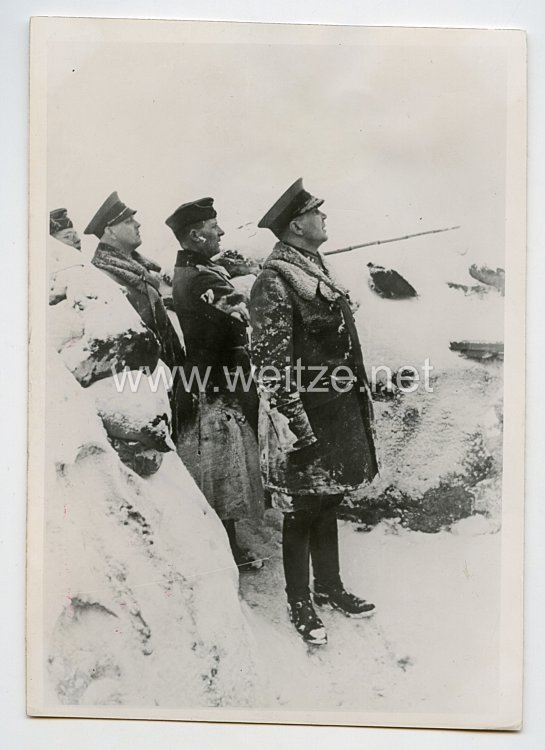
Wehrmacht Press Photograph, Finnish Officers at a German Army High Command, April 11, 1942

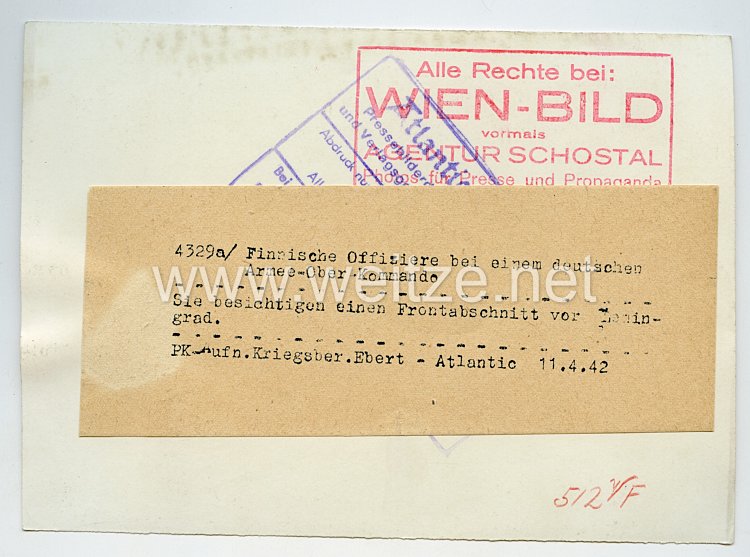
Dimensions approximately 18 x 13 cm, with inscription on reverse. Damaged, condition 2.
397828
25,00

Wehrmacht Press Photograph, Finnish Officers at a German Army High Command, April 11, 1942

This Wehrmacht press photograph dated April 11, 1942, documents a significant moment in German-Finnish military cooperation during World War II. It shows Finnish officers visiting a German Army High Command, serving as evidence of the close military collaboration between the German Reich and Finland during the Continuation War (1941-1944).

The Propaganda Companies of the Wehrmacht (Propaganda-Kompanien, PK) played a central role in the photographic reporting of Nazi Germany. These units, assigned to all branches of the armed forces, were tasked with documenting the course of the war through photography and film. The resulting press photographs were distributed through the High Command of the Wehrmacht (OKW) and the Reich Ministry of Public Enlightenment and Propaganda under Joseph Goebbels to domestic and foreign media outlets.

The temporal context of this photograph is particularly revealing. In April 1942, the German-Soviet war was in a phase of relative calm following the failed German advance on Moscow during the winter of 1941/42. The Wehrmacht was preparing its summer offensive of 1942, known as Case Blue, which would lead toward the Caucasus and Stalingrad. In this strategic environment, relationships with allied nations were of paramount importance.

Finland had joined the German attack on the Soviet Union in June 1941, motivated by the desire to reclaim territories lost to the Soviet Union during the Winter War (1939-1940). The Finnish leadership under Marshal Carl Gustaf Emil Mannerheim viewed the conflict as a separate “Continuation War,” while Germany regarded Finland as an important ally in the struggle against the Soviet Union.

The visit of Finnish officers to a German Army High Command in April 1942 fits into a pattern of regular military consultations. Such meetings served the exchange of intelligence information, coordination of military operations, and strengthening of political-military alliance relations. The Army High Command (Armee-Oberkommando, AOK) was the highest command level of a German field army, typically under the command of a Colonel General or Field Marshal.

Visual propaganda played an essential role in portraying these alliances. Photographs of meetings with allied officers were intended to demonstrate international support for the German war effort and convince the public of the strength of the Axis Powers. Simultaneously, they served domestic political purposes in allied states, where they were presented as proof of equal partnership.

The format of the photograph (approximately 18 x 13 cm) corresponds to the standard dimensions for press photographs of this era. The inscription on the reverse was customary and typically contained information about the date, location, persons depicted, and the context of the photograph. These inscriptions were of great importance for editorial offices and archives and today enable the historical classification of such documents.

The indicated condition 2 (damaged) is not unusual for photographs from this period. After more than eight decades, many of these documents show signs of aging, creases, discoloration, or other damage. However, this does not diminish their historical value as authentic contemporary documents.

German-Finnish military cooperation encompassed various levels: joint operations in northern Norway and northern Finland, weapons deliveries, training assistance, and strategic coordination. Germany was particularly interested in Finland's role in the blockade of Leningrad and securing the Arctic flank. The German AOK Norway and later the AOK Lapland coordinated military activities in this region.

Press photographs like this one are important sources for historical research today. They document not only military events but also the staging and self-representation of the Nazi regime. Critical analysis of such propaganda materials provides insights into the functioning of National Socialist public relations and the instrumentalization of alliance relationships for propagandistic purposes.

For collectors and historians, authentic Wehrmacht press photographs represent significant contemporary documents that, when carefully contextualized, can contribute to understanding this dark chapter of history.

r