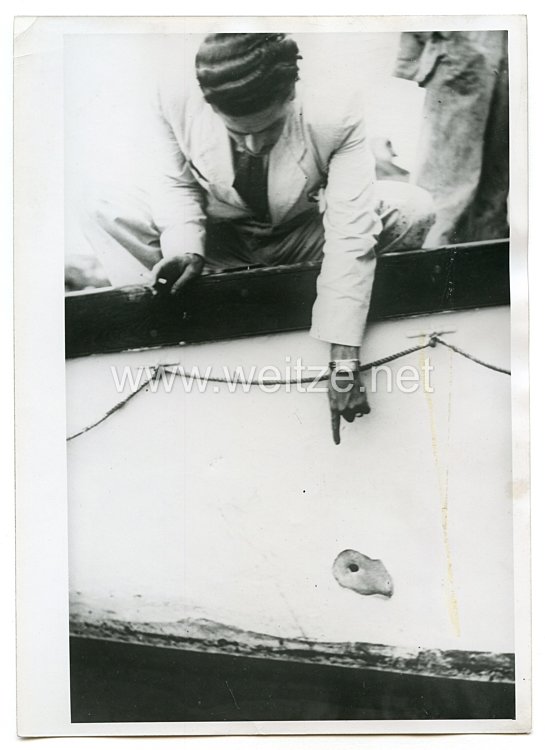
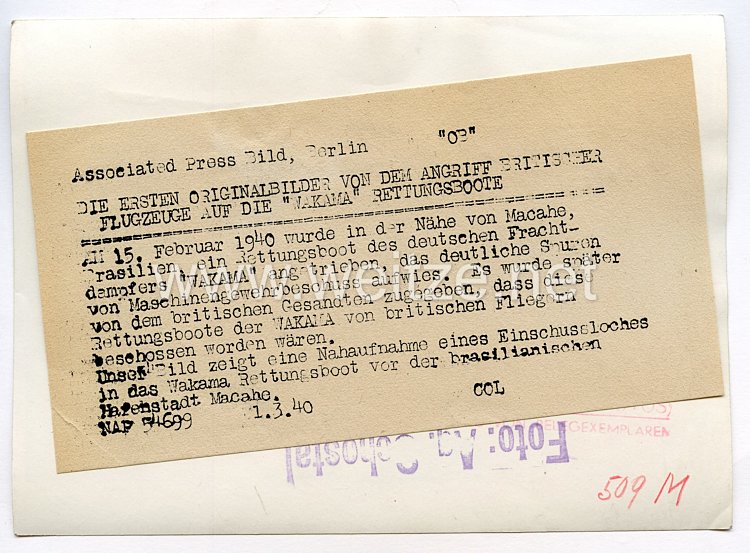
Kriegsmarine Press Photo: Attack by British Aircraft on the “Wakama” Lifeboats, March 1, 1940

Dimensions approx. 13 x 18 cm, with inscription on reverse. Used condition.
345728
10,00

Kriegsmarine Press Photo: Attack by British Aircraft on the “Wakama” Lifeboats, March 1, 1940

This Kriegsmarine press photograph documents a tragic incident from March 1, 1940, in which British aircraft attacked lifeboats from the German steamer “Wakama”. The photograph belongs to the extensive propaganda machinery of the Third Reich, which systematically exploited such events for its purposes.

The Wakama was a German merchant vessel operating in the Atlantic during the early war year of 1940. The Battle of the Atlantic had already reached dramatic intensity in the first months of the war, with both sides attempting to disrupt enemy trade routes. German merchant ships faced constant threats from the Royal Navy and the Royal Air Force.

War reporting played a central role in World War II. The Oberkommando der Wehrmacht (OKW) and specifically the Propaganda Companies of the various Wehrmacht branches produced numerous photographs and reports daily for domestic and foreign press. The Kriegsmarine maintained its own press departments that coordinated and distributed such images.

The documented attack on lifeboats was highly problematic under international law. The Hague Conventions and Geneva Conventions already provided protective provisions for shipwrecked persons. Attacks on lifeboats and their occupants were considered violations of maritime warfare law. German propaganda intensively exploited such incidents to portray the Allies as war criminals, while simultaneously concealing its own violations of international law, particularly in submarine warfare.

The technical execution of the photograph corresponds to the standards of contemporary press photography. With dimensions of approximately 13 x 18 cm, this represents a typical format for press photos of the 1940s. The caption on the reverse was standard for all official war photographs and typically contained information about the date, location, photographer, and a caption for editorial offices.

In March 1940, the war was in the phase of the so-called “Phoney War” on the Western Front, while at sea a bitter struggle was already raging. The British naval blockade aimed to economically strangle Germany, while the German Navy attempted to disrupt British supply lines. In this context, German merchant ships were frequently forced to take dangerous routes or seek refuge in neutral ports.

The use of such photographs in Nazi propaganda followed a clear pattern: they were intended to demonstrate the alleged brutality of the enemy, mobilize the domestic population, and generate sympathy in neutral foreign countries. The Reich Ministry of Public Enlightenment and Propaganda under Joseph Goebbels strictly controlled which images were published and how they were contextualized.

For historians today, such press photographs are valuable sources but must always be critically analyzed. While they document real events, their selection, staging, and distribution served propagandistic purposes. The authenticity of the depicted event must be verified through comparison with other sources such as war diaries, British records, and eyewitness accounts.

The used condition of the present photograph suggests that it was actually employed in editorial offices or archives. Many of these press photos were distributed to numerous newspapers and magazines, both in the Reich and in neutral countries. After the war, large collections of such photographs entered Allied archives, while others passed into private ownership.

Research into the naval warfare history of World War II has produced nuanced insights in recent decades about incidents such as the attack on the Wakama lifeboats. While propaganda made one-sided attributions of blame, historical research shows that both sides committed violations of international law in naval warfare, albeit to varying degrees.

Such photographs serve today as important testimonies to the intersection of warfare, propaganda, and media in the twentieth century. They remind us that historical sources must always be examined in their contemporary context and that the boundary between documentation and manipulation was often fluid in wartime reporting.

r