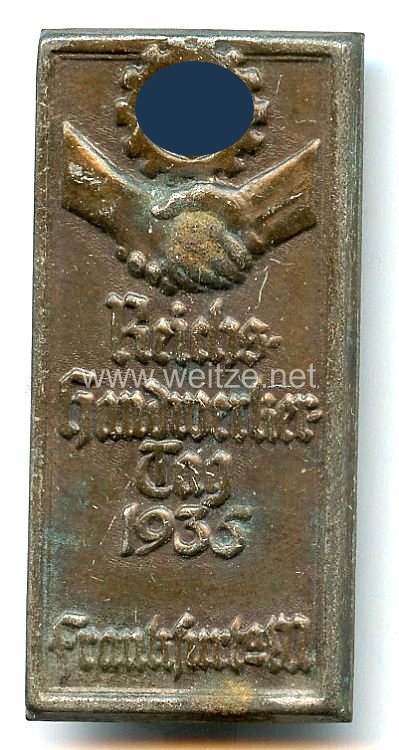
Third Reich - Reich Craftsmen's Day 1935 Frankfurt a.M.

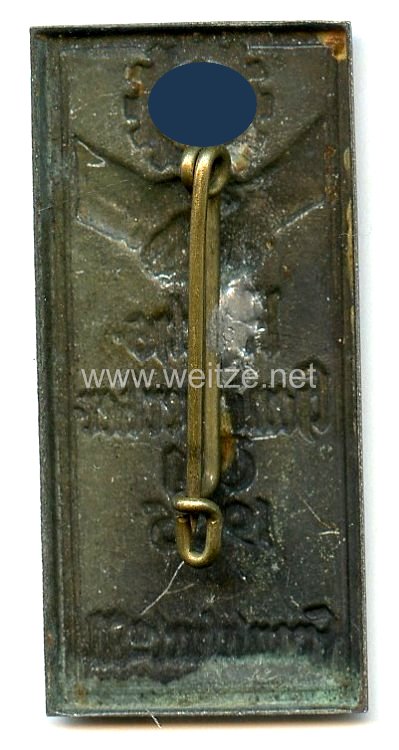
Sheet iron badge, with pin, condition 2.
389528
25,00

Third Reich - Reich Craftsmen's Day 1935 Frankfurt a.M.

The Reich Craftsmen's Day 1935 in Frankfurt am Main represents a significant chapter in the history of National Socialist professional and economic policy. The badges issued for this occasion, such as the sheet iron badge with pin construction described here, document the propagandistic instrumentalization of the German craftsmen's estate by the NS regime.

The Reichshandwerkertag (Reich Craftsmen's Day) was not a National Socialist invention, but had its roots in the Weimar Republic. Since 1927, this event had been held as a gathering of German craftsmen's organizations. After the seizure of power in 1933, however, the Reichshandwerkertag was transformed into an important instrument of National Socialist economic and social policy. In the NS worldview, craftsmanship was considered particularly “indigenous” and “Aryan” and was ideologically played off against capital, which was defamed as “Jewish.”

The Reich Craftsmen's Day 1935 in Frankfurt am Main took place from February 15-17, 1935, and was one of the largest events for German craftsmanship during the NS era. The event was organized by the Reichsstand des Deutschen Handwerks (Reich Estate of German Craftsmanship), which had been created in 1933 as a compulsory organization intended to encompass all craftsmen in the German Reich. At its head was Reich Master Craftsman Otto Wagener, who was later replaced by Carl Schmitt.

The Frankfurt event served multiple purposes: on one hand, it was meant to demonstrate the unity and strength of German craftsmanship, and on the other, it provided the NS leadership with a platform for announcing economic policy guidelines. The Reich Craftsmen's Day 1935 took place against the backdrop of economic consolidation following the Great Depression and the increasing orientation toward rearmament policy.

The sheet iron badge described here belongs to the category of event badges that were produced in large numbers in the Third Reich. These badges fulfilled several functions: they served as participant identification, as collectibles, and not least as propagandistic carriers of National Socialist symbolism. The manufacture from sheet iron was typical for the mass production of such badges and enabled cost-effective production while maintaining sufficient durability.

The technical design with pin construction corresponded to the standard of the time. The pin on the back allowed the badge to be attached to clothing, uniforms, or civilian suits. Such badges were typically worn on the lapel and signaled participation in the event as well as belonging to the “people's community” of craftsmanship.

The design of such event badges usually followed a fixed pattern: they frequently displayed NS symbols such as the swastika or eagle, the name of the event, the location, and the year. Frankfurt am Main was deliberately chosen as the venue because the city was considered a traditional commercial and economic center and was also conveniently located in the middle of Germany in terms of transportation.

In the context of NS economic policy, the Reich Craftsmen's Day 1935 was part of a more comprehensive strategy for the corporate structuring of the economy. The crafts sector was to be strengthened as the “middle class” and delineated against large-scale industry and commerce. At the same time, however, it was integrated into the centralized planning of the NS economy and factually lost its autonomy.

The collectibility of such badges today lies in their documentary value as witnesses to the NS propaganda machinery. They document the penetration of all areas of society with National Socialist symbolism and ideology. The stated condition 2 indicates a well-preserved specimen that, despite being nearly 90 years old, shows only minor signs of use.

For historical research, such everyday objects are significant because they provide insight into the mechanisms of NS rule beyond major political events. They show how the regime attempted to create a sense of belonging and integration through the creation of common symbols and events. The Reich Craftsmen's Day 1935 was one of many such staged mass events intended to convey the image of a unified “people's community.”

r