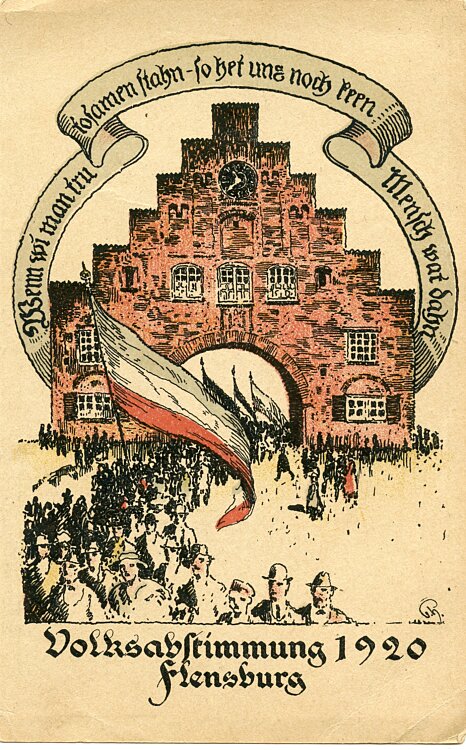
Weimar Republic - Propaganda Postcard "Volksabstimmung 1920 Flensburg"
The 1920 Schleswig Plebiscite represents one of the most significant events of the immediate post-war period and marks an important moment in the history of the Weimar Republic. This propaganda postcard relating to the plebiscite in Flensburg documents the intense political mobilization that accompanied this historic decision.
Following the end of World War I and the signing of the Treaty of Versailles on June 28, 1919, Germany was forced to accept extensive territorial cessions. Articles 109 to 114 of the treaty regulated the future of Schleswig, that historically contested region between Germany and Denmark. The Allied Powers determined that the population in two separate zones would decide their national allegiance through plebiscites.
Zone I (North Schleswig) encompassed the area north of a line from Flensburg to the coast and voted on February 10, 1920. With an overwhelming majority of 75 percent, residents chose to join Denmark. Zone II (Central Schleswig), which included Flensburg and the more southerly territory, voted on March 14, 1920. Here the result clearly favored Germany: approximately 80 percent of voters chose to remain with the German Reich.
Propaganda postcards such as this one played a central role in the plebiscite campaign. In an era when mass media like radio was still in its infancy, printed materials were the most important means of political communication. Both sides – German and Danish activists – used postcards intensively to spread their messages. These cards were mass-produced, distributed to households, displayed in public places, and sent through the postal system.
The German propaganda campaign in Zone II emphasized economic connections to the Reich, cultural and linguistic affiliation, and fears of economic isolation in the event of annexation to small Denmark. Flensburg, as the largest city in the region and an important economic center, stood at the heart of these efforts. The city, traditionally German-dominated but with a significant Danish minority, was symbolically particularly significant.
The International Plebiscite Commission, led by the British diplomat Charles Marling, supervised the process. Despite the tense political atmosphere, both plebiscites proceeded largely properly. However, propaganda on both sides was intense and emotionally charged. German materials warned of “separation from the homeland,” while Danish campaigns emphasized the historical rights and cultural identity of the Danish-speaking population.
Such postcards are today important historical documents that provide insight into the political culture of the early Weimar Republic. They demonstrate the young democracy's efforts to maintain territorial integrity through public opinion formation. The design of these cards ranged from sober information sheets to emotionally charged patriotic representations featuring national symbols, flags, and historical references.
The outcome of the plebiscites led to the partition of Schleswig: North Schleswig became part of Denmark as South Jutland, while Central and South Schleswig remained with Germany. This border demarcation, which has essentially remained in place to this day, created national minorities on both sides – Germans in Denmark and Danes in Germany. The German-Danish border was officially established on June 15, 1920.
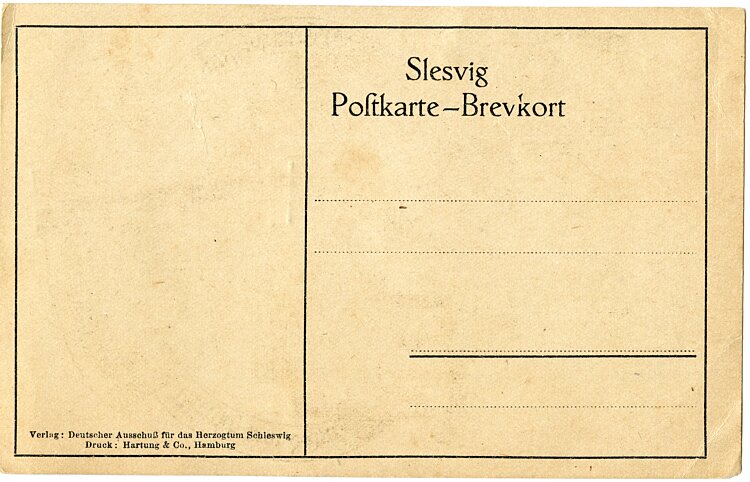
For collectors and historians, such propaganda postcards are particularly valuable as they represent authentic testimonies of the political conflicts of their time. The condition rating of “2-” (good to very good) indicates a card that has preserved its historical significance. Unused examples, those never sent through the mail, are often better preserved and show the original print quality more clearly.
The Schleswig plebiscites are considered one of the few successful cases of self-determination policy after World War I. Unlike many other territorial arrangements of the Treaty of Versailles, they did not lead to lasting conflicts, but rather to a stable border demarcation and eventually to exemplary minority arrangements between Germany and Denmark.