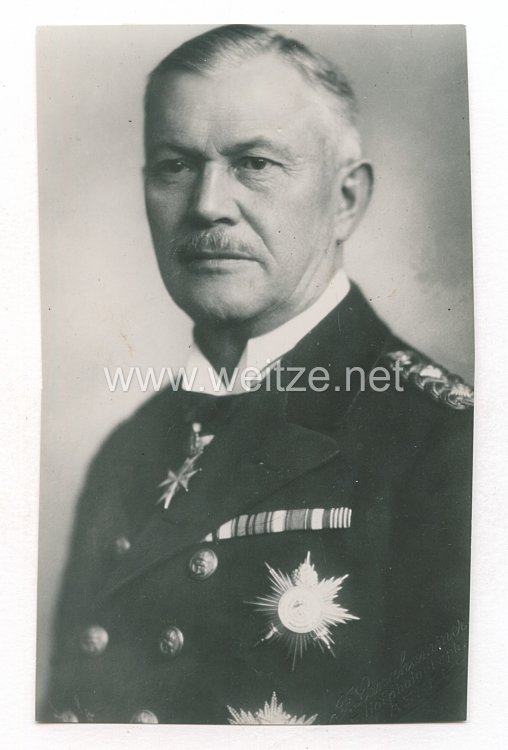
Weimar Republic Press Photograph: Admiral Reinhardt
Press Photography in the Weimar Republic: Admiral Reinhardt
Press photographs from the Weimar Republic (1918-1933) represent important historical documents that provide direct insight into the political and military culture of this turbulent epoch in German history. The present photograph of Admiral Reinhardt is a typical example of press photography from that era, which served both as an information medium and as an instrument for the public presentation of military leadership figures.
The Reichsmarine in the Weimar Republic
Following the end of World War I and the signing of the Treaty of Versailles in 1919, the German Navy was subjected to severe restrictions. The once-powerful Imperial Navy was reorganized into the Reichsmarine, whose size and armament were drastically reduced. The treaty limited the German Navy to a maximum of 15,000 men, six battleships, six cruisers, twelve destroyers, and twelve torpedo boats. Submarines were completely prohibited.
In this context, admirals like Reinhardt played a crucial role in rebuilding and reorganizing the German naval forces under the restrictive conditions of the post-war order. The leadership of the Reichsmarine had to contend with the political realities of the young democracy while simultaneously attempting to maintain maritime traditions and professional standards.
Press Photography as Medium
The 1920s marked a golden era of press photography in Germany. Technical advances, particularly the development of more portable cameras and improved reproduction processes, enabled newspapers and magazines to use photographic images with increasing frequency. Illustrated magazines such as the Berliner Illustrirte Zeitung, the Münchner Illustrierte Presse, and other publications experienced tremendous growth.
Military dignitaries were popular subjects of press photography. Official portraits served multiple purposes: they informed the public about important personalities, contributed to legitimizing military institutions, and were part of public reporting on military and political events. The photographs were typically created by press agencies or official photographers and distributed to various media outlets.
Technical Characteristics
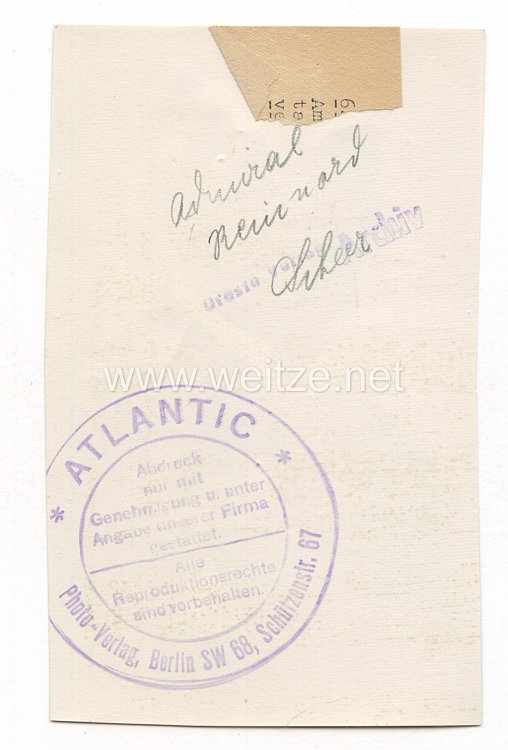
The present photograph in the format 10 x 16 cm corresponds to a standard format for press photographs of the Weimar era. Such prints were usually made on baryta paper, a photographic paper coated with barium sulfate, known for its good image quality and durability. The inscription on the reverse was common and served for identification and archiving. It typically contained names, dates, occasions, and sometimes also the name of the press agency or photographer.
The faded condition and signs of use are characteristic of working materials from press archives. These photographs were frequently handled, sorted, and selected for publication, which led to natural wear.
Historical Context and Significance
The Weimar Republic was a time of intense political confrontation in which the role of the military was controversially discussed. The Reichsmarine had to find its position in the new democratic order while simultaneously being confronted with the humiliation of Versailles restrictions. Admirals and senior officers were often subjects of public interest, especially during official occasions, fleet visits, or political events.
Press photographs like this document not only individual personalities but also the visual culture and self-representation of the military in the interwar period. They show uniforms, rank insignia, and the formal presentation of military authority in a democratic society.
Collector Value and Historical Relevance
Today, such press photographs are important sources for historians and valued collector's items. They offer authentic contemporary representations and complement written sources with visual documentation. The used condition underscores their authenticity as actually utilized press photos rather than subsequently created reproductions. For collectors of military-historical documents and researchers of the Weimar Republic, such photographs represent valuable primary sources that provide insight into the media landscape, military culture, and public representation of the interwar period.